Crochet Handbag: Free Chunky Pattern in Three Hours

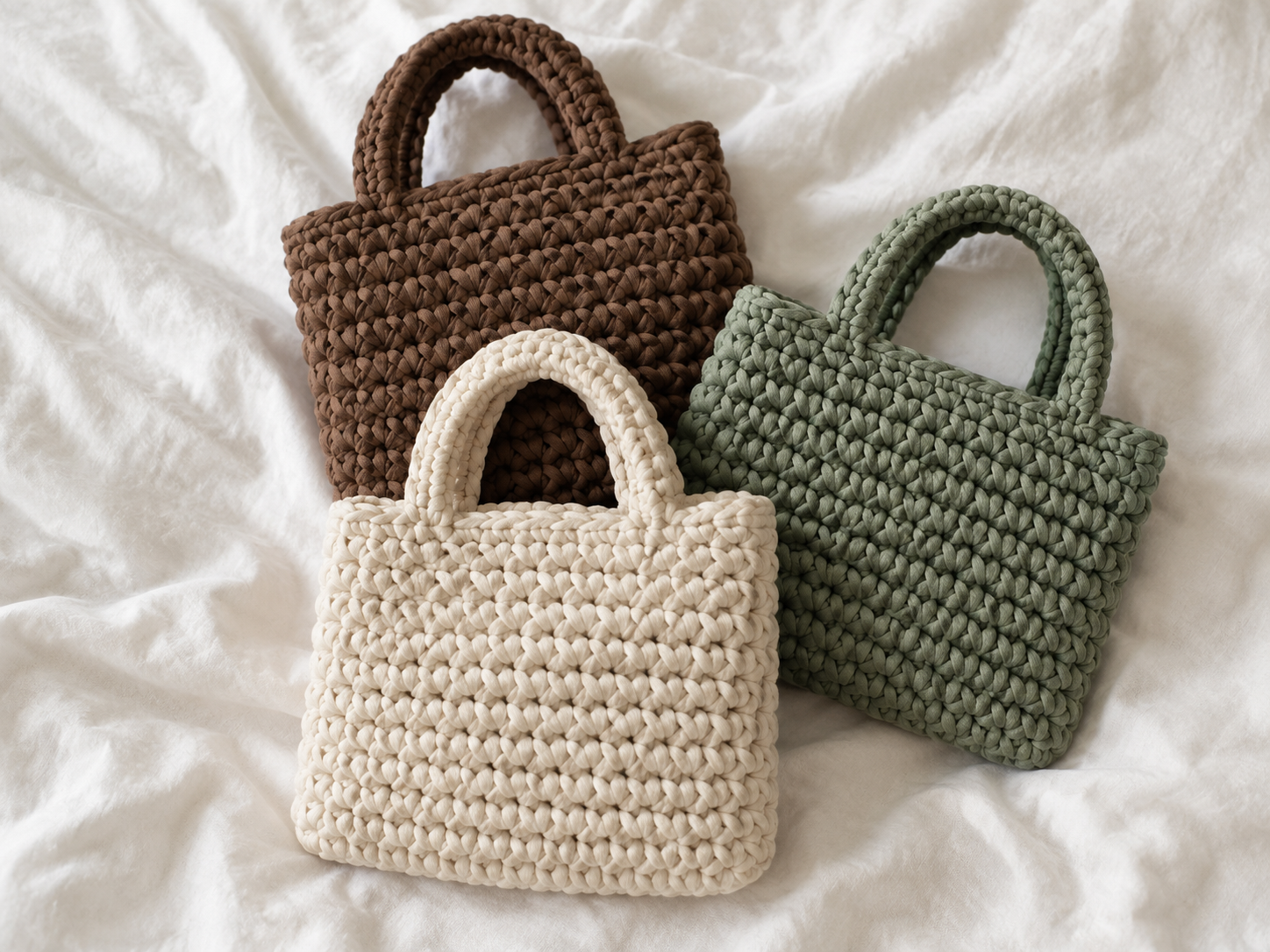
A crochet handbag is a small chunky-yarn tote — usually 20cm square with two short top handles — worked bottom-up from a flat rectangle base. This version uses one skein of super-bulky cotton tube yarn, a 10mm hook, and takes about three hours from cast-on to finished bag. No lining, no hardware, no pattern chart to lose your place in.
I've made this bag six times this summer in different colours — brown, cream, sage, dusty pink, black, and one experimental oatmeal-and-cream stripe. It's the fastest satisfying project I know, and every time someone spots one on my shoulder they ask where I bought it.
Key Takeaways
- The bag is a flat rectangle base + straight walls in the round + two integrated arched top handles. That's it — no sewn-on straps, no hardware.
- Craft Yarn Council classes this as a Level 2 Easy project. If you can chain and single crochet, you're ready.
- Yarn: one 250g skein of super-bulky cotton tube (Hoooked RibbonXL, Wool and the Gang Jersey Be Good, or Bernat Blanket Big). About 120–130m gets you a 20cm bag.
- Time: 3 to 4 hours in super-bulky; 1.5 to 2 hours if you go up to jumbo (#7) yarn on a 15mm hook.
- Finished size: 20cm wide × 20cm tall × 8cm deep.
What Yarn Do You Need for a Crochet Handbag?
You need one 250g skein of Craft Yarn Council weight #6 Super Bulky cotton tube yarn, or one 300g skein of weight #7 Jumbo if you want the fastest possible build. Cotton tube (T-shirt yarn) is what gives the bag its structure — acrylic bulky yarns are softer and slouch immediately once you put keys and a phone in the bag.
The Craft Yarn Council Standard Yarn Weight System puts Super Bulky (#6) at a 9–15mm hook range with a sc gauge of 5–9 stitches per 4 inches. That density is what gives you the crisp square silhouette without any lining. Jumbo (#7) yarn was officially added to the CYC system in 2014, which is why you'll see older patterns treating T-shirt yarn as "off-scale bulky."
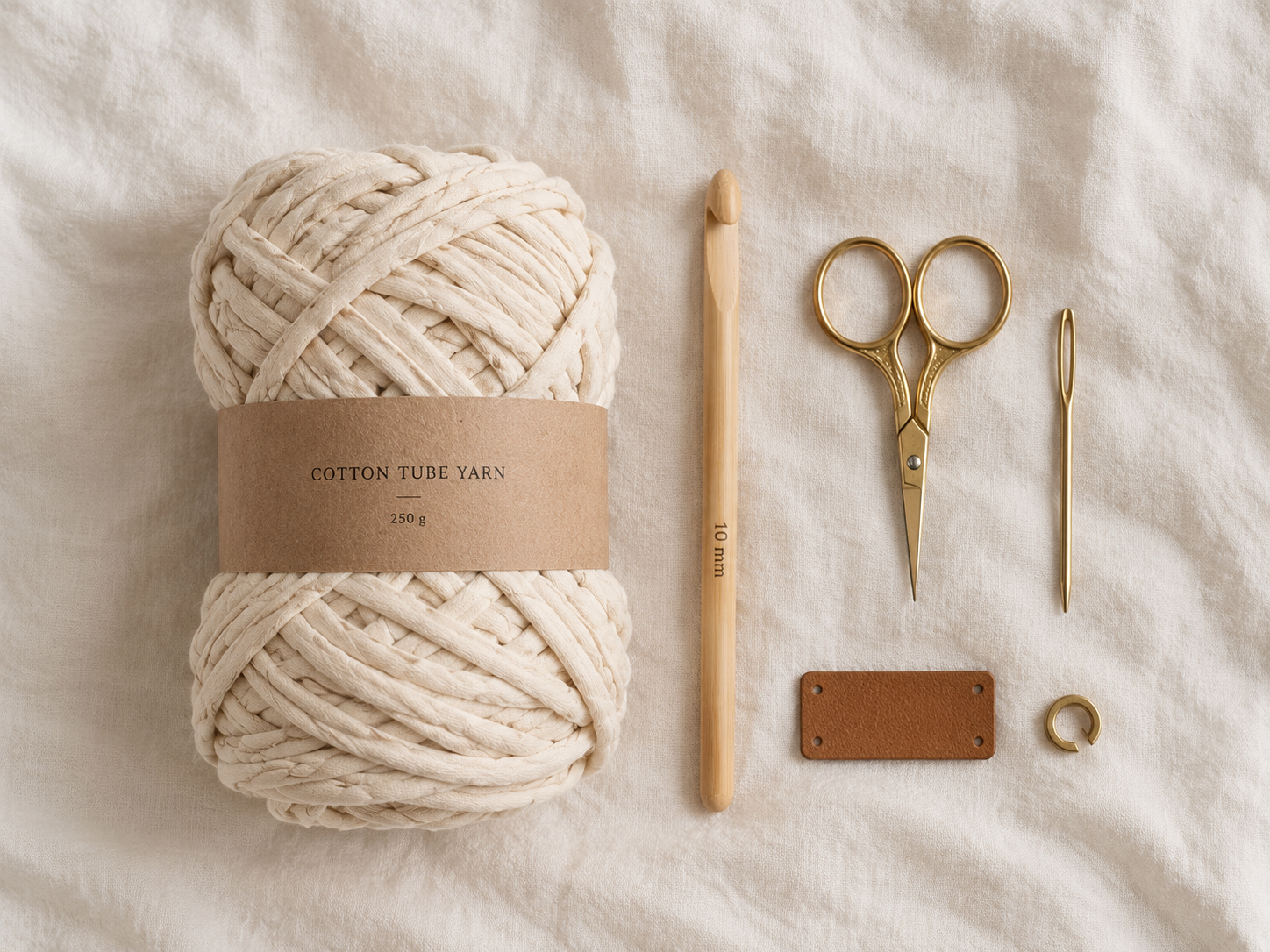
Materials list:
- Yarn: one 250g skein of super-bulky cotton tube. My defaults: Hoooked RibbonXL (250g / 130m, 80% recycled cotton), Wool and the Gang Jersey Be Good (T-shirt yarn from cutting-room offcuts), or Bernat Blanket Big (300g / 29m per skein — you'll need 4 skeins).
- Hook: 10mm for RibbonXL and Jersey Be Good. 25mm for Bernat Blanket Big.
- Tapestry needle with a large eye — any wool-embroidery needle works at this yarn thickness.
- Scissors.
- Stitch marker — one is enough.
- Optional: a small leather tag for the front of the bag, sewn on with a hand stitch or a brass rivet.
For a deeper look at chunky yarn brands for bags, see my guide to chunky yarn brands for crochet.
How Do You Crochet a Handbag? The Full Free Pattern
You crochet a flat rectangle base, pick up stitches around all four edges to work the walls straight up in the round, then chain across two gaps in the top edge to form arched handles and reinforce them with three more rounds. Only two stitches used the whole way through: chain and single crochet.
Stitch abbreviations (US terms): ch chain · sc single crochet · sl st slip stitch · st(s) stitch(es).
Gauge and finished size
- Gauge: 8 sc × 9 rows = 10cm × 10cm in Hoooked RibbonXL with a 10mm hook.
- Finished size: approximately 20cm wide × 20cm tall × 8cm deep.
- If your gauge is off: the bag is forgiving. A looser tension gives a slightly bigger bag. What matters is that the fabric feels dense enough that light doesn't pass through.
Part 1 — The flat rectangle base
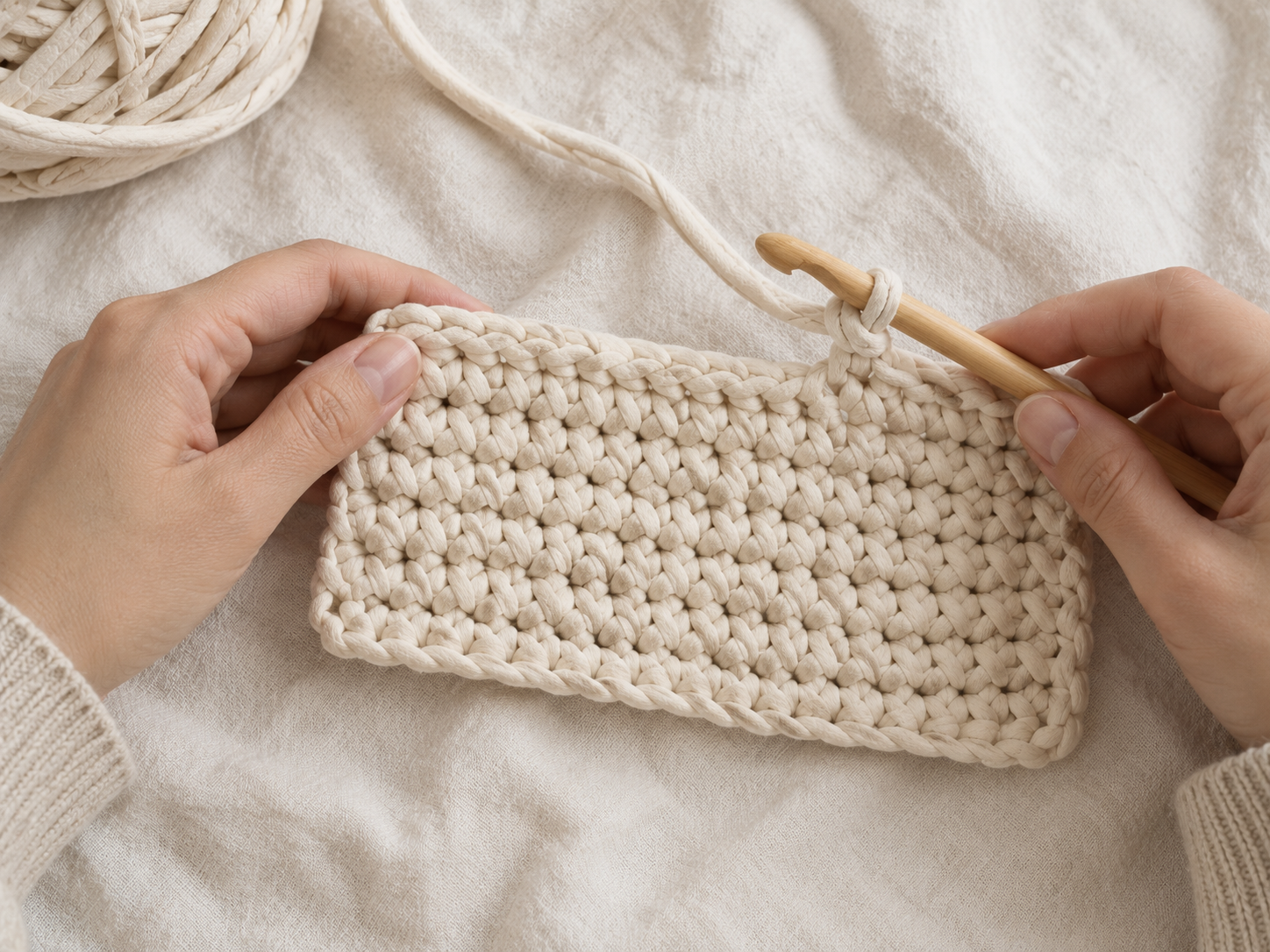
The base is a plain sc rectangle, 20cm × 8cm.
- Row 1: ch 17. Sc in 2nd ch from hook and in each ch across. (16 sts)
- Rows 2–7: ch 1, sc in each st across, turn. (16 sts each row)
- Do not fasten off. You'll continue straight into the walls.
The rectangle should measure roughly 20cm × 8cm. If yours is smaller, add another two rows before continuing.
Part 2 — Pick up stitches around the edge
You now work sc all the way around the base to set up the walls. Turn the rectangle so a long edge is at the top.
- Round 1: ch 1. Sc 16 across the top long edge (in the tops of the last row), sc 6 down the short edge (in row-end stitches), sc 16 across the bottom long edge (in the free loops of the foundation chain), sc 6 up the other short edge. Join with a sl st to the first sc. (44 sts total) Place your stitch marker in that first sc so you can track the join every round.
44 stitches is the count you keep for every wall round. If yours is 42 or 46, don't panic — just track the count you have and stay consistent.
Part 3 — The straight walls in the round
- Round 2: ch 1, sc in each st around, working through back loops only on this round. (44 sts) — this creates a crisp fold-line where the base meets the wall.
- Rounds 3–17: ch 1, sc in each st around, through both loops. Join with sl st at the end of each round. (44 sts each round)
Fifteen rounds of straight sc on top of the back-loop fold round gives you a wall about 18cm tall. For a shorter clutch, stop at Round 12. For a taller shopper, keep going to Round 20.
Part 4 — The integrated arched top handles
This is the detail that turns a tote into a handbag. Instead of sewing on flat straps, you chain across two gaps in the top edge and reinforce the arch with extra rounds — the same method the classic Hoooked and Wool and the Gang bag patterns use. The handles come out thick, rounded, and part of the bag structure, not glued on.
Your last completed round (Round 17) has 44 sts: 16 on the front face, 6 on the right side, 16 on the back face, 6 on the left side. You'll create one handle opening centred on the front and one on the back.
- Round 18 (handle-opening round): ch 1. Sc 4 across the front, ch 14, skip 8 sts (this is the front handle arch base), sc 4 across the front. Sc 6 down the right side. Sc 4 across the back, ch 14, skip 8 sts, sc 4 across the back. Sc 6 up the left side. Sl st to join. (28 sc + 28 ch = 56 total stitch positions)
- Round 19: ch 1. Sc in each of the 4 front sts, sc in each of the 14 chains (working under the whole chain), sc in each of the 4 front sts, sc in each of the 6 side sts. Repeat the same pattern for the back and other side. Sl st to join. (56 sts)
- Round 20: ch 1, sc in each st around, sl st to join. (56 sts)
- Round 21: ch 1, sc in each st around, sl st to join. Fasten off with a 20cm tail. (56 sts)
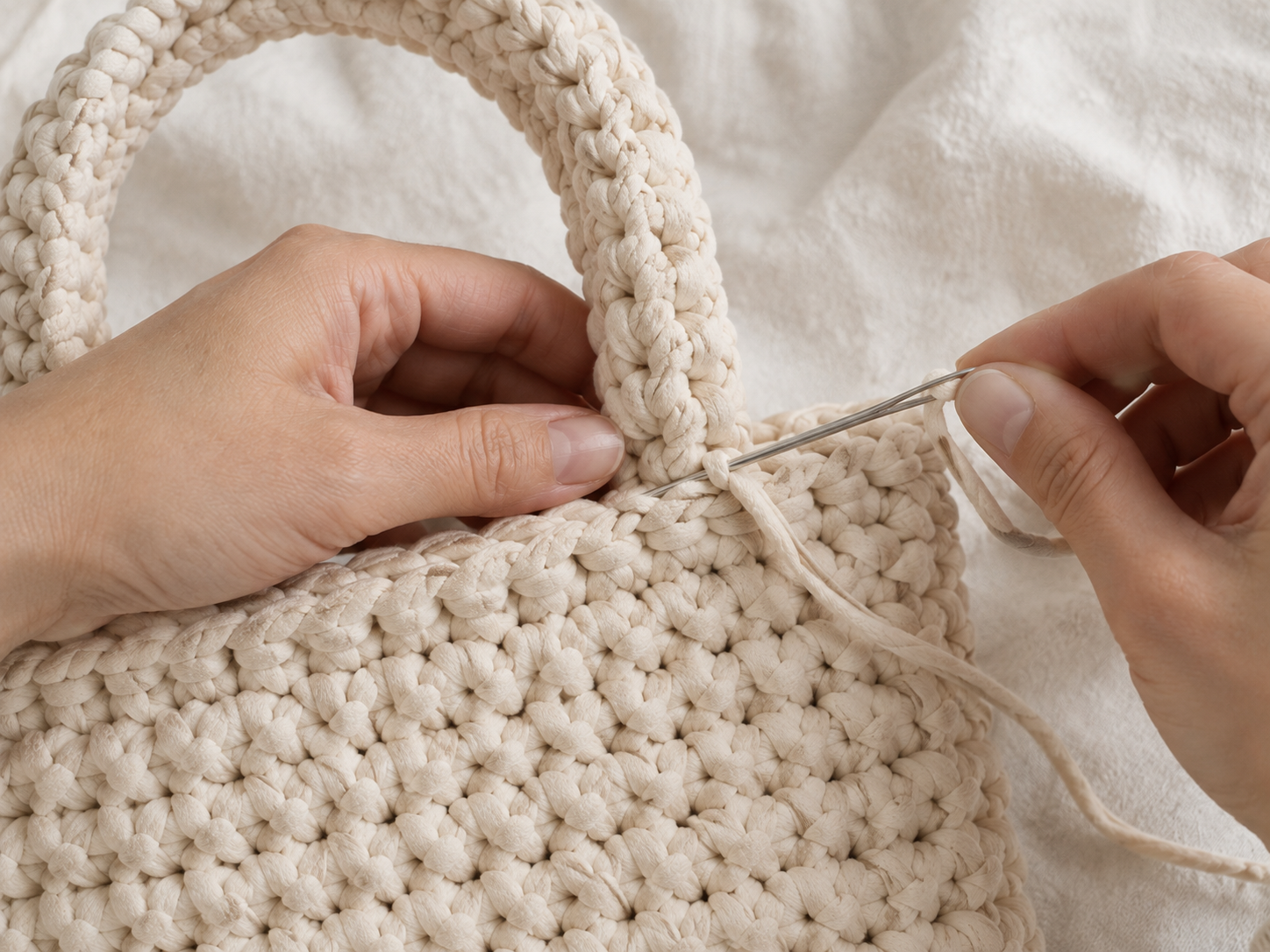
Rounds 19 to 21 build up the thickness of the handle arch — each pass adds a layer to the same 14 chains, so the finished handle is 4 rounds thick, which is what gives it that solid chunky rounded look on the image. Weave the tail into the top rim.
Part 5 — Finishing
- Weave in every remaining tail with the tapestry needle, going through 3–4 stitches on the inside of the bag before trimming.
- Optional: sew a small tan leather label centred on the front face, about 3cm below the handle base, with a hand stitch or two brass rivets.
- Give the finished bag a light steam if the walls have any wave to them — cotton tube yarn takes shape well from moderate steam heat.
That's the whole pattern. Total build time: about three hours in super-bulky.
How Much Yarn Does a Crochet Handbag Really Use?
Yardage scales predictably with finished size. A mini 15cm clutch needs about 90–100 metres of super-bulky cotton; the small 20cm handbag above needs 120–130 metres; a medium 25cm shopper takes 160–180 metres. These numbers are anchored to two verified Ravelry patterns: the Textured Bag by Emma Wilkinson uses ~142 yards of RibbonXL, and the Ribbon Basket Bucket Bag by Kristen Stein uses 130–140 yards.
Practical implication: one 250g skein of Hoooked RibbonXL (130m per skein) gets you exactly one 20cm handbag with a few metres to spare. Buy two if you want to be safe on a longer handle.
How Long Does It Take to Crochet a Handbag?
For an intermediate maker, three hours in super-bulky RibbonXL on a 10mm hook. One and a half hours if you switch up to Jumbo (#7) yarn like Bernat Blanket Big on a 25mm hook. Two to three hours for T-shirt yarn on a 12mm hook. This is the fastest-satisfying crochet project I know, and it's why chunky handbags dominate Pinterest fall boards.
My own record: 75 minutes using Bernat Blanket Big and a 25mm hook. The 15-minute base, 45-minute walls, and 15-minute handles. The fabric was so thick I could set the bag down and it stood up on its own like a paper bag from a boutique.
The bag is a Level 2 Easy by the Craft Yarn Council skill-level system: basic stitches, simple shaping, simple finishing. You need to know how to chain, how to single crochet, and how to work into row-end stitches when picking up around the base. That's the whole skill set.
Why Chunky Crochet Handbags Are Everywhere Right Now
The chunky handbag trend is what Vogue Adria in 2026 called "granny chic" — the crossover of grandmother-craft aesthetics with modern minimalist styling. Cotton tube yarn holds shape without hardware, photographs beautifully on Pinterest, and works up fast enough to test three colourways in a weekend.
The other reason: they're cheap to make and sell well. One 250g skein of RibbonXL costs around £12–£15, and finished bags in the same silhouette sell on Etsy for £35–£65. The margin is what makes the pattern spread — every crocheter who makes one immediately makes two more for friends, and the friends ask for the pattern.
Save this pattern on Pinterest
What I got wrong the first time: I used acrylic super-bulky (Bernat Blanket, not Blanket Big). The bag was gorgeous for exactly four days, then the handles stretched from carrying a book and turned floppy. Switched to RibbonXL. Structure problem solved.
Common Mistakes and How to Fix Them
Most first chunky handbags fail at the base-to-wall transition, the handle reinforcement, or the yarn choice. All three are quick to spot and fix.
The bag looks lopsided or trapezoidal
Your stitch count around the base is uneven. Recount Round 1 — you need 16 stitches on each long edge, 6 stitches on each short edge, for 44 total. If the short edges have too few, you're crocheting through the row-end knots instead of the full row-end stitches.
The handles stretch and sag after one use
You're using acrylic yarn. Chunky acrylic (Bernat Blanket, Hobbii Ribbon Cake) feels lovely to work with but has zero shape memory. Cotton tube yarn (RibbonXL, Jersey Be Good) is what holds up under weight, especially on integrated handles that carry the full bag load.
The handle arch looks stringy or thin
You only worked one or two reinforcement rounds instead of three. The handle needs Rounds 19, 20, and 21 all sc'd through the 14 chains to build up thickness. If yours looks bare, add another two rounds around the whole top before fastening off.
The base curls up into a bowl
You're crocheting too tightly. Try one hook size up — a 12mm instead of 10mm for RibbonXL — for just the base rows, then drop back down for the walls.
Frequently Asked Questions
Is a crochet handbag hard to make? Not at all — Craft Yarn Council rates it Level 2 Easy. If you can chain and single crochet, you have every skill this pattern needs. Total time: three hours in super-bulky yarn, or ninety minutes in Jumbo (#7) yarn on a 25mm hook. It's genuinely the fastest satisfying project in crochet.
What yarn is best for a chunky crochet bag? Super-bulky (#6) or Jumbo (#7) 100% cotton tube yarn. Hoooked RibbonXL (250g / 130m per skein), Wool and the Gang Jersey Be Good, and Bernat Blanket Big are the three I'd recommend. Cotton holds shape under weight; acrylic super-bulky stretches into a slouch within a week.
How much yarn do I need for a small crochet handbag? For a 20cm square top-handle bag, plan on 120–130 metres of super-bulky cotton tube. That's exactly one 250g skein of Hoooked RibbonXL with a small buffer, or roughly four 300g skeins of Bernat Blanket Big (29m per skein). Buy one extra skein to avoid a dye-lot mismatch.
Are crochet bags still trendy in 2026? Yes — Vogue Adria specifically framed 2026 as the year of "granny chic" crochet accessories, with chunky top-handle totes leading the trend on Pinterest and Instagram. Finished handmade chunky bags sell on Etsy for £35–£65, which is why the pattern spreads so fast among makers.
Can I sell handbags made from this pattern? Yes, you can sell the finished bags. The construction method — flat rectangle base, sc walls in the round, integrated arched handles — is a public-domain crochet technique that predates any single pattern. What you can't do is republish this specific write-up or my photos. Sell the object, not the pattern.
What's Next?
Once you've made one, colour is the next lever. Make it in three colourways for a stacked photo on Pinterest — the reference image at the top of this article is exactly that. Or size up to a beach shopper (25cm walls, 30cm base), or add a small decorative crochet mini rose to the front for a wedding-favour version.
For the rose add-on, see my mini rose pattern — one rose sewn onto the top-front of the bag turns a plain tote into a gift piece. For a sibling pattern with more structure (flap, drawstring, adjustable straps), try the cream cotton crochet backpack.
If you'd like small-project patterns like this one landing in your inbox each week, join the Wavode letter — one email, Saturday morning, no filler.
Questions about this pattern? Write to support@wavode.com.