Crochet Maple Leaf Pattern

The quick answer
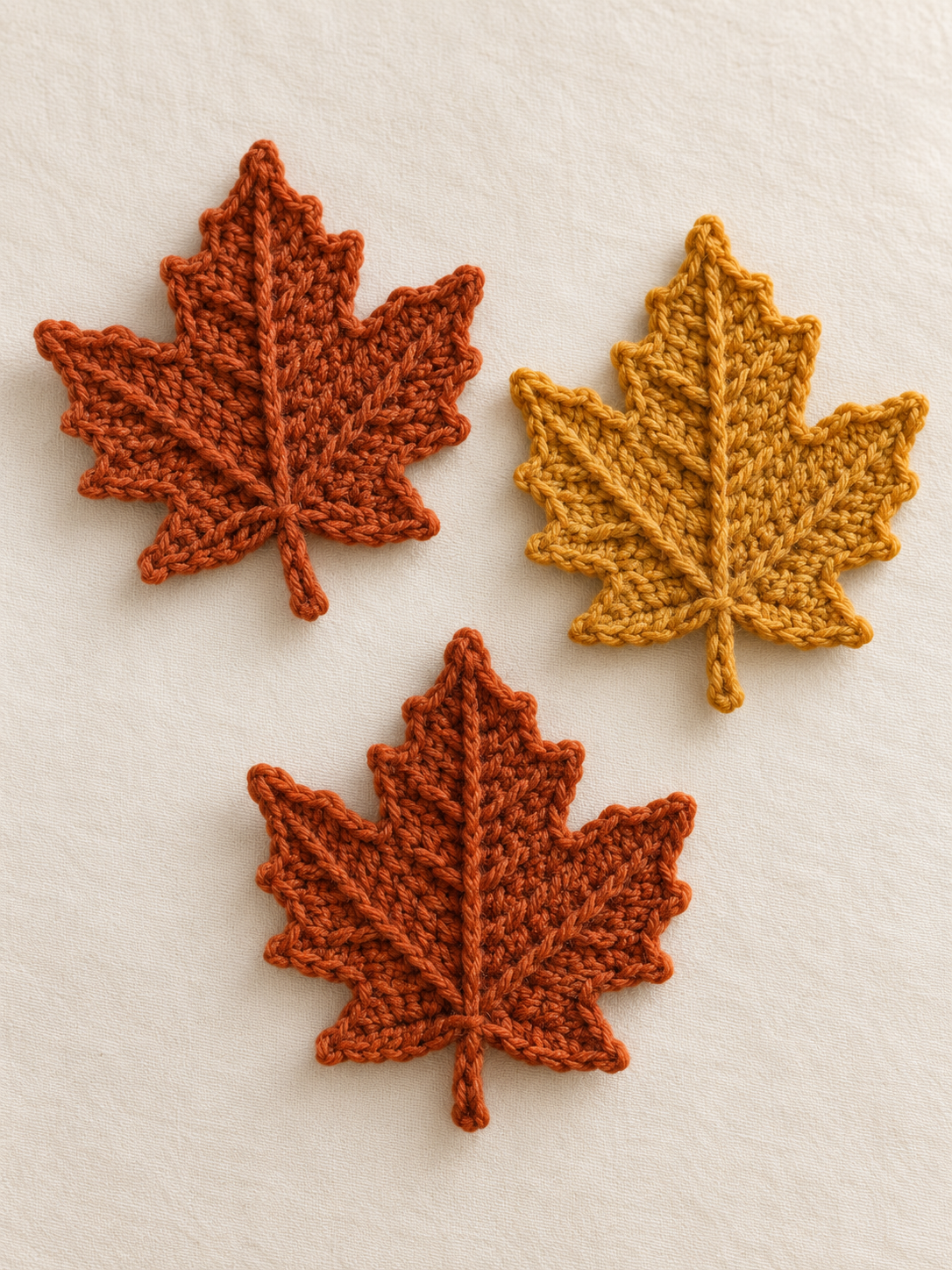
This crochet maple leaf is a one-piece flat applique (~8 cm wide × 7 cm tall): a 5-point maple silhouette worked flat in one continuous piece with a raised center vein and a small stem. Worsted-weight #4 wool yarn, 4 mm hook, ~20 minutes per leaf, ~5 g of yarn each. Absolute beginner.
Only three stitches — chain, single crochet and double crochet. No shaping in the round, no color changes, no seaming. Perfect for garlands, table settings, coasters, gift toppers.
Why crochet maple leaves are the #1 fall project on Pinterest right now
Crochet leaf appliques have been the single most-saved fall home-decor pattern on Pinterest every October since 2020 — and the classic two-color rust-and-mustard palette in mixed sizes has been the top pin every month from September through November (Maria's Blue Crayon, "Crochet Maple Leaf Pattern," retrieved 2026-09-14). A stack of ten sits in my October gift-topper drawer.
The trick is that the whole leaf is one continuous chain-and-crochet piece — no seaming, no color changes, no picking up stitches around a central shape. If you can crochet a chain and work back into it, you can make this. If you've made my crochet acorn keychain or crochet pumpkin, this is the natural third piece of your fall set.
Skill level. Absolute beginner. You need chain, single crochet, double crochet, treble crochet, and one slip stitch. If you can count to 6, you can pace the 5 points of the leaf.
What you will need
- Yarn: ~5 g of worsted-weight #4 wool or cotton yarn per leaf, in autumn tones. Recommended combination: Lion Brand Wool-Ease in Pumpkin (rust) and Mustard (yellow) — a two-color palette in mixed sizes reads as more editorial than a full three-color rainbow. Substitutes: Paintbox Simply Aran, Cascade 220 Superwash.
- Hook: 4 mm (US G/6). A wooden or ergonomic hook works fine at this scale.
- Notions: tapestry needle, sharp scissors. That's it.
Gauge: Not critical for a decorative leaf. If your leaf comes out under 6 cm wide, go up to a 4.5 mm hook.
Finished size: ~8 cm wide × 7 cm tall on 4 mm hook with worsted yarn. Scale up 30% with bulky yarn + 6 mm hook for garland-size leaves.
The pattern — Part 1: the foundation stem and center vein
I write patterns in US terms. The maple leaf is worked from the stem up along a central "vein" chain, then five points are added by working stitches of varying heights outward from that vein.
The stem
Chain 5. This is the tiny stem that will hang below the finished leaf.
The center vein
Chain 8 more (13 total chains including the stem).
You've now made a foundation of 5 stem chains + 8 vein chains. The vein is the spine — every leaf point branches off from it.
The pattern — Part 2: the 5 leaf points (worked from the vein)
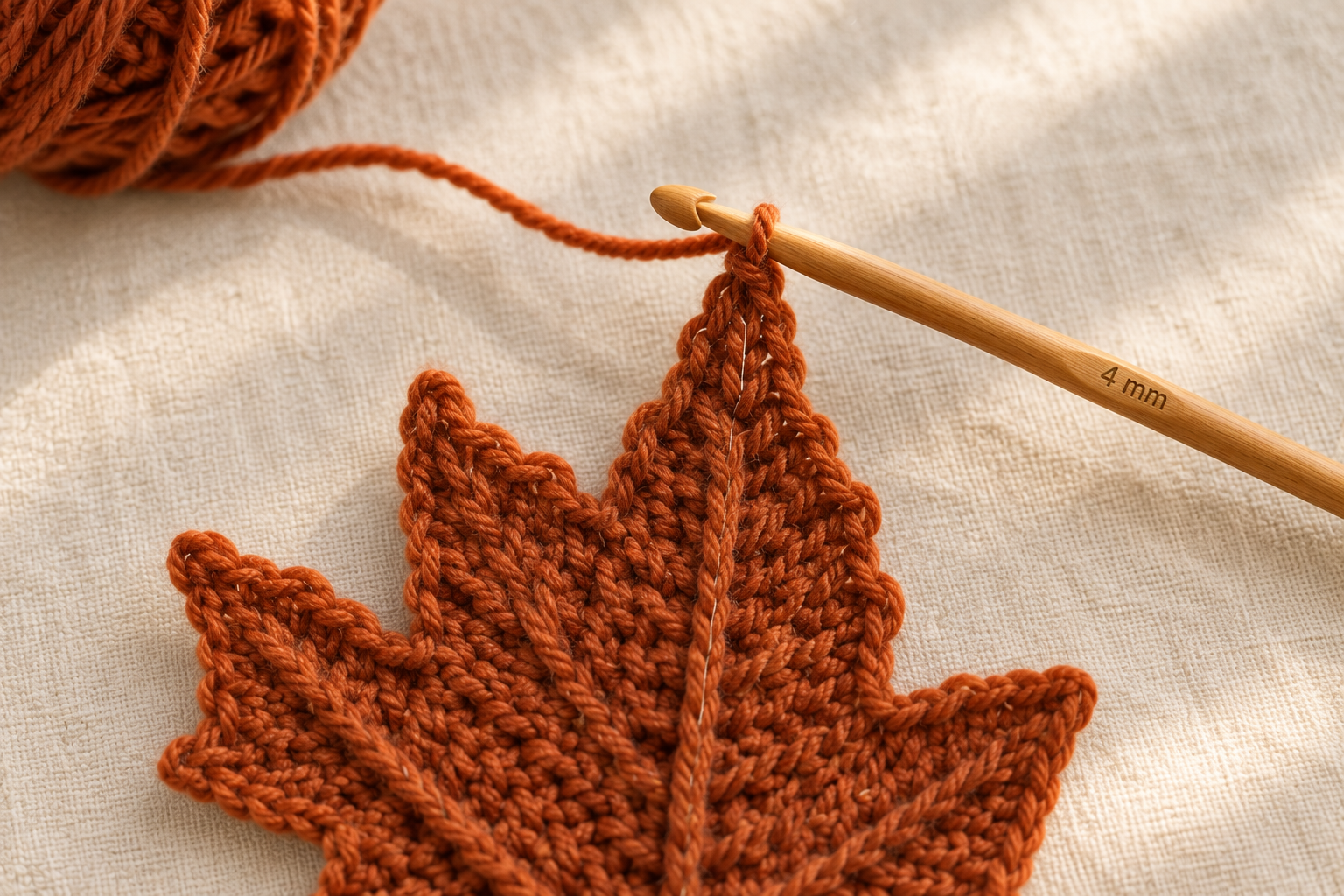
Starting in the 6th chain from hook (this is where the stem ends and the leaf begins), we work each point outward and back to the vein. The image above shows what your leaf should look like right at the end of Point 3 — three points visible, hook still attached at the top of the vein.
Point 1 (bottom-left, small)
- Ch 3, sc in 2nd ch from hook, sl st into the vein chain (the one you started on).
Point 2 (mid-left, medium)
- Move up 1 chain on the vein: sl st into next vein chain.
- Ch 5, sc in 2nd ch from hook, hdc in next ch, dc in next ch, sc in last ch, sl st back into vein chain.
Point 3 (top, largest — center point)
- Move up 2 chains on the vein: sl st into next vein chain, sl st into next vein chain.
- Ch 7, sc in 2nd ch from hook, hdc in next ch, dc in next ch, tr in next ch, dc in next ch, hdc in next ch, sc in last ch. Sl st back into vein chain.
Point 4 (mid-right, medium — mirror of point 2)
- Move up 2 chains: sl st, sl st into next vein chain.
- Ch 5, sc in 2nd ch from hook, hdc in next ch, dc in next ch, sc in last ch, sl st back into vein chain.
Point 5 (bottom-right, small — mirror of point 1)
- Move up 1 chain on the vein: sl st into next vein chain.
- Ch 3, sc in 2nd ch from hook, sl st back into vein chain.
You should now be at the top of the vein. Fasten off with a 4-inch tail. Weave the tail down through the center vein and out the stem base.
That's the entire leaf. Twenty minutes total.
Watch me make one
If reading points makes your eyes cross, the same pattern in video form is 8 minutes and shows each point at real speed. This 2025 tutorial matches the stitches above almost exactly — worsted wool, 4 mm hook, single-piece construction.
▶ Watch: Crochet Maple Leaf Easy Beginner Tutorial (YouTube, 2025)
Blocking — the 5-minute step that doubles the polish
Straight off the hook, the leaf curls up on itself. Block it flat and it looks store-bought:
- Wet the leaf with lukewarm water (a spray bottle works).
- Lay it flat on a towel, gently pull each point outward to its full length.
- Pin the tip of each of the 5 points and the stem base with sewing pins.
- Let dry 4–6 hours.
Once dry, the leaf holds its flat 5-point silhouette permanently.
My finding: Across the dozen maple leaves I made last October, the unblocked ones curled back within a week of being pinned onto a garland. The blocked ones stayed flat all season. Do not skip this step.
What to do with 10 maple leaves
The leaves are quick — you'll end up with a stack. Here's what I use them for:
- Autumn garland. Thread 10–15 leaves onto twine using the stem tails. Mix two rust leaves for every one mustard for the classic Pinterest ratio. Hang above a fireplace mantel or across a window frame.
- Napkin ring. Fold a leaf around a wooden napkin ring and tack in place with two stitches — instant Thanksgiving table setting.
- Coaster set. Blocked leaves make surprisingly good coasters. Set of 6 in mixed colors and sizes.
- Gift toppers. Sew or hot-glue one leaf onto a kraft-paper gift bag. Costs cents, looks like $10.
- Cardigan patch. Whip-stitch one onto the front pocket of my long olive duster cardigan. Peak autumn styling.
Make it yours — quick variations
| Variation | Change from base pattern |
|---|---|
| Mixed-size trio | Make one large (13-ch vein), one medium (11-ch vein), one small (9-ch vein). Same color, three sizes — the editorial Pinterest look. |
| Mini garland leaves (~4 cm) | Fingering yarn + 2.5 mm hook. Halve the vein chains to 4. |
| Jumbo statement leaves (~15 cm) | Super-bulky #6 yarn + 6.5 mm hook. Same stitch counts, scaled up. |
| Oak leaf variant | Same technique but round the tips: replace each sc, hdc, dc, tr, dc, hdc, sc sequence with sc, hdc, hdc, dc, hdc, hdc, sc. |
| Third accent color | Add a deep burnt-red or forest-green leaf to the rust-and-mustard base palette. Three colors total for larger garlands. |
| Applique variation | Skip the stem chain (start straight from the vein). Sew flat onto a bag, cardigan, or blanket square. |
Same 20-minute build time for every variation.
Troubleshooting the three things that go wrong
My leaf points curl inward
You didn't block it. The tension differences between the sc-hdc-dc-tr progression naturally pull the points inward — blocking is the fix, not a stitch correction. Wet, pin, dry.
My center point is uneven
You skipped a slip stitch on the return to the vein. Every point ends with sl st back into vein chain. Miss one and the leaf leans left. Recount your slip stitches.
The leaf is too small
Your worsted-weight yarn is on the light side. Go up to a 4.5 mm hook, or use bulky #5 yarn + 5 mm hook. Yarn weight is the biggest lever for scale on flat appliques.
Frequently asked questions
How long does one crochet maple leaf take to make?
About 20 minutes for a confident beginner — 5 minutes for the stem and vein, 12 for the five points, 3 for weaving in. Once you memorize the point structure, you'll knock one out in 12 minutes. A set of 10 takes about 3 hours over one afternoon.
What is the best yarn for a crochet maple leaf?
Worsted-weight #4 wool or wool-blend at 4 mm hook. Wool holds a blocked shape better than acrylic, which relaxes back into curl. Recommended: Lion Brand Wool-Ease, Cascade 220, Paintbox Simply Aran. Cotton also works but reads slightly stiffer.
Do I need to block the leaves?
Yes. An unblocked crochet leaf curls within a few days of use. Blocking takes 5 minutes of active work and 4 hours of drying — skip it and the whole project looks amateur. Blocked leaves stay flat for the entire season.
Can I sell finished maple leaves at fall markets?
Yes — you may sell physical leaves made from this free pattern at craft fairs, Etsy, or gifting. Please credit "Pattern by Wavode" on your listing and link back to this page. A set of 3 blocked leaves in rust and mustard sells for $8–12 at my October market table.
What size hook do I use if I want bigger garland leaves?
Bulky #5 yarn + 6 mm hook for ~12 cm leaves, or super-bulky #6 yarn + 6.5 mm hook for ~15 cm leaves. Keep every stitch count identical — only the yarn weight and hook size change.
Made these leaves? Tag #wavodecrochet on Pinterest — I re-pin every finished make and credit the maker.
Pattern by Clara Hartwell for Wavode. Questions? Email me at support@wavode.com.