Coquette Crochet Coaster

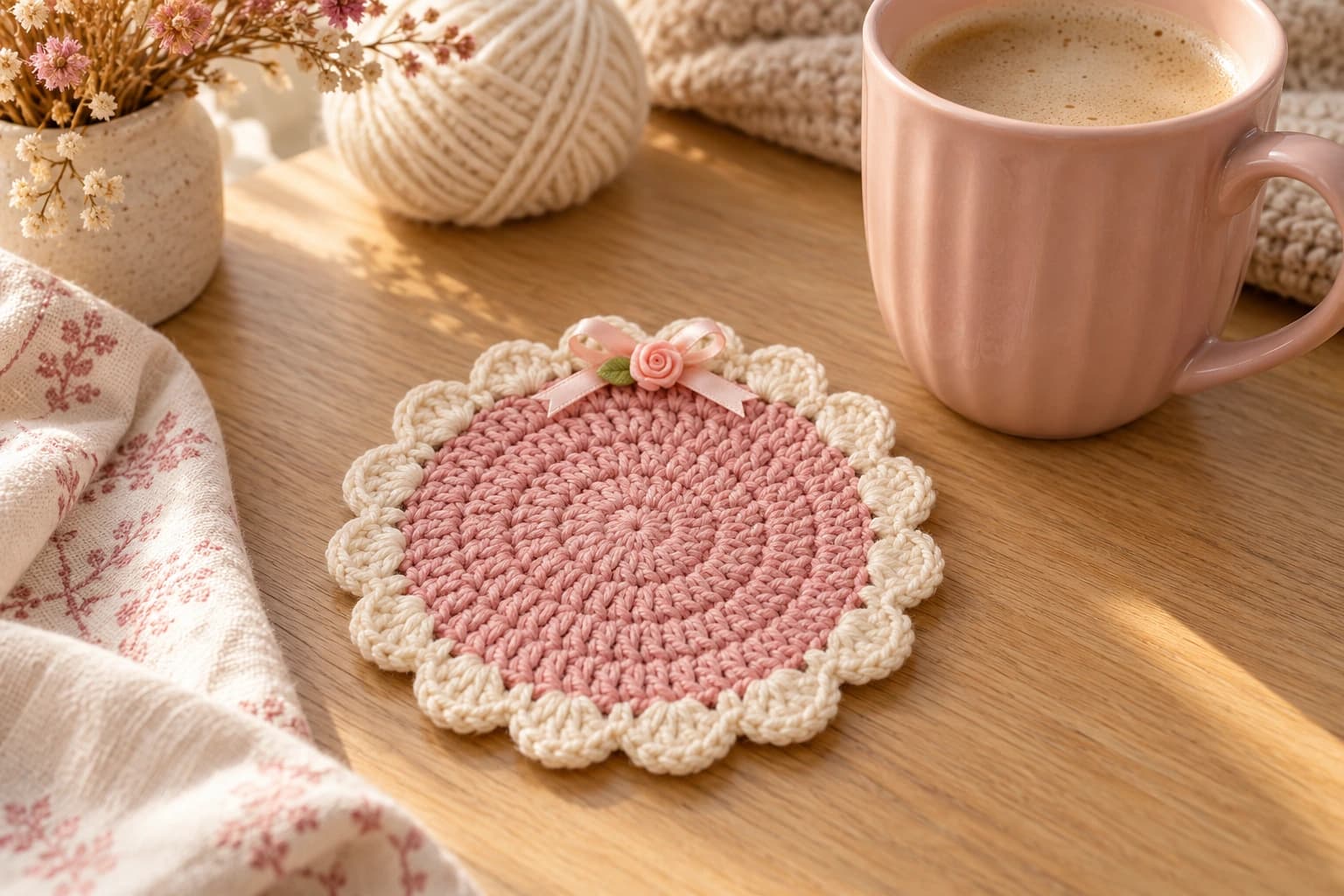
I like a tea tray with one little detail that makes it feel set for company. This coquette crochet coaster is about 4 in (10 cm) across, with a pink cotton center, cream scallops and a satin bow tucked along the edge. A tiny ribbon rose sits over the knot, with its green leaf peeking out beneath it.
The pink middle is worked in double crochet, so the stitches spread out from the center like spokes. I keep the decoration near the outer rim and leave the middle clear for the cup. Blocking comes before the ribbon: the cotton gets its shape first, then the shiny little bow goes on.
| At a glance | |
|---|---|
| Finished size | about 4 in (10 cm) across; pink center about 3¼ in (8 cm) |
| Yarn | DK #3 cotton in dusty pink and cream |
| Hook | 3 mm throughout |
| Pieces | 1 crocheted piece, with a sewn satin bow and purchased ribbon rose |
| Time | about 45–60 minutes, plus drying time |
| Skill | easy: magic ring, double crochet, joined rounds and shell edging |
Cotton and little details for the coquette coaster
- Yarn: DK #3, 100% cotton, about 137 yd (125 m) per 50 g, such as Paintbox Yarns Cotton DK. Allow about 18 yd dusty pink and 8 yd cream for one coaster. Small leftovers are plenty for the cream edge.
- Hook: 3 mm for the center and the scallops. I keep the cotton fairly snug so the coaster holds its shape under a cup.
- Ribbon: 14 in (36 cm) of narrow pink satin ribbon, about ⅛ in (3 mm) wide. This gives you room to tie a small bow and trim its ends.
- Rose: one sewable pink ribbon rose about ⅜ in (1 cm) across, with a tiny green fabric leaf beneath it. Choose a soft fabric-backed embellishment that a needle can pass through.
- Finishing: pink sewing thread, a fine sewing needle, a tapestry needle, scissors and two stitch markers. For blocking, a clean towel, rustproof pins and a flat pinning surface.
Tension. A small, unwashed single-crochet swatch should give about 6 sc per inch (2.5 cm), worked flat and unstretched. This is a dense cotton fabric. The pink circle should measure about 3¼ in (8 cm) across after R5; the scallops bring the finished coaster to about 4 in (10 cm). Check the circle flat before adding the edge.
Stitches (US terms): magic ring (MR), chain (ch), slip stitch (sl st), single crochet (sc), double crochet (dc) and stitch (st). A double crochet is: yarn over, insert the hook, yarn over and pull up a loop; yarn over and pull through 2 loops, then yarn over and pull through the last 2 loops.
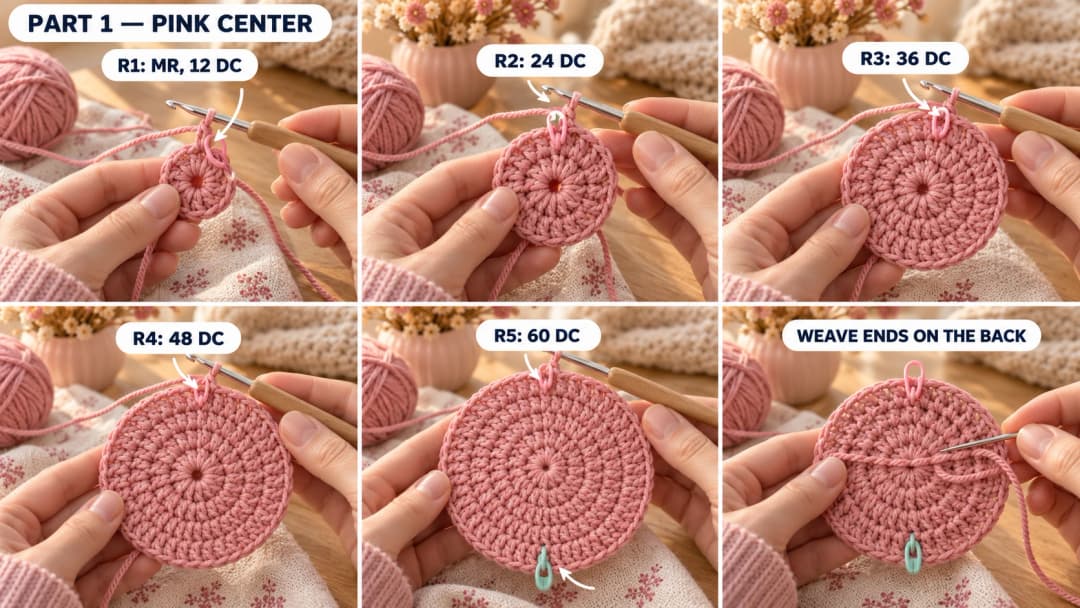
Work in joined rounds, with the right side facing you throughout. At the beginning of each pink round, ch 2; this does not count as a stitch. Put a marker in the first actual dc, then sl st into that dc to finish the round. Work the next round's first stitch in that same marked stitch. Neither the starting chain nor the joining sl st counts. The numbers in parentheses give the stitches made.
Making the pink center, round by round
Dusty pink cotton, 3 mm hook, Make 1. The magic ring is the middle of the coaster. The last pink round becomes the edge where the cream scallops attach. Leave a 6 in (15 cm) starting tail.
Make the magic ring and ch 2. For R2–R5, ch 2 before working the written stitches. Join each round as described above; keep the front of the coaster facing you.
- R1: MR, 12 dc in the ring. (12)
- R2: (2 dc in the next st) × 12. (24)
- R3: (dc, 2 dc in the next st) × 12. (36)
- R4: (dc 2, 2 dc in the next st) × 12. (48)
- R5: (dc 3, 2 dc in the next st) × 12. (60)
Pull the ring closed after R1, holding the stitch bases so the center stays neat. After joining R5, fasten off with a 6 in (15 cm) tail at the outer edge. Turn the circle over and weave both pink ends through the backs of the stitches, first one way and then back through a neighboring path. Trim them close.
Keep the marker in the first dc of R5. Count that round from the marker and place a second marker in st 30. I keep that second marker at the top; the bow will sit there later.
Tip. Spread the pink circle on the table after each round. If it makes a bowl, check that every increase is there and loosen the starting ch 2. If it ripples, check for an accidental extra stitch at the join. The joining slip stitch sits beside the first dc; skip over it when you count.
A cream scalloped edge around the pink center
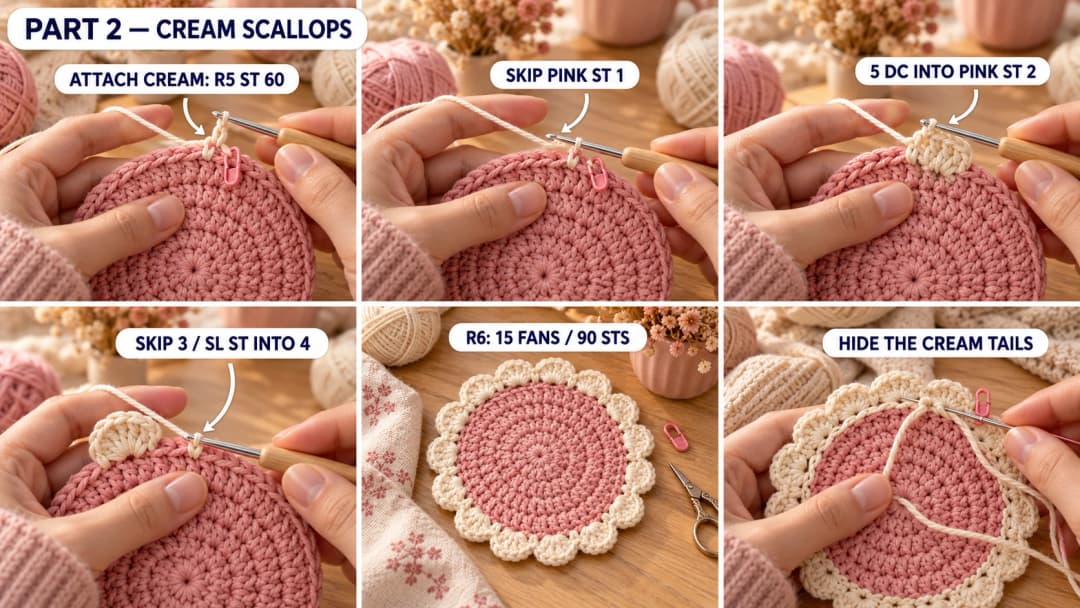
Cream cotton, 3 mm hook. Continue on the same coaster. With its right side facing you, find st 60 of R5, immediately before the first-stitch marker. Pull up a loop of cream through that stitch, leaving a 6 in (15 cm) starting tail, and ch 1. The pulled-up loop and ch 1 are just the attachment; they do not count as a border stitch.
Begin with pink st 1 as the next stitch to work past.
- R6: (skip the next st, 5 dc in the next st, skip the next st, sl st in the next st) × 15. (90)
Each fan of 5 dc is one scallop. Work the 15 repeats around the circle; the last sl st goes into pink st 60, where the cream was attached. Fasten off there with a 6 in (15 cm) tail. Weave both cream ends into the backs of the cream stitch bases, changing direction once before trimming.
Here's the first scallop slowly:
- Skip pink st 1.
- Work 5 dc into pink st 2, all into the same stitch.
- Skip pink st 3.
- Sl st into pink st 4 to bring the edge down into a valley.
Continue the same way around. Let the cream fans lie beside one another, like little rounded petals. Keep the joining valleys relaxed so the pink circle stays flat.
Adding the satin bow and tiny ribbon rose
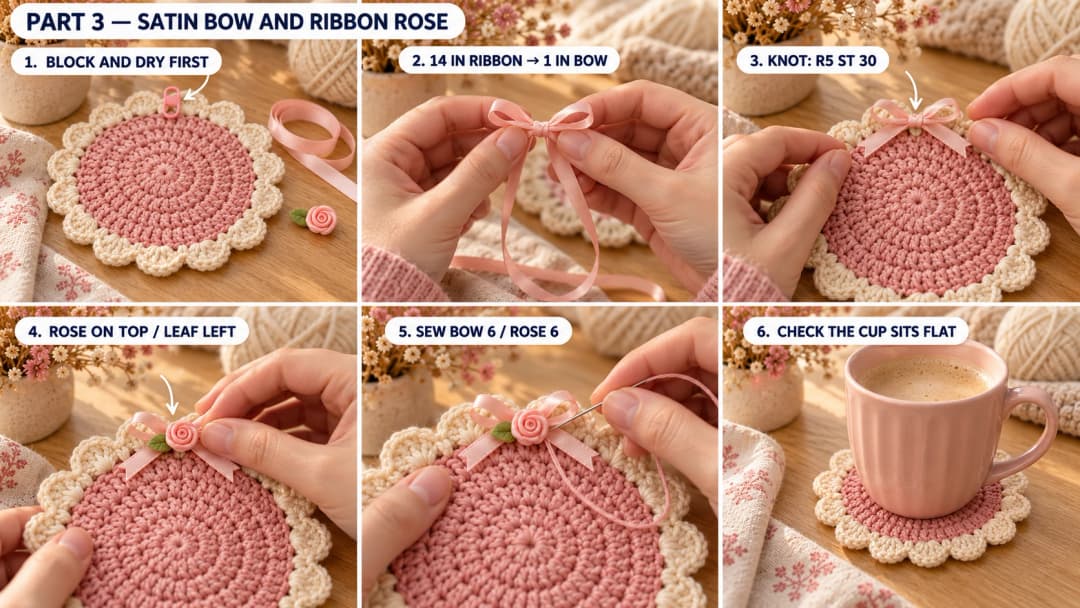
Block the cotton first, using the next section, and let it dry completely. Then return here to add the ribbon. Keep the second marker in pink R5 st 30 while you block; that is the top of the coaster.
Tie a small, flat satin bow
Find the middle of the 14 in (36 cm) ribbon. Tie a small bow there, then gently pull the loops until the bow is about 1 in (2.5 cm) across. Keep the tails loose until it is pinned to the coaster. Press the knot flat between your fingertips; that's where the little rose will sit.
Place the decoration at the outer rim
Lay the coaster right side up, marked st 30 at the top. That stitch sits beneath the middle of a cream scallop. Pin the bow's knot over pink R5 st 30, with the loops lying left and right along the rim. Angle the tails outward over the cream, trim each to about ⅜ in (1 cm) and tuck their tips toward the valleys above pink sts 28 and 32.
Set the pink ribbon rose over the knot, its green leaf pointing to the left along the edge. Keep the leaf and ribbon ends outside the cup space. Put your usual mug in the middle before sewing: its base should sit entirely on the pink cotton, resting level and clear of the rose. Move the cup away again before picking up the needle.
With pink sewing thread, take 6 small stitches through the bow's knot and the tops of pink R5 sts 29–31. Sew the rose through its fabric backing and the same outer pink stitches with 6 more small stitches. Catch the leaf at its base with 2 stitches, then tack each ribbon tail once where it rests against the cream stitch bases. Keep the thread underneath the rose and ribbon, and knot it on the wrong side.
Tip. For a mug with a wide base, place the rose right over the outer pink edge and spread the bow along the cream scallops. Check again before sewing. If the mug still touches the decoration, leave the bow and rose off that coaster and keep them for a smaller cup's place setting.
Safety. This decorated coaster has a small sewn embellishment and isn't a toy for children under 3. Keep the ribbon and rose away from little hands, and check their stitches when you wash it.
Blocking the coaster so your cup sits flat
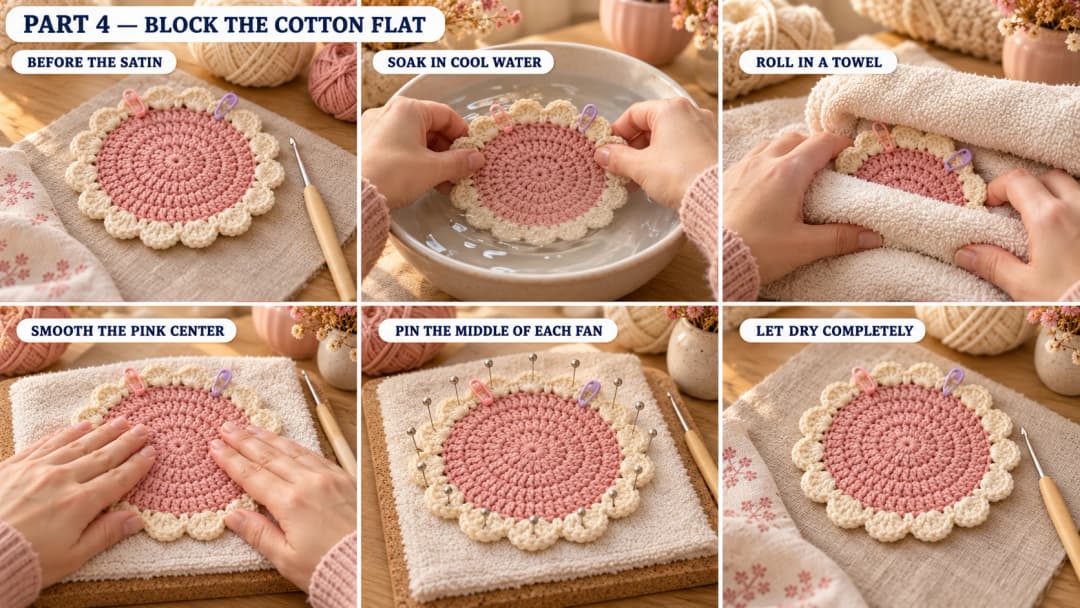
Wet-block after the cream border and before attaching the satin decoration. Keep both stitch markers in place. Soak the cotton briefly in cool water, squeeze gently, then roll it in a towel to take out the extra moisture.
Lay the coaster right side up on a dry towel over your pinning surface. Smooth the pink circle into a flat round with your palms. Ease each cream fan outward, then place a rustproof pin through the middle dc of each of the 15 scallops. I ease the cream fans into little half-moons and let the pink center rest flat.
Let it dry completely before removing the pins. Return to the ribbon section, sew the decoration on and remove the two markers. Rest a cup on the center and check that it sits level.
For later cleaning, gently hand-wash the decorated coaster in cool water with mild soap. Press it in a towel and dry it flat, easing the scallops back into shape. Keep a hot iron away from the satin rose.
A pink-and-cream pair for the tea tray
I like a matching pair beside a little pot of tea. For two coasters, set aside about 36 yd pink and 16 yd cream, 28 in (71 cm) of ribbon and two ribbon roses with their leaves. Work the same pattern again, keeping the bows at the same spot on each edge.
For a small gift, stack the coasters with the decorated rims facing opposite ways so the roses aren't pressed together. Slip the pair into a shallow box with tissue between them. The cream scallops are the part I like to leave peeking out.
Using UK terms? US dc = UK tr; US sc = UK dc; sl st is the same in both.
Made a pink-and-cream coaster? Tag #wavodecrochet on Pinterest so I can see it.