Color Block Crochet Cardigan

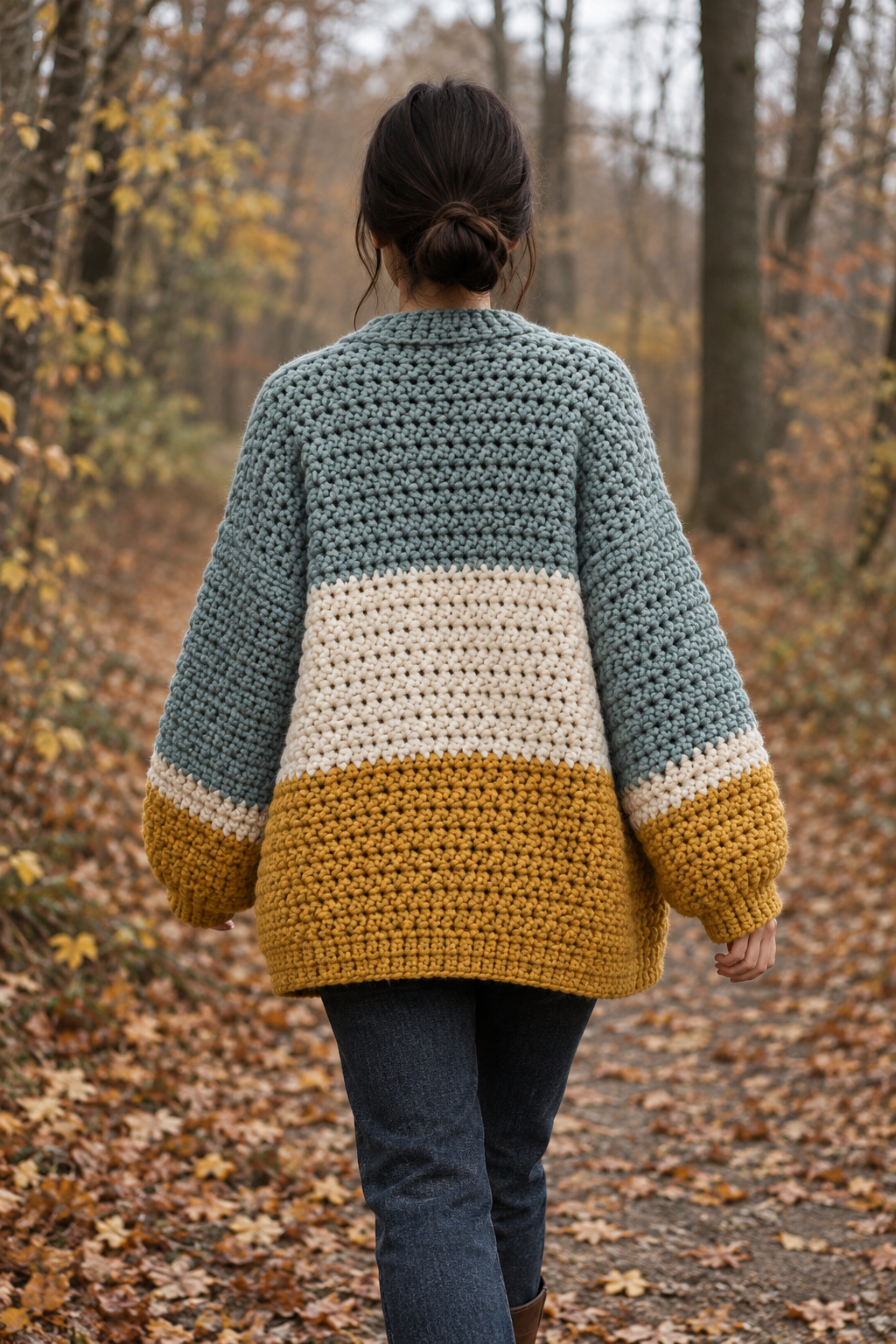
The easiest free color block crochet cardigan uses four flat rectangles and half double crochet worked in three chunky #5 stripes — sage blue, cream and mustard. There's no increasing, no decreasing, no shaping. You crochet two body panels and two sleeves, seam them, add a ribbed collar, and you have an oversized cardigan in a weekend. Around 1,200 yards of yarn for a women's medium, an 8 mm hook, and half double crochet as your only stitch beyond chains.
Pattern at a glance
- Stitch: half double crochet in the back loop only (BLO) for the ribbed collar, regular HDC for the body.
- Yarn: chunky #5 weight, 1,200 yd total split across 3 colors (400 yd each).
- Hook: 8 mm (US L-11).
- Construction: 4 flat panels — 2 body rectangles + 2 sleeve rectangles.
- Shaping: none. The oversized drape does the fitting.
- Stripes: sage blue yoke, cream middle band, mustard hem and cuffs.
- Finished size: one size fits XS–XL, ~24 in body length, 27 in sleeve.
- Time to complete: 12–15 hours over one weekend.
- Skill level: advanced beginner — you need only HDC and seaming.
Key takeaways
- Four rectangles, no shaping — beginner-safe geometry.
- 1,200 yd of chunky #5 yarn in three colors (Lion Brand Wool-Ease Thick & Quick works beautifully).
- 8 mm hook, half double crochet throughout.
- Oversized fit flatters every size XS–XL without measuring.
Why the color block cardigan is beginner gold
Rectangles are the safest thing you can crochet. No increases to miscount, no decreases that pucker, no armhole math. According to the Craft Yarn Council, half double crochet in chunky yarn produces a stitch tall enough that a weekend actually gets you a garment — not just a swatch. The color block trick then does the styling work for you: three flat blocks of color read as a curated design even when your tension wobbles.
I made my first cardigan from this exact formula the winter I was still counting stitches on my fingers. The oversized fit hid every mistake I'd made in the sleeves. That's why I recommend it as the first wearable, every time.
What you'll need
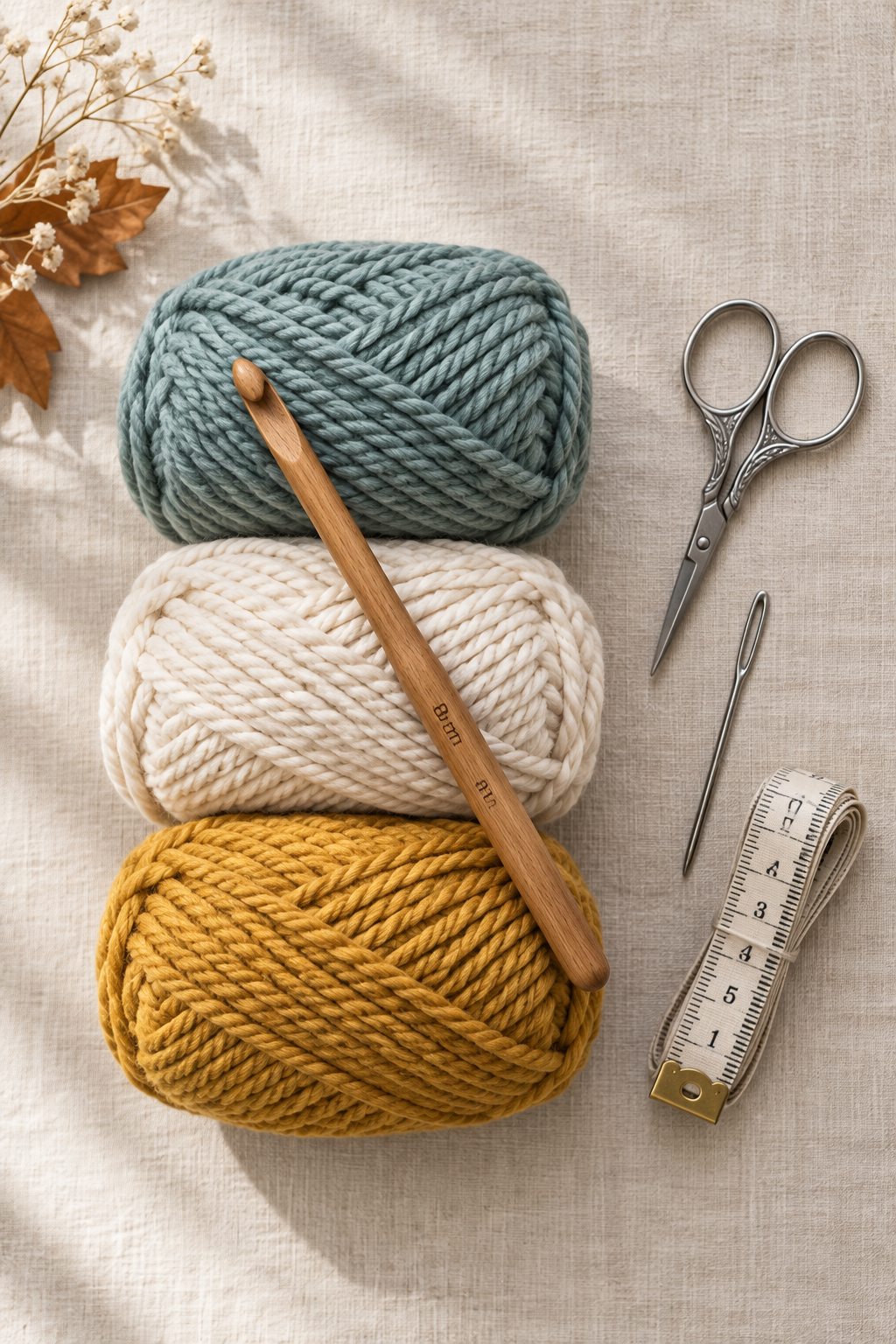
Yarn (chunky #5 weight, ~1,200 yd / 1,100 m total)
- 400 yd sage blue (Color A) — Lion Brand Wool-Ease Thick & Quick in Fisherman or Denim.
- 400 yd cream or ecru (Color B) — same yarn family in Fisherman.
- 400 yd mustard or ochre (Color C) — Mustard or Butterscotch.
Hook
- 8 mm (US size L-11). A tapered oak hook feels warmer in the hand for a long project.
Other
- Tapestry needle with a large eye — chunky yarn needs a wide-eye needle.
- Scissors, measuring tape, and stitch markers to mark shoulder seams.
The pattern (US crochet terms)
Step 1 — Body panels (make 2)
Foundation: Chain 41 with Color A (sage blue).
Row 1: HDC in 3rd chain from hook and each chain across (40 HDC). Turn.
Rows 2+: Chain 2, HDC in each stitch across (40 HDC). Continue in Color A until the panel measures 8 inches from the bottom.
Switch to Color B (cream). Crochet 8 more inches. Fasten off Color B.
Switch to Color C (mustard). Crochet 8 more inches. Fasten off. The finished panel is roughly 24 × 20 inches.
Make a second panel identical — this is the back and front of the cardigan (the front will be cut open later).
Step 2 — Color change close-up
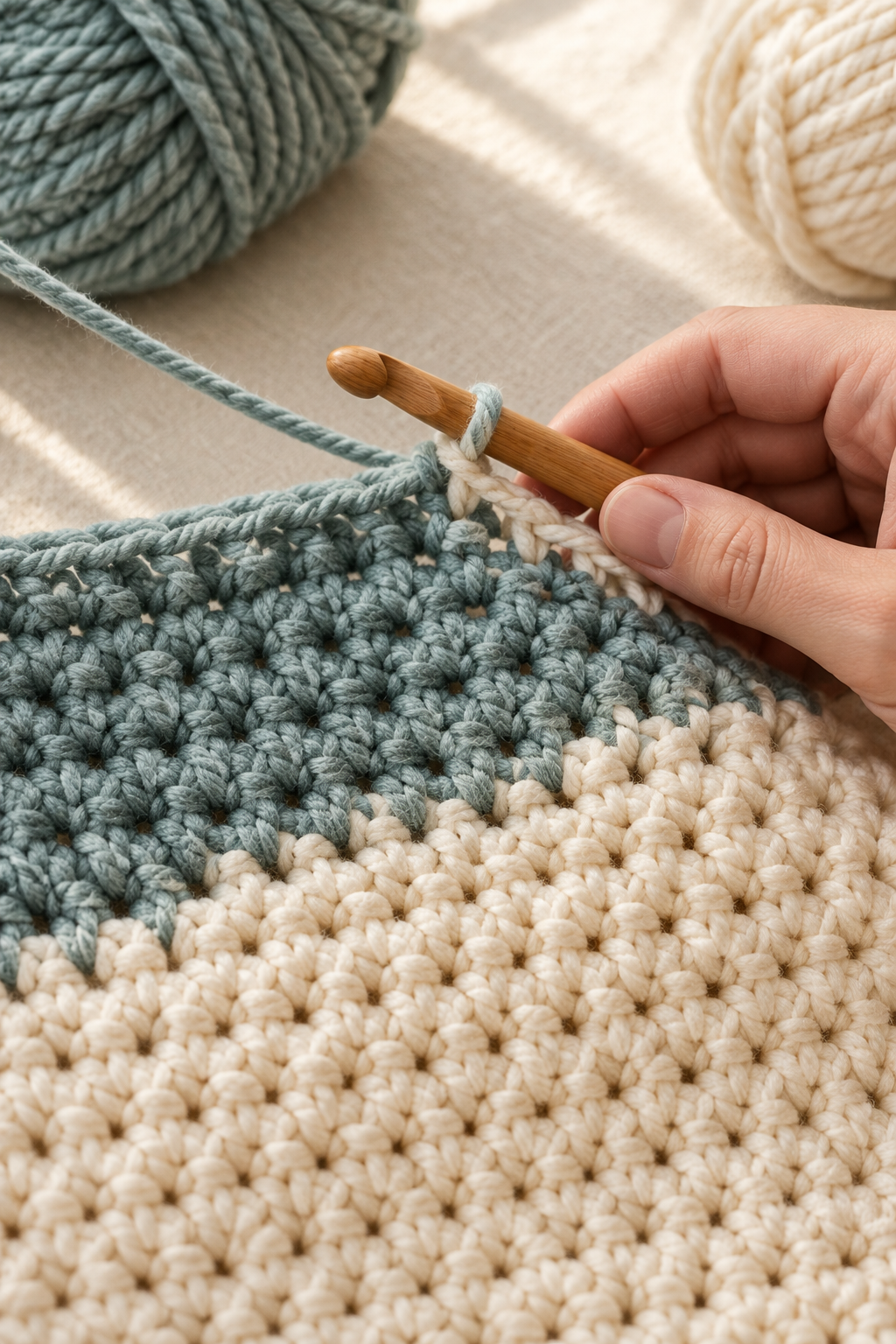
Change color on the last yarn-over of the row's final HDC — pull the new color through both loops instead of the old. This gives you a crisp horizontal transition with no jog. Cut the old color leaving a 6-inch tail to weave in later.
Step 3 — Sleeve panels (make 2)
Foundation: Chain 33 with Color C (mustard).
Row 1: HDC in 3rd chain from hook and each chain across (32 HDC). Turn.
Rows 2 to end: Chain 2, HDC in each stitch across (32 HDC). Continue until the sleeve measures 27 inches. Fasten off.
Make a second sleeve identical.
Step 4 — Seam and open the front
Fold both body panels together with right sides facing. Whip-stitch across the top edge to make the shoulder seam, leaving 10 inches open in the middle for the neck. Whip-stitch the sides, leaving 8 inches unstitched at the top for armholes.
Take one body panel and cut it open vertically down the center front. Yes, cut. Reinforce with a line of single crochet in Color A before cutting so the yarn can't unravel. This is how you get an open-front cardigan without complicated shaping.
Attach the sleeves flat into the armholes with single crochet seams, matching sleeve top center to shoulder seam.
Step 5 — Ribbed collar
Working around the entire front opening and neck, crochet 6 rows of half double crochet in the back loop only (BLO) using Color A. This creates the ribbed collar. Fasten off, weave in ends.
How long does the color block cardigan take?
A confident beginner finishes this cardigan in 12–15 hours of stitching, spread across a Saturday and Sunday. Chunky yarn and half double crochet build fast — the body panels grow about 1.5 inches per hour. Seaming and the collar take about 90 minutes together at the end.
What size does this pattern fit?
The color block cardigan is one-size-fits-most, from women's XS through XL. The oversized drape means a size XS wears it like an intentional slouch, and a size XL wears it fitted. Because it's rectangles, you can easily add 5 inches to the body panels for a longer duster length or 3 inches to the sleeve for extra bell.
Can I use a different yarn weight?
Yes. Worsted weight (#4) with a 5.5 mm hook makes a lighter cardigan for spring — you'll need roughly 1,600 yards total instead of 1,200, and the project will take about 25 hours. Super bulky (#6) with a 10 mm hook cuts the time to 8–10 hours but the finished sweater feels more like a robe.
Styling ideas that make it look intentional
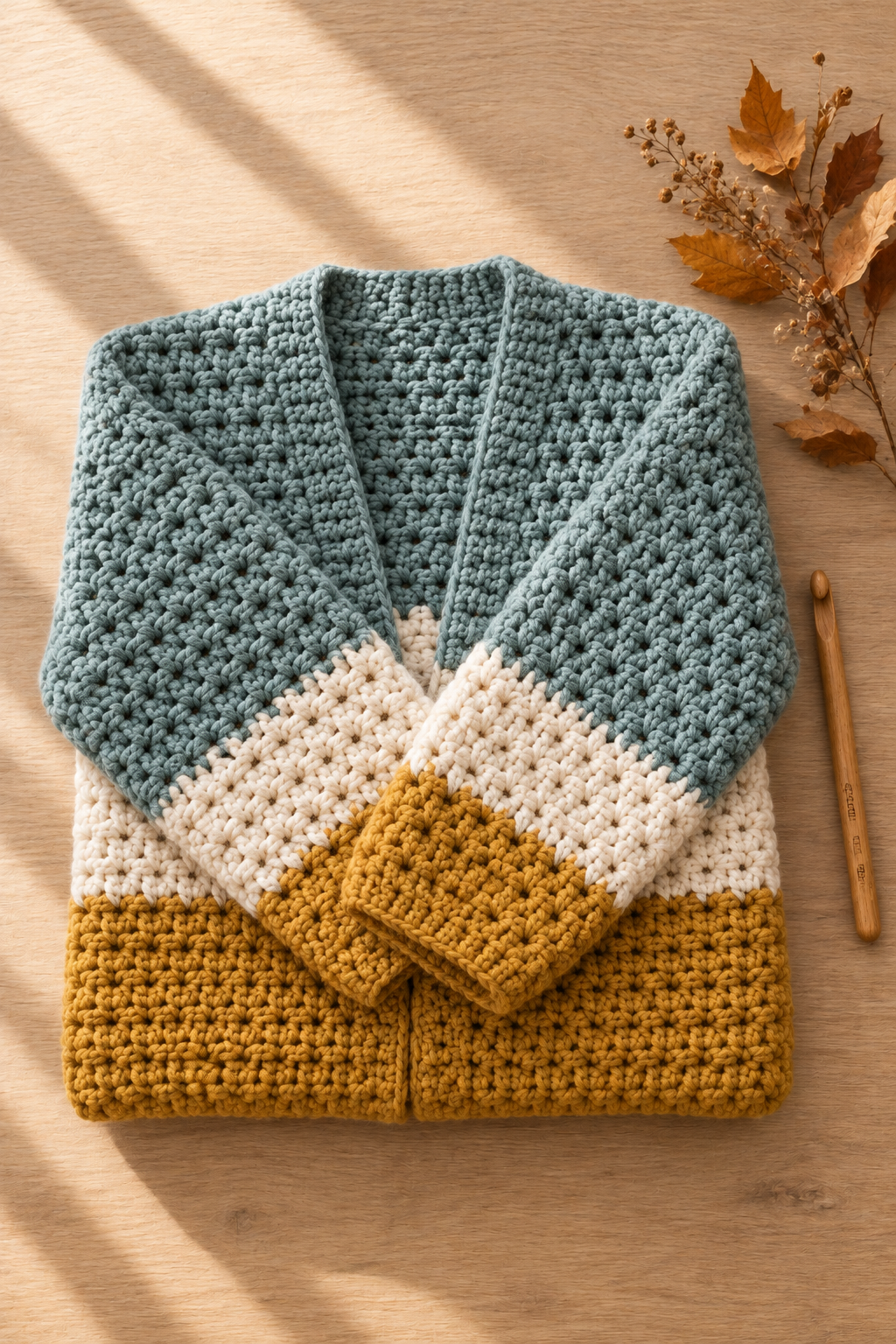
Choose two neutrals plus one accent for a wardrobe cardigan — cream + sage + mustard reads autumnal, cream + navy + ochre reads coastal, all-cream with a single mustard sleeve stripe reads editorial. Skip contrasting seams in your first version. Match your sewing yarn to the panel color so the seams disappear. A pop of contrast draws the eye to the mistake.
Frequently asked questions
Do I really have to cut the front panel open? Yes, and I know it's terrifying the first time. Reinforce the cut edge with a line of single crochet before cutting so the yarn can't unravel. Every "beginner cardigan" pattern uses this trick — it's how you avoid buttonhole math.
Can absolute beginners handle this? If you know how to chain and do half double crochet, yes. The four rectangles are honestly less difficult than a scarf with fringe. Seaming is the only new skill.
How do I know when to switch colors cleanly? Change color on the last yarn-over of the row's final HDC — pull through with the new color. This gives you a clean stripe transition. Cut the old color leaving a 6-inch tail to weave in later.
Can I make this without the color block? Absolutely. Use the same construction with one continuous color for a solid oversized cardigan. Skip color changes entirely and the pattern still works.
Related patterns on Wavode
- Easy crochet baby blanket pattern — same moss-stitch beginner energy in a smaller project.
- Granny square bag crochet pattern — a one-weekend accessory to pair with your cardigan.
- Piko the Pond Turtle amigurumi — a no-sew plush for scrap yarn from this project.
External resources
Written by Clara Hartwell.