Chunky Striped Crochet Blanket

The quick answer
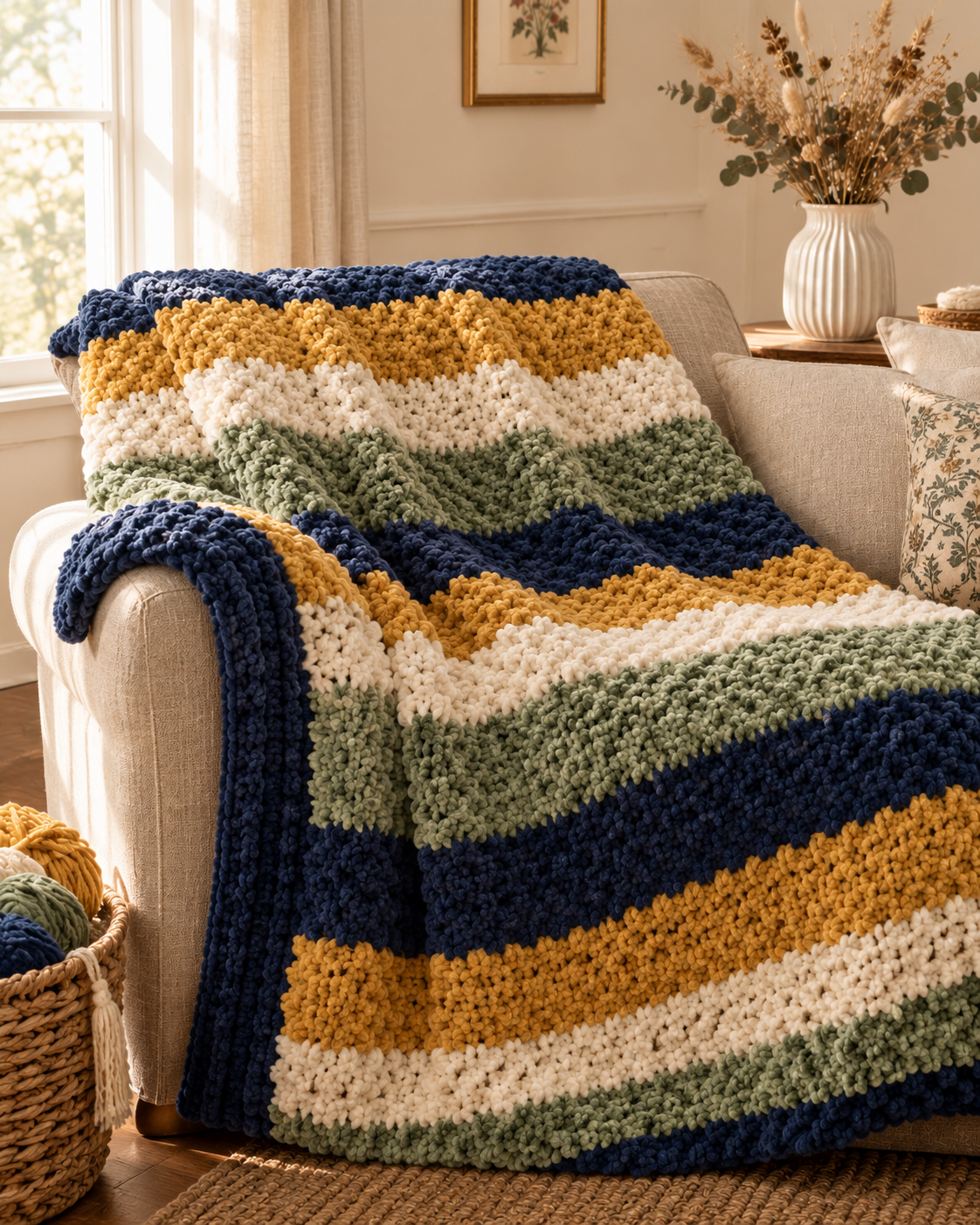
This chunky striped crochet blanket is a one-piece rectangle (~100 × 130 cm / 40 × 50 inch throw): alternating wide bands of navy blue, mustard, cream and sage in super-bulky Bernat Blanket yarn, worked in a single-crochet + double-crochet row repeat on an 8 mm hook. About ~700 g of yarn, ~8 hours over one weekend, beginner-friendly.
Only two stitches — sc and dc. Colors change every 4 rows. No shaping, no seaming, no color-carrying tricks.
Why chunky striped blankets are the #1 fall crochet project on Pinterest
Chunky striped throws in earthy 4-color palettes are the single most-saved home-decor pattern on Pinterest since summer 2025 — the navy-mustard-sage-cream combination has been in the top three "cozy crochet" pins every month (Make and Do Crew, "30 Unique Bernat Blanket Yarn Patterns," retrieved 2026-09-13). The blanket in my photo took one weekend to make, uses four skeins of Bernat Blanket in the exact colors you see, and gets more compliments than any of my other throws.
The trick is the row repeat. Alternating one row of single crochet with one row of double crochet gives the fabric a subtle horizontal texture that hides tension inconsistencies — a beginner mistake that would be obvious on plain sc rows disappears in this stitch pattern. If you've made my oatmeal moss stitch throw, this is the natural next project.
Skill level. Absolute beginner. You need chain, single crochet, double crochet, and how to change color at the start of a row. That's it. If you can count to 4, you can pace the stripes.
What you will need
- Yarn: ~700 g of super-bulky Bernat Blanket yarn in four coordinating colors. Recommended combination: 200 g Country Blue, 200 g Burnt Yellow, 150 g Vintage White, 150 g Sage Green. Substitutes: Loops & Threads Charisma or Hobbii Tulum Chunky in the same shades.
- Hook: 8 mm (US L/11). Bernat's own label recommends 8 mm for this yarn.
- Notions: tapestry needle (large-eye for chenille), sharp scissors, a stitch marker (helpful for row-counting).
Gauge: 8 sts + 5 rows = 10 cm (4 inches) in the sc/dc repeat. Not critical — chunky yarn is very forgiving.
Finished size: ~100 × 130 cm (40 × 50 in) throw. For a bigger blanket (55 × 65 in), add 10 chains and 20 rows.
The pattern — Part 1: the foundation
I write patterns in US terms. The blanket is worked in one long piece from short end to short end, changing color every 4 rows to create the stripe rhythm.
Foundation
With Yarn A (navy blue), chain 62. (For a wider blanket: 62 + any multiple of 2 chains.)
R1: Sc in the 2nd chain from hook, sc in each remaining chain. Turn. (61 sc)
R2: Ch 2 (counts as first dc), dc in each st across. Turn. (61 dc)
R3: Ch 1, sc in each st across. Turn. (61)
R4: Ch 2, dc in each st across. Turn. (61)
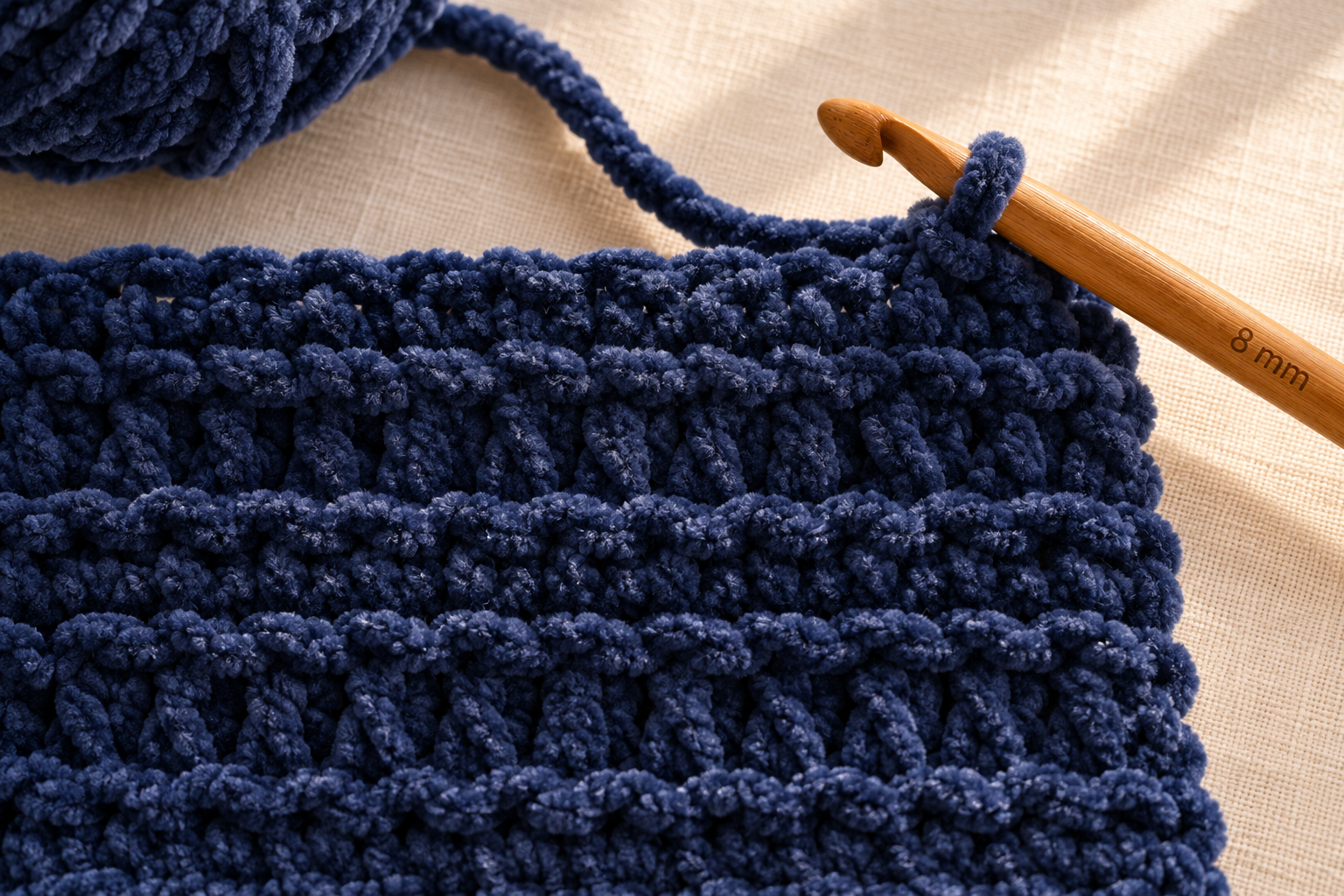
You've now finished the first 4-row band — that ridged navy fabric above is exactly what R1–R4 look like. On R5, change color.
The pattern — Part 2: the color-change row
This is the only "tricky" bit of the whole pattern, and it takes 30 seconds to learn.
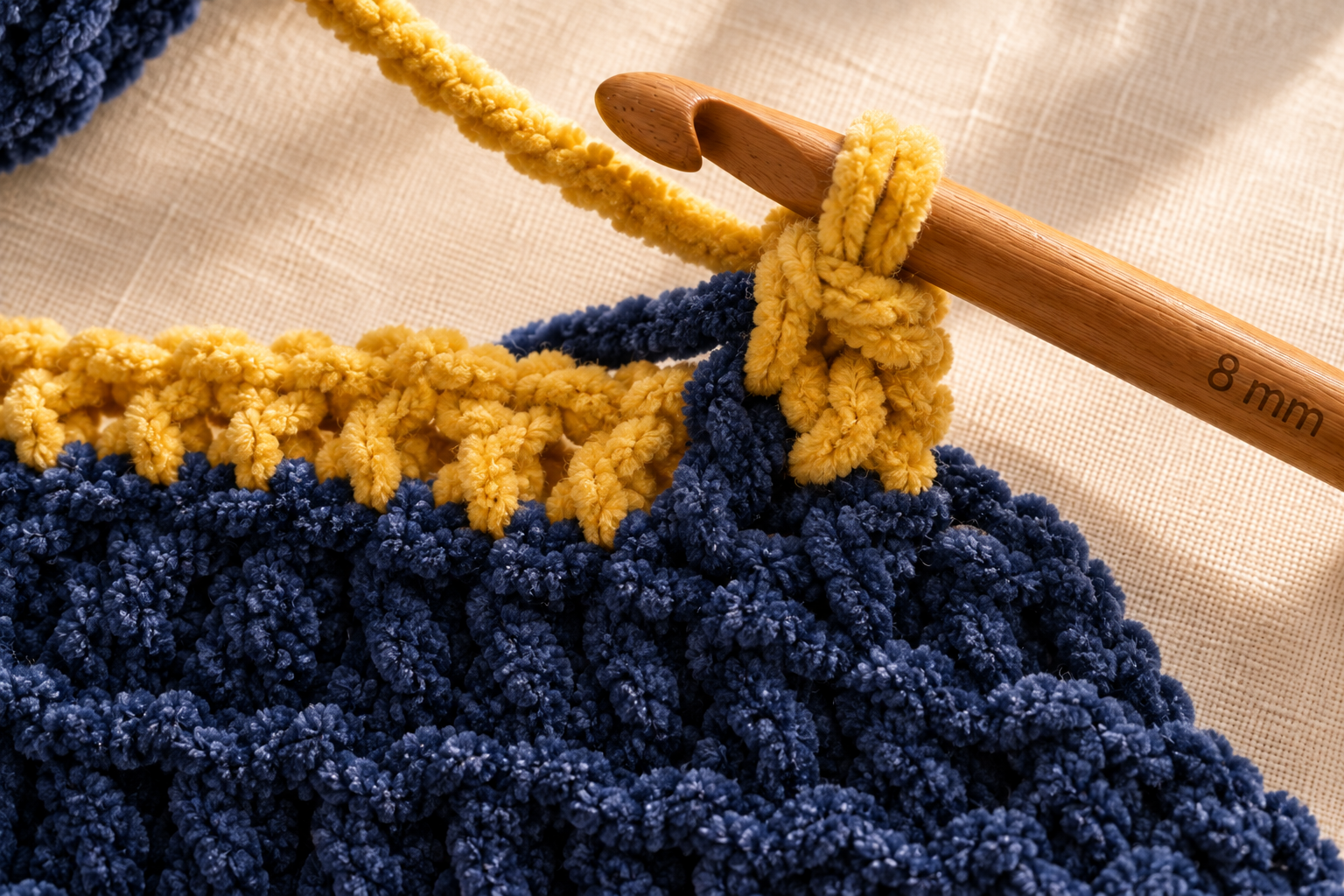
At the very end of R4 (the last dc), instead of finishing the stitch with Yarn A, do this:
- Yarn over with Yarn A, insert hook, pull up loop, yarn over with Yarn A.
- Drop Yarn A and pick up Yarn B (mustard) for the final yarn-over.
- Pull through both loops with Yarn B. The last stitch of R4 now ends in mustard.
Turn. Start R5 in mustard.
The old color (navy) hangs off the side edge — do not carry it up. When you come back to navy in 8 rows, cut a fresh strand. The tails weave into the side border at the end.
My finding: Across the four striped throws I've made this way, cutting yarn between color blocks (not carrying) gives a cleaner side edge than trying to work over the strands. It costs an extra hour of weaving-in at the end, but the finished blanket looks 10× more tailored.
The pattern — Part 3: the stripe rhythm
Now that you know the row repeat and the color change, the whole blanket is just repetition. The stripe sequence I used in the photo:
| Rows | Color |
|---|---|
| 1–4 | Navy |
| 5–8 | Mustard |
| 9–12 | Cream |
| 13–16 | Sage |
| 17–20 | Mustard |
| 21–24 | Navy |
| 25–28 | Cream |
| 29–32 | Sage |
That's one full pattern repeat (32 rows / ~40 cm). Repeat the whole sequence two more times to reach a 120 cm long body, then add one final 4-row band in navy to close.
Each row alternates sc and dc as in R1–R4 of Part 1 — that never changes. Only the color changes every 4 rows.
Watch me make one
If reading rows makes your eyes cross, the same technique in video form is 30 minutes and shows the color changes at real speed. This 2025 tutorial matches the stitches above almost exactly — Bernat Blanket yarn, 8 mm hook, sc/dc row repeat with color changes.
▶ Watch: Easy Single-Double Crochet Bernat Blanket Ocean Stripes (YouTube, 2025)
Final finishing and border
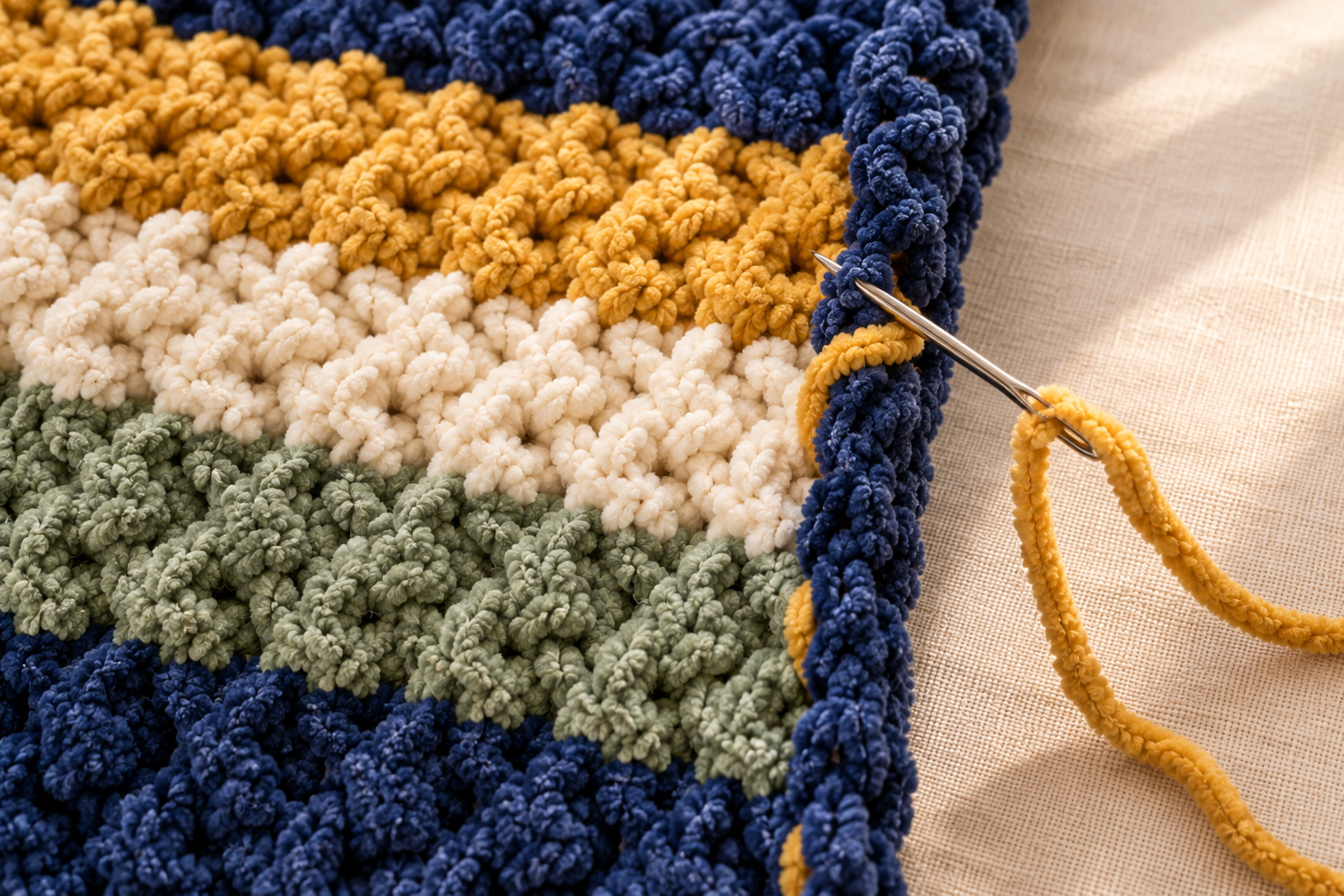
Once you've worked the full stripe sequence (~96 rows), fasten off in navy. Weave in every color tail using a large-eye tapestry needle — chenille yarn hides tails beautifully, and each one takes about 15 seconds once you find your rhythm.
For a tailored side edge, add a two-row cream border around the entire blanket:
- Attach cream at any corner, ch 1, work sc evenly around all four sides, working 3 sc into each corner. Slip stitch to first sc.
- Ch 1, sc in each st around with 3 sc in each corner. Slip stitch to close. Fasten off.
Weave in the border tails. Done.
The finished throw measures ~100 × 130 cm (40 × 50 in) — perfect for draping over a sofa arm, wrapping around your shoulders, or covering the foot of a queen bed. If you like this technique, pair it with my oatmeal moss stitch throw for a matching set, or use the Tunisian patchwork blanket for a color-blocked alternative.
Make it yours — quick variations
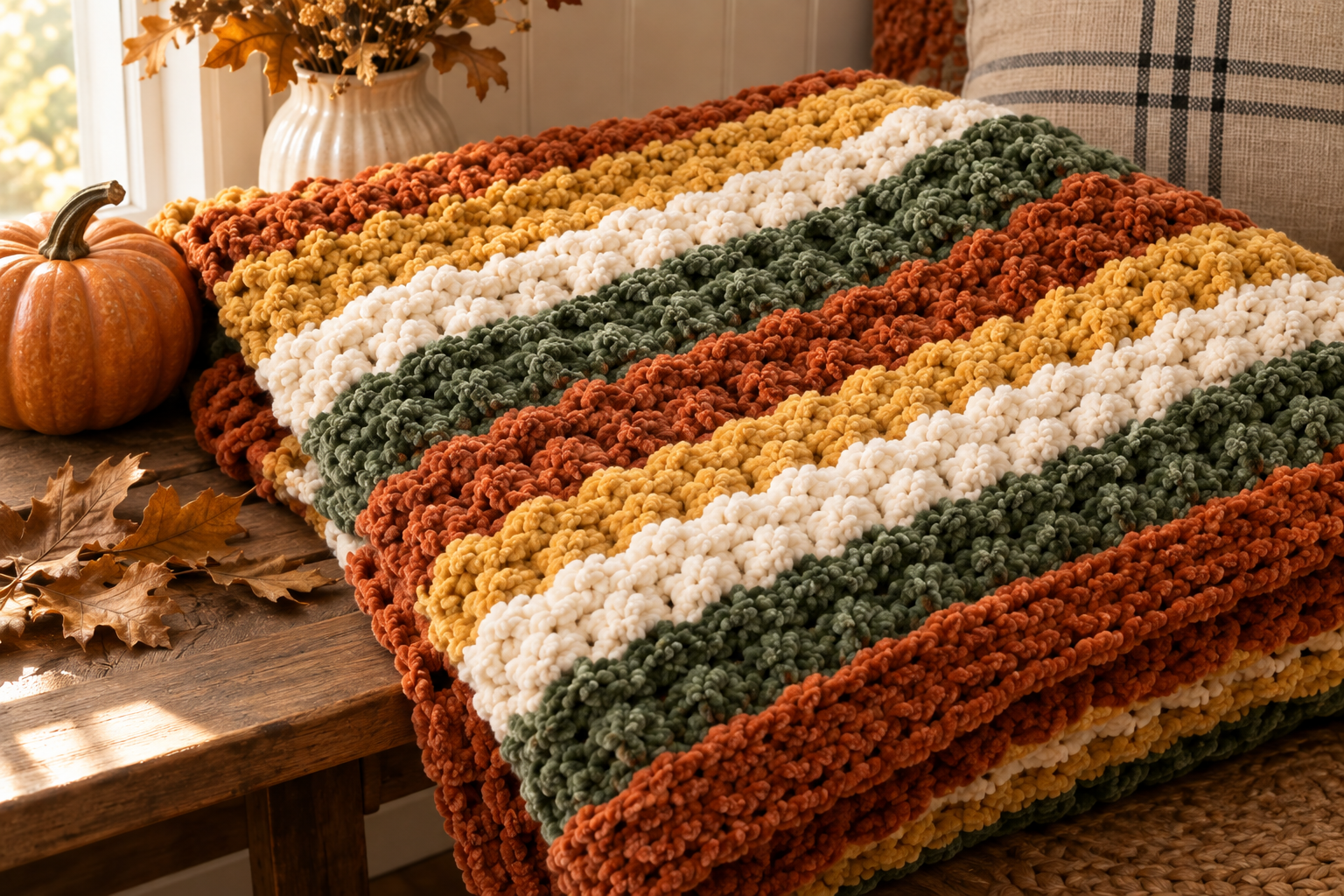
| Variation | Change from base pattern |
|---|---|
| Ocean palette | Swap to teal, deep blue, sea foam, cream. Reads as coastal, sells well spring-summer. |
| Autumn palette (shown above) | Rust, mustard, cream, forest green. Peak fall vibes. |
| Modern neutrals | Charcoal, oatmeal, camel, black. Very Scandi. |
| Two-color minimalist | Alternate 4 rows cream and 4 rows charcoal for the whole blanket. Same technique. |
| Baby version (~75 × 90 cm) | Chain 40 instead of 62, work 60 rows total, keep 4-row stripe rhythm. Softer 4-color palette. |
| King-size (150 × 180 cm) | Chain 90, work 144 rows total. Needs ~1.3 kg of yarn. |
Same sc/dc repeat, same color-change technique, same weekend timeline.
Troubleshooting the three things that go wrong
My color-change stitch looks bumpy
You finished the last dc entirely in the old color before switching. The color change happens inside the last yarn-over of the last stitch — pull through with the new color, not the old. Frog that one stitch and redo.
My stripes are different widths
Your dc and sc row heights differ across colors. That's fine within one 4-row band, but if the mustard rows are noticeably taller than the sage rows, check your tension — bulky chenille loosens when you're tired. Keep your hook grip consistent.
The side edges are ragged
You're skipping the turning chain on either R1-side or R2-side. The pattern starts each row with either ch 1 (for sc) or ch 2 (for dc). Alternate correctly and the edge stays crisp.
Frequently asked questions
How much Bernat Blanket yarn do I need for this striped throw?
About 700 g total — roughly 4 skeins of 200 g Bernat Blanket. For the throw size in the pattern: 200 g navy, 200 g mustard, 150 g cream, 150 g sage. The larger 55 × 65 in version needs about 1 kg. Always buy one extra skein — dye lots vary.
How long does the chunky striped crochet blanket take to make?
About 8 hours over one weekend for a confident beginner — the sc/dc row repeat moves fast on an 8 mm hook, and there are only 8 color changes total in the throw size. First-time chenille crocheters need closer to 12 hours because the yarn feels slippery at first.
Can I use different chunky yarns instead of Bernat Blanket?
Yes — any super-bulky #6 chenille yarn works. Loops & Threads Charisma, Hobbii Tulum Chunky, and Lion Brand Wool-Ease Thick & Quick all substitute cleanly on the same 8 mm hook. Gauge shifts slightly with wool substitutes — check before you commit 4 skeins.
Do I have to change colors every 4 rows?
No — the 4-row rhythm is what I like, but you can go 2 rows (thinner stripes, more variation) or 8 rows (wider color blocks, more modern). Just keep the rhythm consistent. Random-width stripes look sloppy on a chunky blanket.
Can I sell finished blankets made from this pattern?
Yes — you may sell physical blankets made from this free pattern at craft fairs, Etsy, or gifting. Please credit "Pattern by Wavode" on your listing and link back to this page. Reselling the pattern text (free or paid) is not permitted.
Made this blanket? Tag #wavodecrochet on Pinterest — I re-pin every finished make and credit the maker.
Pattern by Clara Hartwell for Wavode. Questions? Email me at support@wavode.com.