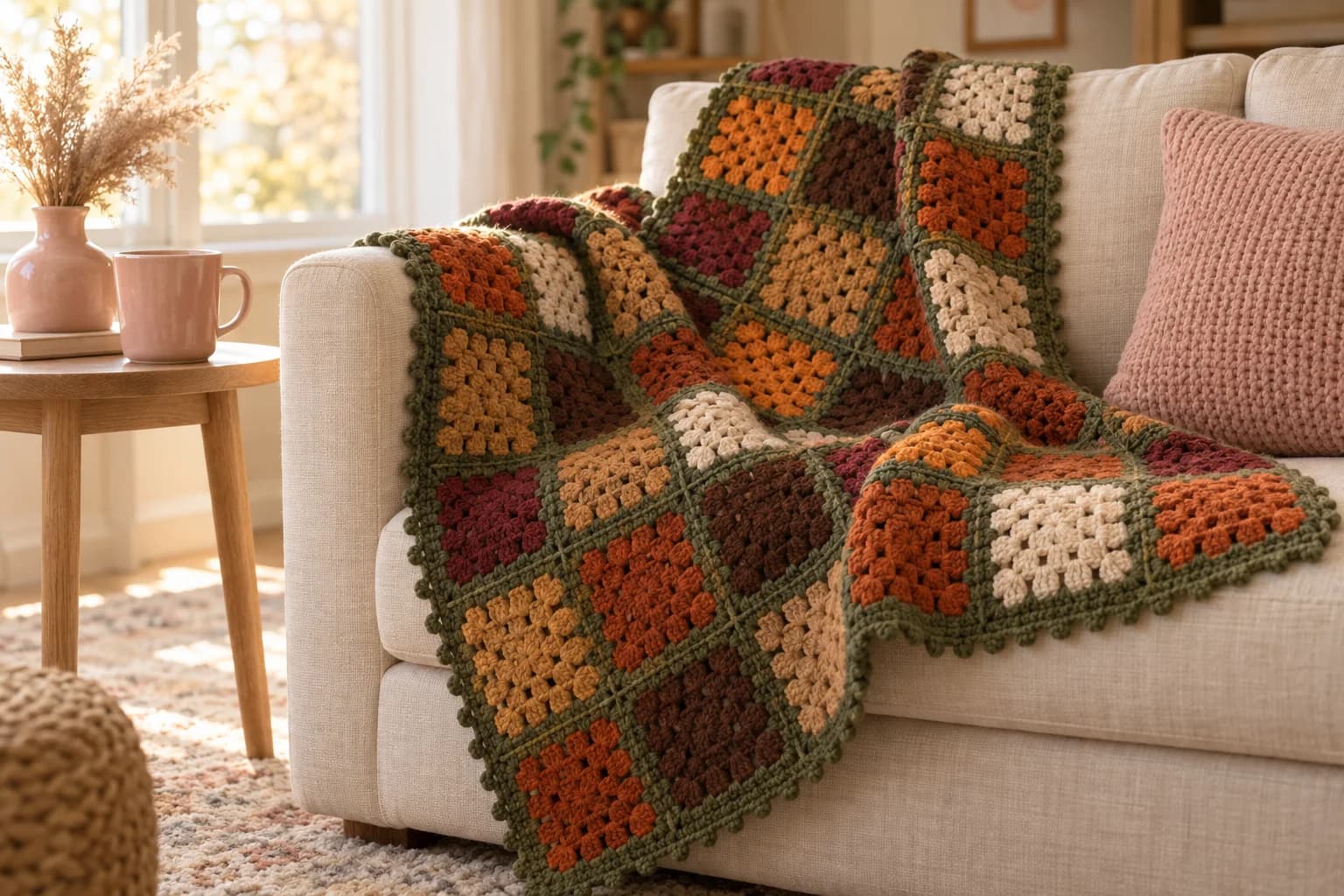
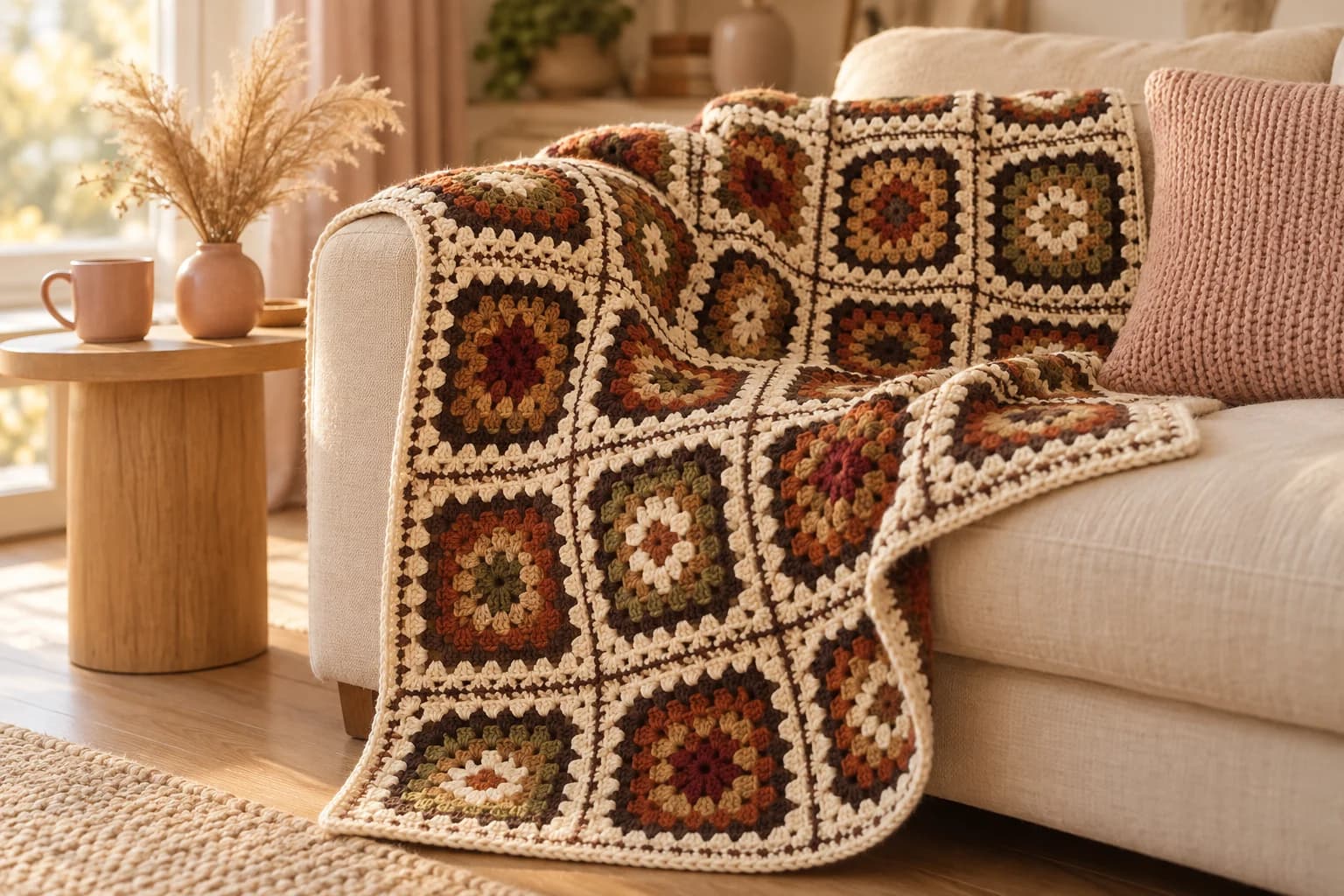
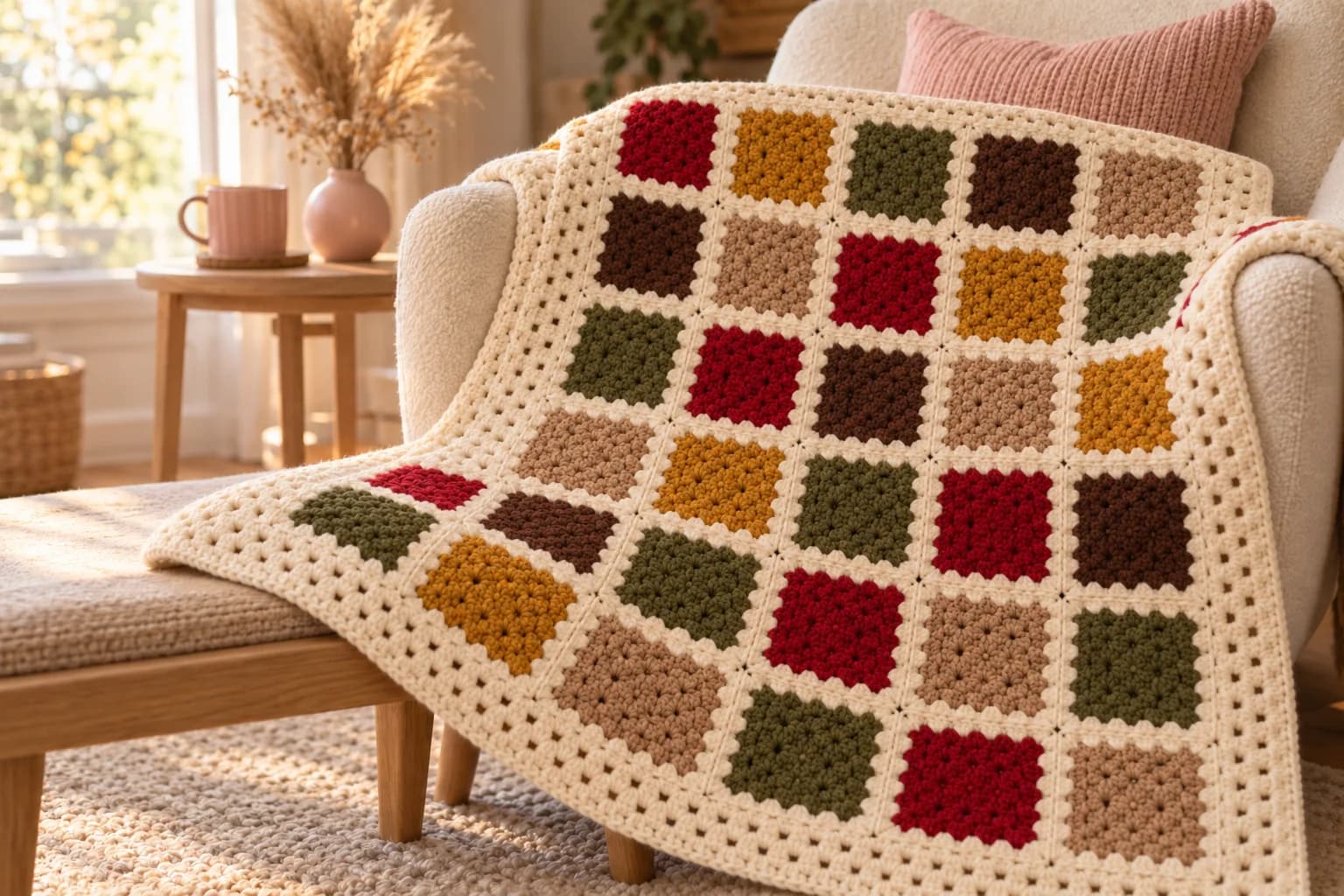
The Autumn Patchwork Throw

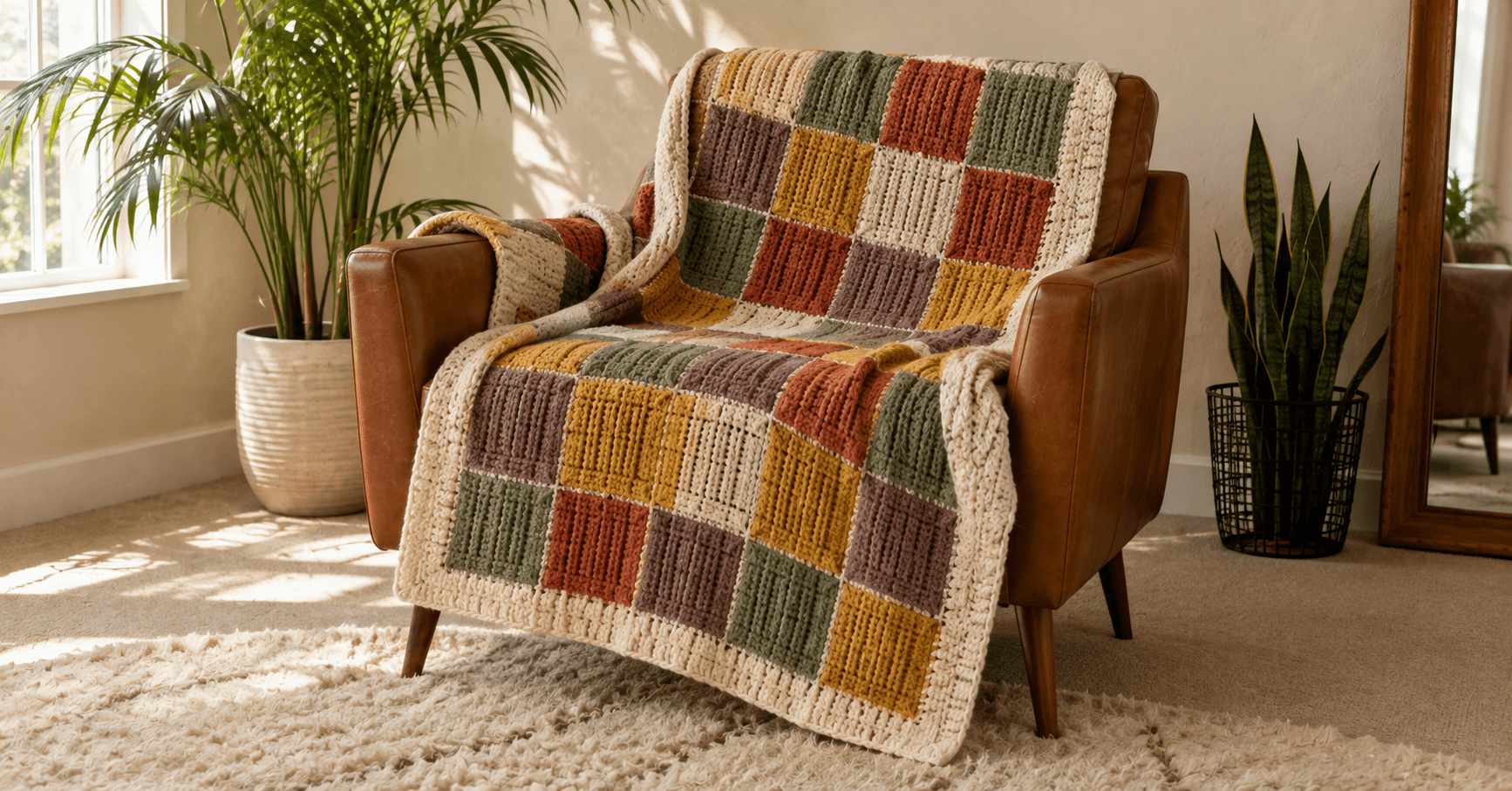
I have a rule about crochet blankets: they should not take three months. This one takes about ten evenings, because it's built from 42 small Tunisian squares you can each finish in twenty minutes, and the joining is invisible. It's the perfect couch project — one square per episode, then you seam them at the end and add a cream border while you catch up on your inbox.
The palette is what I call "grandma's sun porch, but modern" — sage green, warm mustard, deep terracotta, dusty mauve-brown, and creamy oat. Five colors in a patchwork grid, framed by a cream border that keeps the whole thing from feeling busy.
Every square uses Tunisian Simple Stitch (TSS) — the very first Tunisian stitch anyone learns. If you've never done Tunisian crochet, this is the ideal project to learn on, because every square is small enough that you can rip and redo without heartbreak.
Why Tunisian squares instead of granny squares: Tunisian TSS gives you a dense, cozy, woven-look fabric with no holes — a real winter throw, not a lacy summer blanket. It also blocks flat like a dream, which matters when you're joining 42 squares in a grid.
Key takeaways
- Finished size: about 44 × 38 in / 112 × 97 cm with the border — a generous lap throw for the sofa.
- Yarn: ~2,000 yd / 1,850 m of worsted-weight cotton or acrylic (CYC 4) across 5 colors + border.
- Hook: 8 mm Tunisian crochet hook, at least 14 in / 36 cm long (or an interchangeable with cable). A 6 mm regular crochet hook for the cream border.
- Time: 12–16 hours total — about 15 min per square (42 squares), plus 2 hours to join and 2 hours to border.
- Skills required: chain, single crochet, Tunisian Simple Stitch (TSS), standard Tunisian bind-off, whip stitch seam.
- No complicated colour changes. Each square is a single solid color.
What you'll need
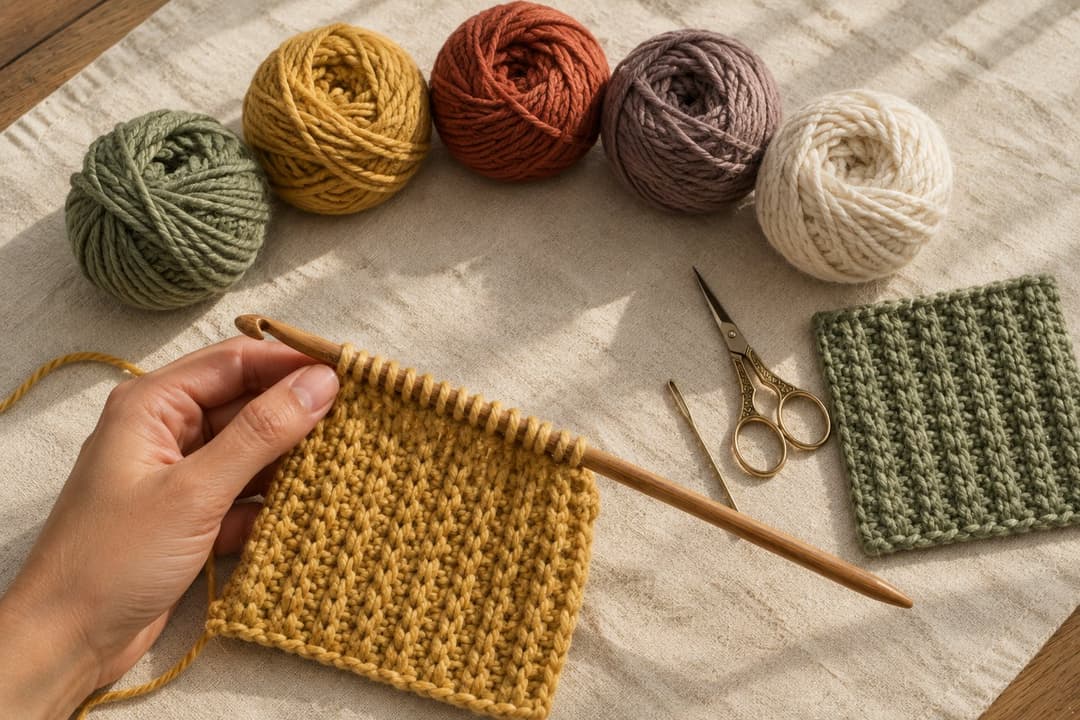
The whole palette in one photo, plus one square mid-Forward-Pass. Each ball is enough for 8 or 9 six-inch squares. The mustard square on the hook shows the classic vertical bar texture of Tunisian Simple Stitch — that's what every square in the blanket will look like.
Yarn (worsted-weight cotton or acrylic, CYC 4)
- Cream / oat, ~500 yd (460 m) — 8 squares + the border.
- Sage green, ~380 yd (350 m) — 8 squares.
- Warm mustard yellow, ~380 yd (350 m) — 8 squares.
- Deep terracotta / rust, ~380 yd (350 m) — 9 squares.
- Dusty mauve / brown, ~380 yd (350 m) — 9 squares.
I used Paintbox Yarns Cotton Aran in Vanilla Cream, Spearmint Green, Mustard Yellow, Rust Orange, and Coffee Brown. Any worsted-weight cotton (Yarn and Colors Must-Have, Ricorumi DK held double) or acrylic (Red Heart Super Saver, Stylecraft Special DK held double) works — just keep all five colors in the same brand and weight so the squares match in size.
Hook
- 8 mm Tunisian crochet hook, at least 14 in / 36 cm long — the barrel needs to hold 30 loops at once.
- 6 mm regular crochet hook for the cream border.
- Cable stopper if using an interchangeable Tunisian set.
Other
- Tapestry needle with a large eye.
- Sharp scissors.
- Stitch markers (optional).
- Optional: a small piece of cardstock to lay out the color grid before you start.
Palette swap: the same pattern in cream + navy + blush + sage + camel is a coastal blanket. In grey + white + mustard + soft pink + charcoal it becomes Scandi. In only two colors (cream + terracotta) alternating in a checkerboard is a 20-square project done in a weekend. The construction is identical.
Abbreviations (US crochet + Tunisian terms)
| Abbr | Meaning |
|---|---|
| st(s) | stitch(es) |
| ch | chain |
| sl st | slip stitch |
| sc | single crochet |
| yo | yarn over |
| TSS | Tunisian Simple Stitch — insert hook under the front vertical bar of the next stitch, yarn over, pull up a loop, keep on hook |
| FwP | Forward Pass — loading loops onto the hook (right to left) |
| RtP | Return Pass — closing off the loops (left to right) |
| ( ) x N | repeat everything in the brackets N times |
| [number] | stitch count at the end of the row |
UK crochet terms note: US sc = UK dc. TSS is the same in both.
Gauge
Not optional for a blanket. Uneven squares = uneven grid = wonky throw.
- With the 8 mm Tunisian hook and TSS: 12 sts × 12 rows = 4 in / 10 cm unstretched, after blocking.
- Each finished square should measure 6 in / 15 cm on every side after wet-blocking.
- If your first square is off by more than ½ inch, adjust hook size — do not just start square #2 and hope. All 42 squares must be the same size or the join won't lie flat.
Blanket composition — what you're going to make
- 42 Tunisian squares, each 18 sts × 18 rows (finished 6 × 6 in).
- Distributed across the 5 colours:
- 8 cream squares
- 8 sage green squares
- 8 mustard squares
- 9 terracotta squares
- 9 mauve-brown squares
- Arranged in a 7-columns × 6-rows grid = 42 squares, about 42 × 36 in before the border.
- Joined with whip-stitched seams in cream, then framed with a wide cream sc border.
Make all 42 squares first, then seam, then border. That's the order I'll walk you through.
Step 1 — One Tunisian TSS square (repeat 42 times)
Every square in the blanket is identical in construction. Only the yarn colour changes.
Foundation: with your chosen colour, ch 18.
Setup Forward Pass (FwP):
- Skip the first ch (it's the edge stitch).
- Insert hook into the back bump of the next ch, yo, pull up a loop. Leave on hook.
- Repeat across every ch. You now have 18 loops on the hook.
Setup Return Pass (RtP):
- yo, pull through 1 loop. [17 loops on hook]
- yo, pull through 2 loops. Repeat until 1 loop remains.
TSS body rows (repeat 17 times):
- FwP: skip the first vertical bar (it counts as the edge stitch). Insert hook under the front vertical bar of the next stitch, yo, pull up a loop, keep on hook. Repeat across every stitch to the end. [18 loops on hook] — for the very last stitch, insert hook under both vertical bars for a clean tight edge.
- RtP: yo, pull through 1 loop. yo, pull through 2 loops. Repeat until 1 loop remains.
After row 18, you have a small square, 18 sts wide × 18 rows tall — 6 in at the gauge above.
Standard Tunisian bind-off:
- Insert hook under the front vertical bar of the next stitch, yo, pull through the stitch AND through the loop on the hook. [1 loop remains]
- Move to the next stitch. Repeat across all 18 stitches.
- Cut yarn (leave a 6-in tail), pull through the last loop, secure.
Fasten off. The square is done. Weave in the two ends (foundation tail + bind-off tail) as you finish each square — do not save them for the end. Trust me on this one.
Repeat 41 more times in the color distribution above.
Why weave in tails as you go? Because 84 loose tails at the end of the project is a nightmare that will make you quit crochet. 20 seconds per square is invisible. Two hours at the end is torture.
Step 2 — Blocking every square
This is the step that transforms "some Tunisian squares" into "a professional-looking throw". Do not skip it.
- Fill a sink with lukewarm water and a splash of wool wash.
- Submerge all 42 squares. Gently squeeze — don't wring.
- Roll a stack of squares in a dry towel to press out the extra water.
- Lay each square flat on a clean towel or blocking mat. Pat and stretch each into a perfect 6 × 6 in square. Use blocking pins if you have them, or heavy books at the corners.
- Let dry for 24 hours.
You'll notice something magical: the squares that came out slightly off-square during crochet all snap into a perfect grid after blocking. This is why every serious Tunisian project involves blocking.
Step 3 — Laying out the color grid
Before you seam anything, lay all 42 squares out on the floor in the 7-columns × 6-rows grid. Move them around until the color distribution feels balanced — no two same-color squares touching diagonally, no clumps of the same tone.
My layout (rows top to bottom, left to right):
- Row 1: cream, sage, mustard, mauve, terracotta, cream, mustard
- Row 2: mauve, terracotta, cream, sage, mustard, terracotta, sage
- Row 3: sage, mustard, mauve, cream, terracotta, mustard, mauve
- Row 4: terracotta, cream, mustard, mauve, sage, cream, terracotta
- Row 5: mustard, mauve, sage, terracotta, cream, mauve, sage
- Row 6: cream, terracotta, mauve, mustard, sage, terracotta, mauve
This gives an even sprinkle where every color appears in every row and no two same-color squares are adjacent (side or diagonal). Take a phone photo of your final layout before seaming — you will forget where a square goes when you pick it up.
Step 4 — Joining the squares
There are three respectable ways to join Tunisian squares. In order of speed:
- Whip stitch with a tapestry needle (my choice — invisible, fast, no extra hook work). Line up two squares right sides together. Using a length of cream yarn and a tapestry needle, whip-stitch through the outermost vertical bars of both squares, one stitch per bar, all the way down. Secure and weave in.
- Slip stitch join (visible ridge, gives a slight embossed look). Line up two squares wrong sides together, single-crochet ridge-join across the seam.
- Zip method (fastest but leaves a slight zigzag). Alternate weaving stitches between the two squares' edge bars.
Order of joining:
- First, join each row horizontally — 7 squares into a strip. Repeat for all 6 rows.
- Then join the 6 strips vertically — line up strip 1's bottom edge with strip 2's top edge, whip-stitch across.
- Check corners: the intersection of 4 squares should meet flat with no puckering. If it puckers, block again with pins on that corner.
The whole join takes about 90 minutes.
Step 5 — The cream border
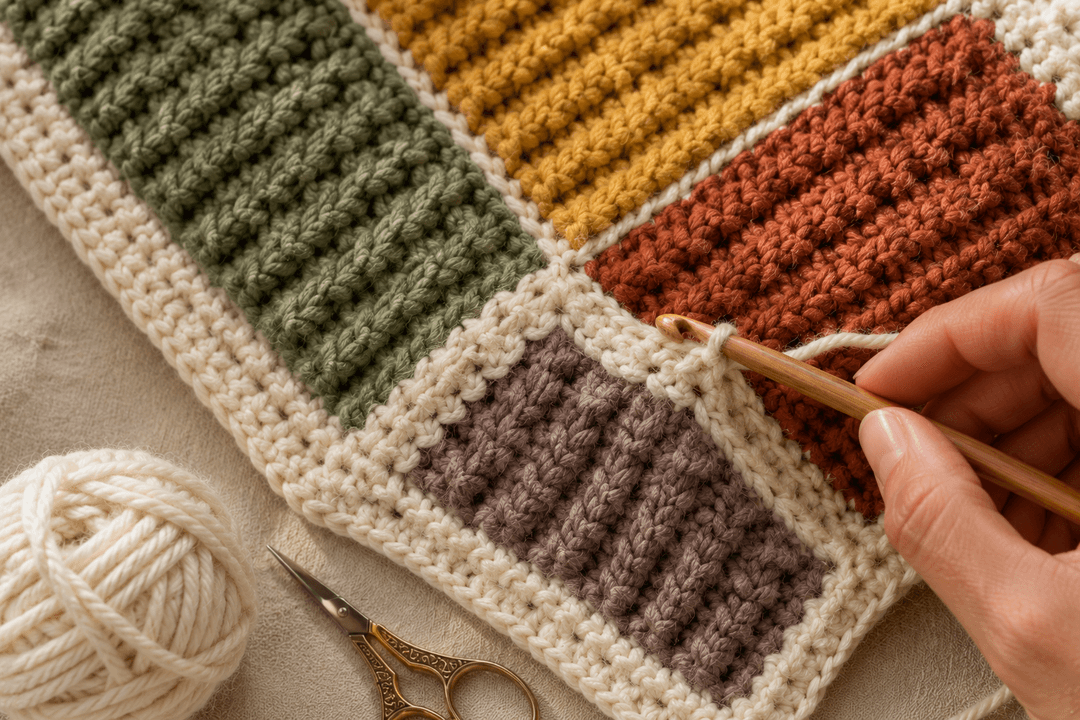
The corner intersection where four squares meet — the moment of truth for any patchwork blanket. If the join lies flat here, the whole blanket will. The cream border works around the entire perimeter and pulls every edge taut, so any small puckering you had after seaming disappears once the border is on.
Switch to the 6 mm regular crochet hook and the cream yarn.
- Attach the cream yarn at any corner with a sl st.
- Round 1 (sc round): sc evenly around the entire perimeter of the blanket. On the top and bottom edges you'll work 1 sc per stitch (7 squares × 18 = 126 sc). On each side edge you'll work 1 sc per row of Tunisian (6 squares × 18 rows = 108 sc). At each corner, work (sc, ch 1, sc) in the corner stitch. Sl st to join.
- Round 2 (sc round): ch 1, sc in every stitch around. In each corner ch-1 space work (sc, ch 1, sc). Sl st to join.
- Round 3 (moss-stitch round): ch 2, hdc in the same stitch. ch 1, skip 1 st, (hdc, ch 1) in the next. Repeat around, adjusting at corners to keep the pattern flowing. Sl st to join.
- Round 4 (sc round): ch 1, sc in every stitch and ch-1 space around. In each corner ch-1 space work (sc, ch 1, sc). Sl st to join.
That gives a wide 4-row cream border that frames the patchwork like a matte around a photo. Weave in every end.
Skill-level scaling
- First Tunisian ever? Make only 20 squares in 2 colors (4 × 5 grid) and skip the border. A 24 × 30 in mini throw in a weekend.
- Baby blanket size (about 27 × 33 in with border): 20 squares (4 × 5 grid). Half the yarn, 6 hours total.
- Large throw (about 50 × 56 in with border): 72 squares (8 × 9 grid). About 70% more yarn.
- Bed-size throw (about 62 × 74 in with border): 120 squares (10 × 12 grid). About three times the yarn — split it across two months.
- Two-color checkerboard: 42 squares in cream + one accent (terracotta or navy), alternating. Reads very modern, half the color-planning work.
FAQ
How long does this blanket actually take? Plan on 12–16 hours. About 15 minutes per square (42 squares = 10 hours), 90 minutes to seam, 90 minutes for the border, plus blocking time (which doesn't count as active hours because you're not doing anything, but adds a day for drying).
Does Tunisian eat more yarn than regular crochet? Yes, roughly 15–20% more, because every stitch effectively has a chain across the return pass. Buy the amounts above (they're already adjusted) — don't scale down a "standard" crochet blanket pattern's yarn.
Cotton or acrylic — which is better for this? Cotton drapes heavier and hangs elegantly off a sofa. Acrylic is lighter, warmer per gram, and easier to machine wash. For a decorative throw, I go cotton. For a well-loved everyday blanket that a toddler will drag around, acrylic.
My squares are different sizes — help. Almost always a gauge issue between squares. Common causes: hook slipped a half-size, one color yarn is subtly thicker than the others, tension changed as you got tired. Fix: block harder — wet-block and pin every square to exactly 6 × 6 in. Blocking can rescue up to 1 cm of gauge drift.
Can I sell finished blankets at markets? Yes — you may sell physical items made from this pattern. Please credit "Pattern by Wavode" on your listing and link back to this page. Reselling or redistributing the pattern text itself (free or paid) is not permitted.
Why not just make 42 granny squares? You can! Granny squares are faster per square (~10 min vs 15). But Tunisian TSS gives a denser, warmer fabric with no holes — more like a real woven throw. Granny squares are lacy and airy. Different vibe, both valid.
My blanket curls after seaming. Individual TSS squares curl a lot (TSS is a stockinette-like fabric). Once seamed together and bordered, curling flattens out because the border pulls all four sides taut. If it still curls after finishing, wet-block the entire blanket flat one more time.
Can I use different Tunisian stitches for different squares? Absolutely — and it looks amazing. Mix TSS (flat plaited), TKS (knit-look V-columns), TPS (purl bumps), and Tunisian Full Stitch (open lacy). Each colour can use a different stitch for a real "sampler" throw. Just check that each variant square blocks to the same 6-in size — different stitches have different gauge.
Keep making
- The Ribbed Wrap Scarf — Free Tunisian Crochet Pattern in Bulky Cream Wool
- The Oversized Cardigan — Free Chunky Crochet Cardigan Pattern
- Diagonal Striped Crochet Blanket — Free Corner-to-Corner Moss Stitch Throw
- More blanket patterns coming Monday, Wednesday, and Friday.
Made this throw? Tag #wavodecrochet on Pinterest — I re-pin every finished make on my board and credit the maker.
Pattern by Clara Hartwell for Wavode.