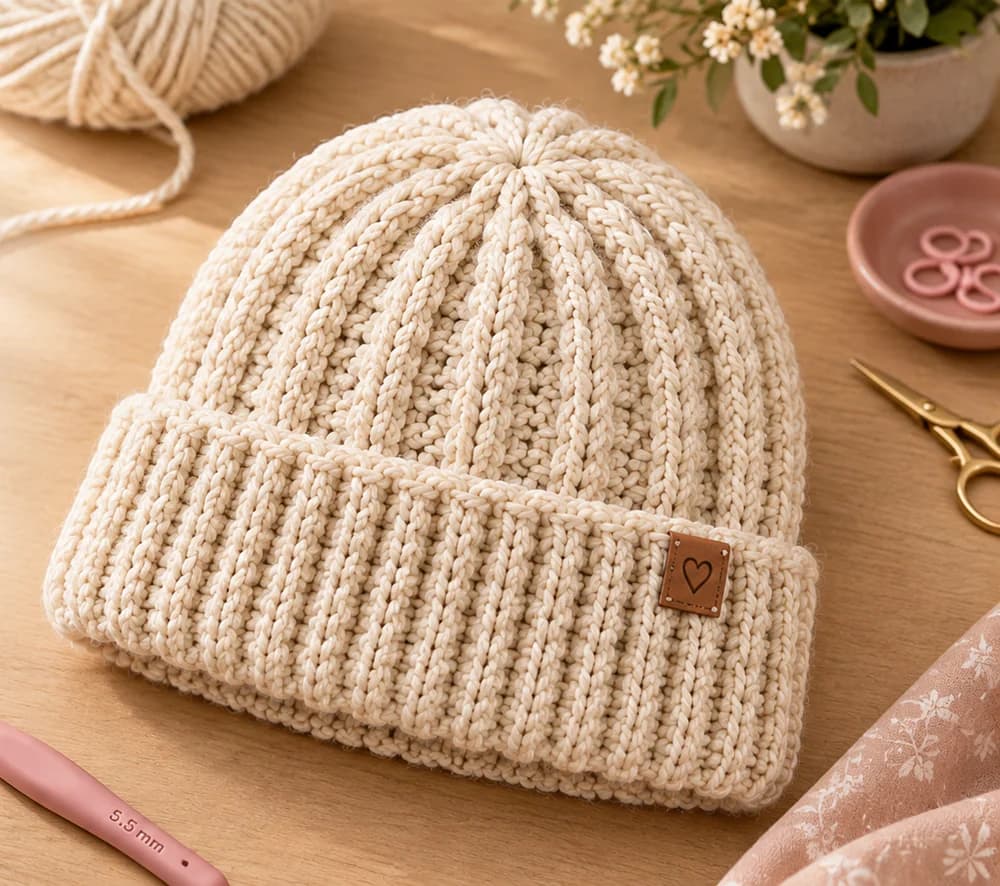
The Ribbed Wrap Scarf

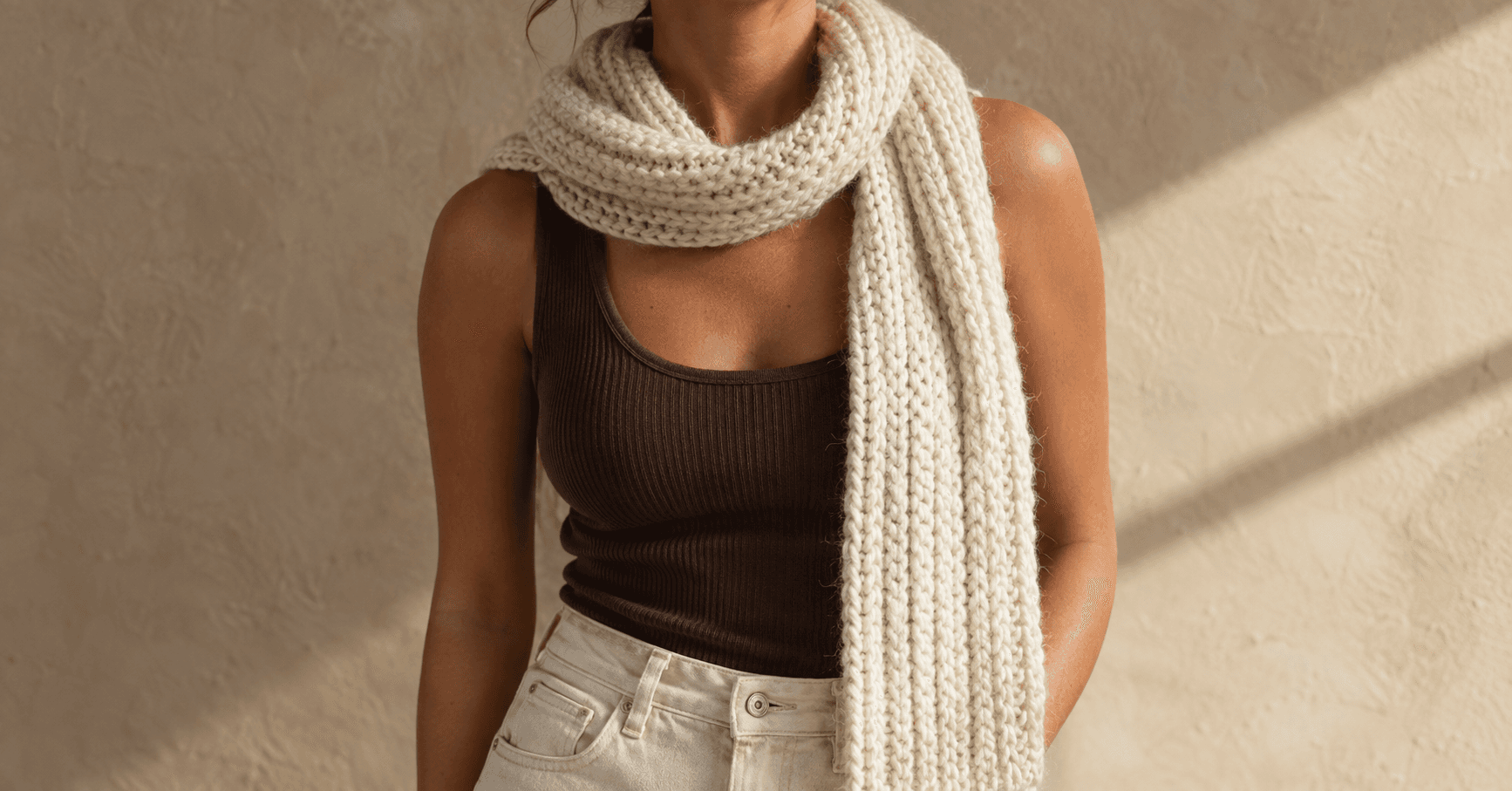
Tunisian crochet is what happens when knitting and crochet have a beautiful baby. You use a long single hook, work all your loops onto it like knitting, and then close them off across a return pass — the fabric that comes out looks and drapes like stockinette but is made with one hook and no needles. It is the perfect first cousin of both crafts.
This ribbed wrap scarf is my go-to Tunisian project when someone new to the technique asks where to start. It's built from two stitches — Tunisian Knit Stitch (TKS) and Tunisian Purl Stitch (TPS) — worked in a 2×2 rib pattern (two knit columns, two purl columns, repeated). The result is a chunky ribbed wrap with satisfying vertical texture that hides every uneven stitch and grows quickly.
It's about 11 inches / 28 cm wide, 60 inches / 152 cm long, cream cotton-blend bulky yarn, and it takes a weekend. No shaping. No decreases. Just rows.
Why Tunisian crochet for a rib scarf: because a "crochet rib" from regular sc-BLO stretches out and looks flat. Real Tunisian TKS + TPS gives you the same vertical V-columns as knit rib — chunky, sculptural, stretchy in both directions — but you never have to touch a knitting needle. It also lays flat with no curling, which is exactly what you want in a scarf.
Key takeaways
- Finished measurements: 60 in / 152 cm long × 11 in / 28 cm wide, drapes as a long neck wrap or a compact shoulder shawl.
- Yarn: ~380 yd / 350 m of bulky (CYC 5) merino or wool-blend in cream. I used 3 skeins of a plush single-ply.
- Hook: 8 mm Tunisian crochet hook, at least 14 in / 36 cm long — or a 40-cm interchangeable set with a flexible cable.
- Time: 6–9 hours — one focused Saturday, or three evenings.
- Skills required: chain, single crochet, Tunisian Knit Stitch (TKS), Tunisian Purl Stitch (TPS), Tunisian standard bind-off.
- No shaping, no colour changes. The whole scarf is one row repeat.
What you'll need
Yarn (bulky merino or wool-blend, CYC 5)
- Cream / undyed natural, ~380 yd (350 m). I used Wool and the Gang Alpachino Merino in Ivory White (3 skeins). Cascade 220 Superwash Bulky, Lion Brand Wool-Ease Thick & Quick, or Malabrigo Chunky all work.
- Tip: Tunisian eats more yarn than regular crochet — the return pass adds a chain to every stitch — so add 10% margin to what a standard crochet scarf pattern would tell you.
Hook
- 8 mm Tunisian crochet hook (US L-11), at least 14 in / 36 cm long. If you don't own one, either buy a fixed-length Tunisian hook (Susan Bates, Clover), or use an interchangeable Tunisian set with a flexible cable (Furls or KnitPro) — the cable version lets you work almost any width because your loops sit on a cable, not on the hook shaft. My favourite for scarves.
- A stopper for the cable end if using an interchangeable — prevents loops sliding off overnight.
Other
- Tapestry needle with a large eye.
- Sharp scissors.
- Two stitch markers — used to mark the transition between knit columns and purl columns on the first row, then removed once your fingers know the pattern.
- Optional: a piece of scrap yarn to baste-mark the halfway point, so you can check progress.
Palette swap: the same pattern in warm oat is Scandinavian minimalism. In deep chocolate brown or camel it becomes autumn boyfriend-wrap. In dusty pink it becomes soft coquette. Or work with two colours — one skein cream, one skein sage — alternating every 10 rows, for a subtle stripe.
Abbreviations (US crochet + Tunisian terms)
| Abbr | Meaning |
|---|---|
| st(s) | stitch(es) |
| ch | chain |
| sl st | slip stitch |
| sc | single crochet |
| yo | yarn over |
| TKS | Tunisian Knit Stitch — insert hook between the two vertical bars of the next stitch, front to back, yarn over, pull through one loop and keep it on the hook |
| TPS | Tunisian Purl Stitch — bring the working yarn to the front, insert hook under the front vertical bar of the next stitch, yarn over, pull through one loop and keep it on the hook |
| FwP | Forward Pass — the row where you put loops onto the hook (working right to left) |
| RtP | Return Pass — closing off the loops (working left to right) |
| ( ) x N | repeat everything in the brackets N times |
| [number] | stitch count at the end of the row |
UK crochet terms note: US sc = UK dc. TKS and TPS are the same names in both.
Gauge
Yes, even for a scarf. If your gauge is off, a "narrow neck scarf" becomes a "chest-band" and you'll wonder why.
- With the 8 mm Tunisian hook, in the 2×2 rib pattern: 10 sts × 8 rows = 4 in / 10 cm (unstretched).
- Tunisian shrinks in width and grows in length compared to knit. If your swatch is significantly off, adjust the hook size — do not rip and just carry on hoping. A quarter-inch of gauge drift over 30 rows becomes 3 inches of finished width.
Scarf composition — what you're going to make
One long rectangle, worked flat, in a single stitch pattern:
- Foundation chain: 28 chains → 28 stitches wide.
- Every row is: edge stitch, (2 TKS, 2 TPS) six times, 2 TKS, edge stitch.
- Total rows: ~120 forward+return pairs, until the scarf measures 60 in / 152 cm from the foundation to the last row.
- Bind-off: standard Tunisian bind-off across all 28 stitches.
That's the entire pattern. The magic is in the fabric that comes out of it.
Step 1 — Foundation chain and the setup row
The setup row is the only fiddly part of a Tunisian project. Once past it, everything is comfortable rhythm.
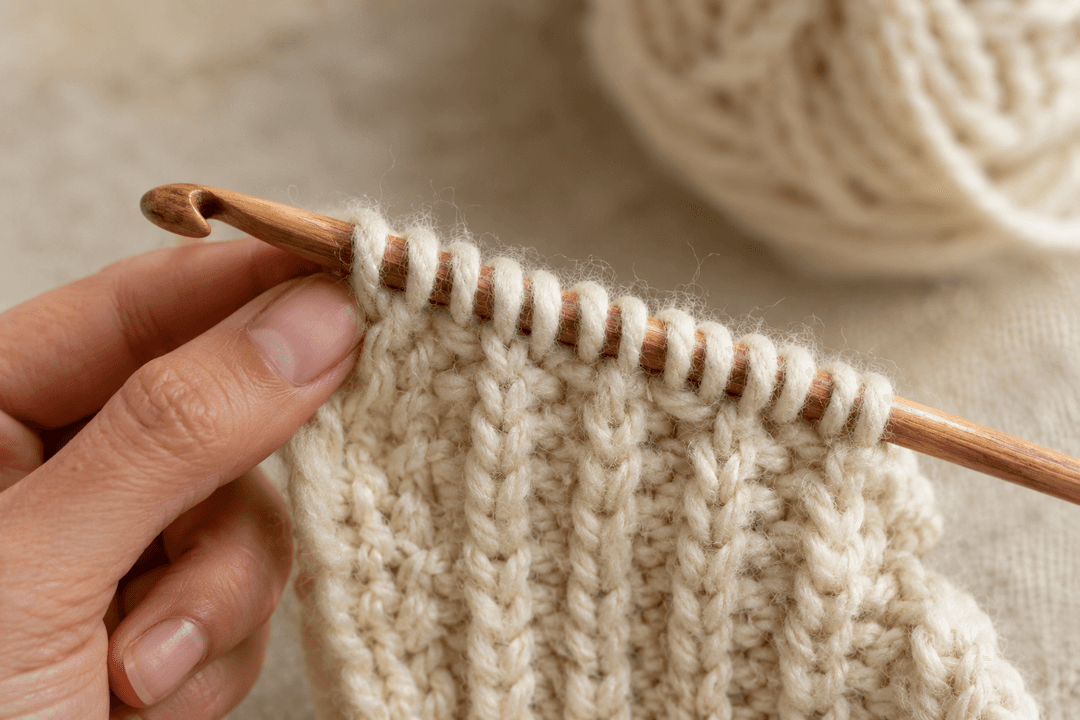
This is the moment that makes Tunisian, Tunisian. Every loop of the current row sits on the long hook barrel, waiting for the return pass to close them all off. Below the hook you can already see the 2×2 rib beginning to form — pairs of V-columns alternating with soft ribbed valleys.
Foundation: ch 28.
Setup Forward Pass (FwP):
Working from right to left, loading loops onto the hook:
- Skip the first ch (it counts as your edge stitch).
- Insert hook into the back bump of the next ch. Yarn over. Pull up a loop. Leave that loop on the hook.
- Repeat across every ch to the end. You now have 28 loops on the hook.
Setup Return Pass (RtP):
Working from left to right, closing off the loops:
- Yarn over. Pull through the first loop only. [27 loops remain on hook]
- Yarn over. Pull through 2 loops. Repeat from * across until only 1 loop remains.
You're back to a single loop on your hook and a base row of standard Tunisian stitches. This is your foundation. Time to start the rib pattern.
Step 2 — The 2×2 rib row (the whole scarf)
Every row of the body of the scarf is identical. Learn it once, then work it 119 times.
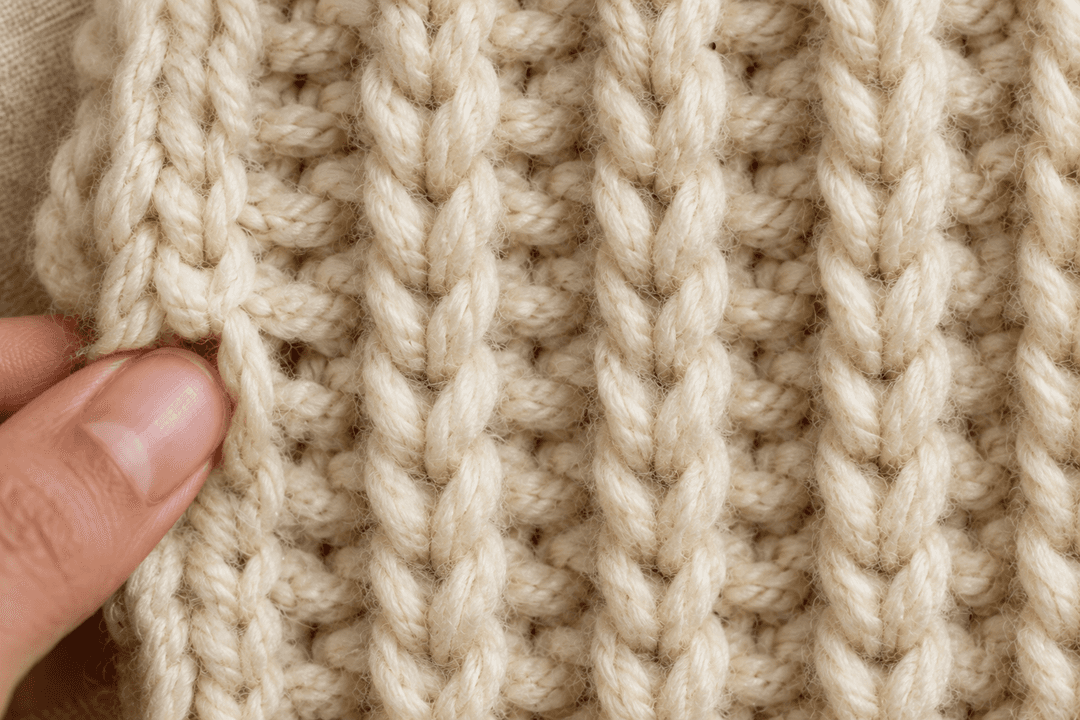
The 2×2 rib in close-up. Two knit-look V-columns rise up, then two purl valleys recede, over and over across every row. This is exactly why Tunisian rib is a joy to photograph and to wear — the texture is deep enough to catch side light and shadow like real knit rib.
Rib Forward Pass:
The loop already on your hook is stitch 1 (the edge stitch), so you never work into the first vertical bar.
- TKS in stitches 2 and 3 (insert hook between the two vertical bars, yarn over, pull up a loop, keep on hook).
- TPS in stitches 4 and 5 (bring yarn to the front, insert hook under the front vertical bar only, yarn over, pull up a loop, keep on hook — move the yarn back to the back before the next TKS).
- Repeat (2 TKS, 2 TPS) until you have worked stitch 25 — six repeats in total.
- TKS in stitches 26 and 27.
- Stitch 28 (the last edge stitch): insert hook under both vertical bars for a clean tight edge.
You now have 28 loops on the hook.
Rib Return Pass:
Identical to the setup return pass — the return pass doesn't care about knit or purl, only about closing loops:
- Yarn over. Pull through 1 loop.
- Yarn over. Pull through 2 loops. Repeat until 1 loop remains.
That's one row of the scarf. Do this 119 more times (or until the scarf reaches 60 in / 152 cm).
First time doing TKS + TPS in the same row? The tricky bit is that TKS wants the yarn at the back of the work and TPS wants the yarn at the front. So every time you switch from TKS to TPS, bring the yarn under the hook to the front. Every time you switch from TPS to TKS, take the yarn back under the hook to the back. After 20 rows this is automatic. Trust me.
Step 3 — Watching the scarf grow
Around row 20, the 2×2 columns become visible. Around row 40, the fabric starts to feel like a proper wrap. Around row 80, you'll want to try it around your neck to check the length preference.
- Roughly every 10 rows, lay the scarf flat and measure. Cream yarn stretches slightly under its own weight, so measure without pulling.
- If you want a compact neck scarf, stop at 50 in / 127 cm.
- For a standard wrap (what this pattern targets), 60 in / 152 cm.
- For a long blanket scarf you can double-loop around the neck, keep going to 75 in / 190 cm — you'll need a fourth skein.
Step 4 — Standard Tunisian bind-off
The last row locks all the stitches so the scarf doesn't unravel. It also creates a top edge that mirrors the bottom foundation, so the scarf looks the same at both ends.
Work one final row (Forward + Return) as normal, then instead of a plain Return Pass:
- Bind-off across the top of the loops:
- Insert your hook into the next stitch (as you would for TKS if it was a knit column, or TPS if it was a purl column — follow the rib pattern).
- Yarn over. Pull through the stitch AND through the loop already on the hook. [1 loop remains]
- Move to the next stitch. Repeat.
- Continue across all 28 stitches.
- After the last stitch, cut the yarn (leave a 6-in tail), pull through the last loop, and secure.
The bound-off edge should look identical to your foundation edge, with the same 2×2 rib pattern. If it's tighter than the bottom (very common for a first Tunisian), go up one hook size just for the bind-off row.
Skill-level scaling
- First Tunisian ever? Make a narrower "practice cowl" — cast on only 20 sts (about 8 in wide) and work 30 rows. It's a wrist warmer / mini cowl and gets you fluent in TKS+TPS in an hour.
- 1×1 rib instead of 2×2: cast on 28 sts, alternate (1 TKS, 1 TPS) across every row. Finer texture, subtly different look, same construction.
- Wider shawl / lap blanket: cast on 56 sts, work 60 rows. About 22 in wide × 30 in long. Double the yarn.
- Two-tone stripe scarf: work 10 rows cream, 10 rows sage, 10 rows cream — repeat. Change colour at the start of a Forward Pass. Weave in every colour-change tail as you go, don't leave them for the end.
- Fringe finish: add 20 fringe tassels along each short end. Cut 40 strands of yarn 12 in long, fold each in half, loop through the edge stitches with a crochet hook, tie a lark's head knot. Trim to length.
FAQ
How long does this scarf actually take? Plan on 6–9 hours. Once past the setup row, each Forward + Return row pair takes me about 3 minutes at cruising speed. 120 rows × 3 min = about 6 hours of hook time, plus another 90 minutes for the setup, weaving in and blocking.
Does Tunisian rib really look like knit rib? From two meters away — nearly identical. The V-columns of TKS look exactly like the V-columns of knit stockinette, and TPS gives the same horizontal bumps as knit purl. Up close a Tunisian expert can tell it's not knit (the loops are slightly asymmetric), but non-crafters cannot tell. Which is the whole point.
My scarf curls at the edges — help. Tunisian curl is real: TKS alone curls badly because it's essentially stockinette. The 2×2 rib in this pattern is the fix — the alternating knit-purl columns balance the fabric so it lays flat. If yours still curls, block it (wet-block, pin flat, dry).
How do I block a Tunisian scarf? Wet-block. Fill a sink with lukewarm water and a splash of wool wash, submerge, gently squeeze out the water (do not wring), roll in a towel to press out more water, then lay the scarf flat on a clean towel. Pin the four corners so the scarf stretches to your target size (this is your chance to stretch a "too short" scarf by 5%). Let dry for 24–48 hours. This one step turns a Tunisian project from "kinda lumpy" to "professional".
Can I sell finished scarves at markets? Yes — you may sell physical items made from this pattern. Please credit "Pattern by Wavode" on your listing and link back to this page. Reselling or redistributing the pattern text itself (free or paid) is not permitted.
My yarn keeps splitting on the Tunisian hook. Bulky merino has long fibers that catch on a rough hook. Use a tapered hook head (Furls Streamline or a Clover Amour Tunisian) and slow down slightly on the return pass. If the yarn is single-ply and very splitty, dampen your hook barrel with a whisper of hand cream — it slides through the loops without dragging.
Can I do this pattern in acrylic yarn? You can — Lion Brand Wool-Ease Thick & Quick is a good acrylic-blend swap. Pure acrylic bulky feels a bit stiffer than merino, and the drape is less soft, but the rib pattern still looks beautiful. Go down half a hook size (7.5 mm) to compensate for acrylic's tendency to loosen.
What's the difference between TKS, TPS, and TSS (Tunisian Simple Stitch)? TSS puts your hook under only the front vertical bar of the previous row — makes a flat plaited fabric. TKS goes between both vertical bars — makes a knit-look V-column fabric. TPS pushes the working yarn to the front and hooks under only the front bar — makes a bumpy purl-look column. This pattern uses only TKS and TPS.
Keep making
- The Oversized Cardigan — Free Chunky Crochet Cardigan Pattern
- Crochet Lily Bouquet — Free Pattern for a Purple & Pink Lily Arrangement
- More wearables patterns coming Monday, Wednesday, and Friday.
Made this scarf? Tag #wavodecrochet on Pinterest — I re-pin every finished make on my board and credit the maker.
Pattern by Clara Hartwell for Wavode.