Crochet Coneflower Keychain

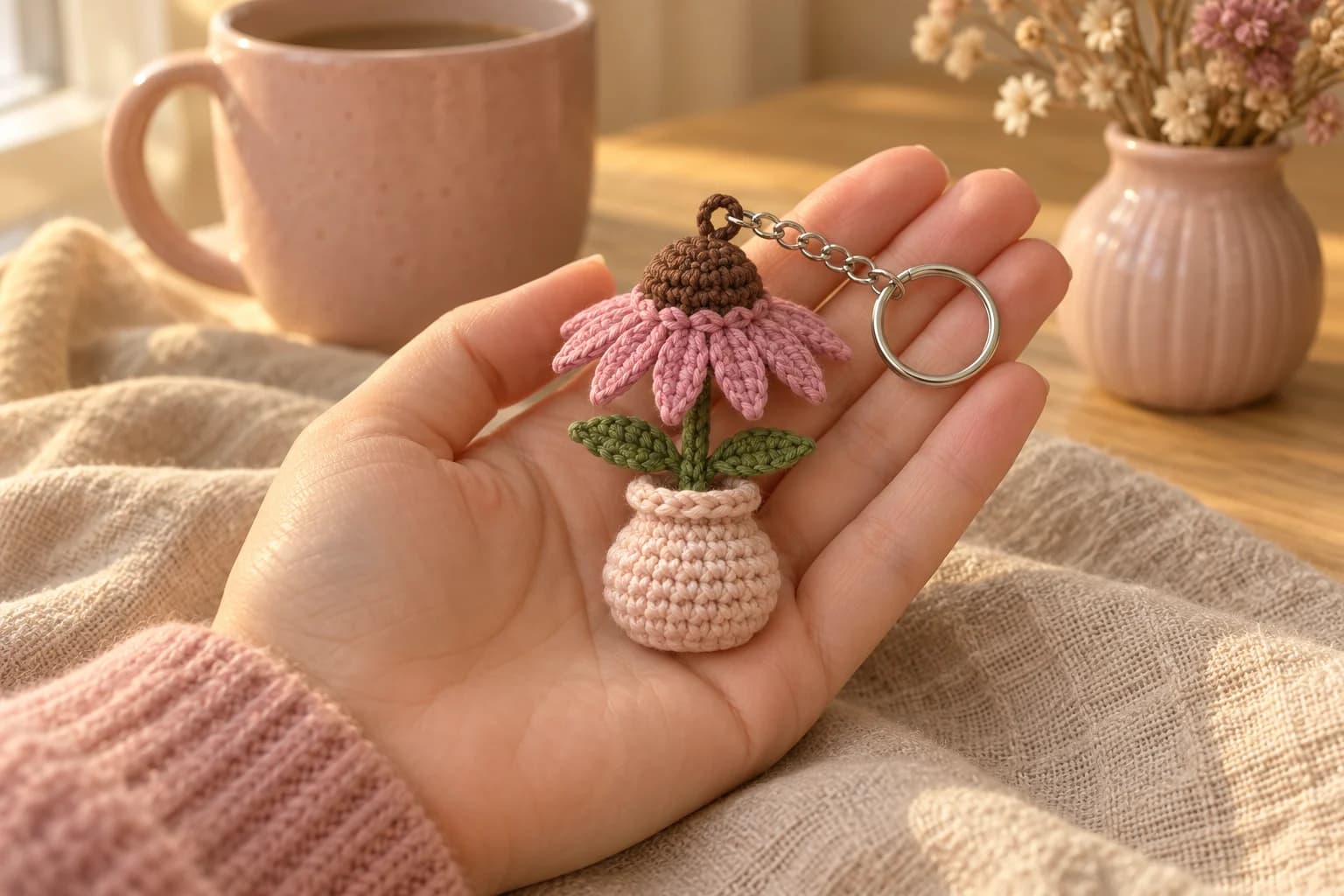
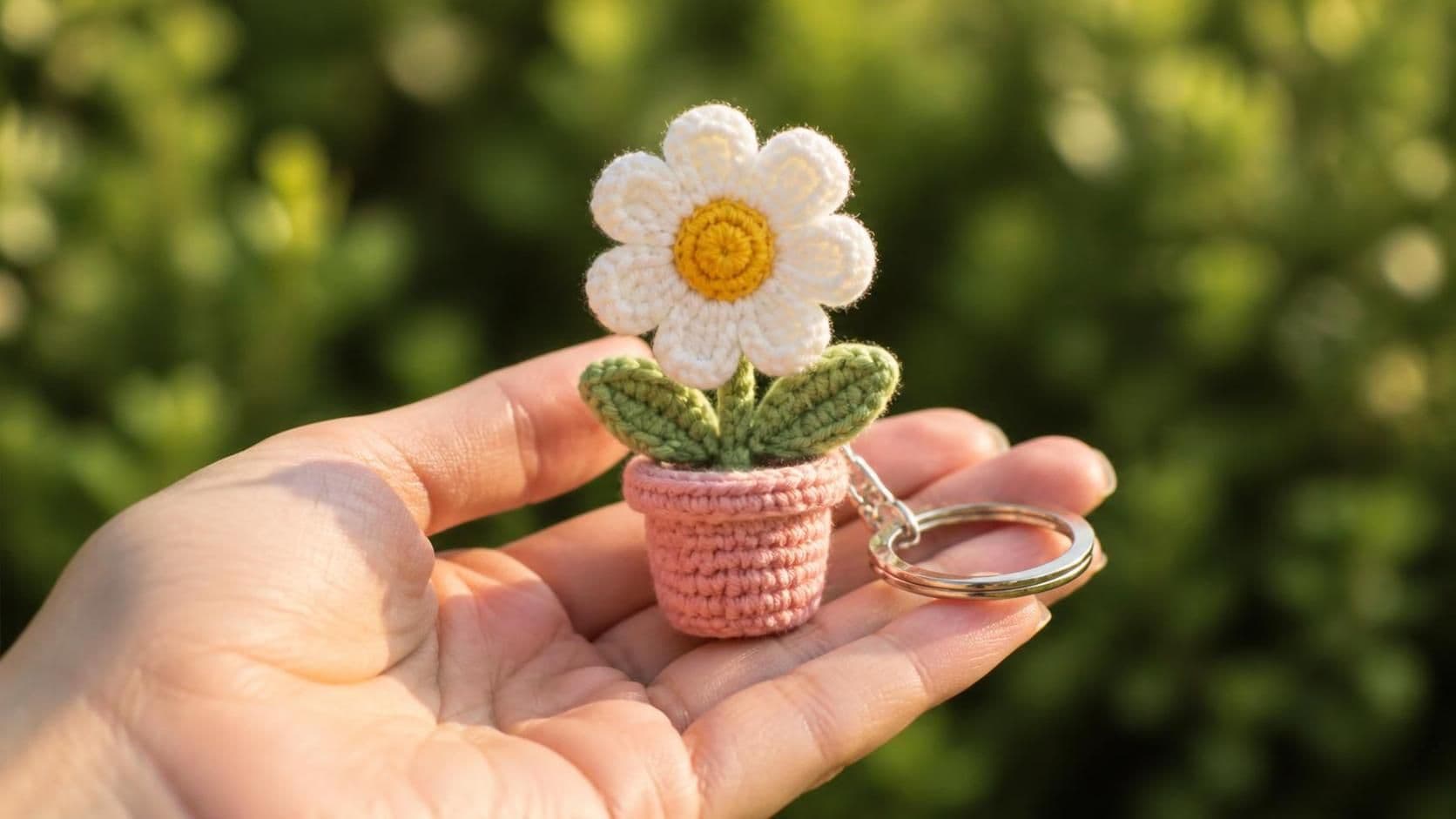
Coneflowers are the ones that look like they're wearing a little hat. This keychain is one coneflower in a tiny round vase: a tall brown dome, twelve long dusty pink petals that droop like the real thing, a green stem with four leaves and a blush vase with a twisted rope edge. It hangs from the top of the dome, so the vase dangles underneath like a little pendulum.
The trick is hidden. A mini flower in a pot usually hangs by its seams, and after a few weeks on a bag the flower starts to lean away from the vase. Here a doubled cord runs from the key loop straight down through the dome, the stem and the vase, and it's anchored at the bottom. The seams just hold the shape; the cord carries the weight.
| At a glance | |
|---|---|
| Finished size | about 3¾ in (9.5 cm) tall, 2½ in (6.5 cm) across the flower |
| Yarn | DK #3 cotton in chocolate brown, dusty pink, blush and green |
| Hook | 2.5 mm |
| Pieces | 9 |
| Time | about 2 hours |
| Skill | easy: magic ring, sc, hdc, dc, back loops, reverse sc for the rim |
Why the flower hangs on a hidden cord
A keychain gets yanked out of pockets, swung, dropped and pulled by the flower. The flower is the obvious thing to grab, and the vase is the heavy part. If the only thing between them is a whipstitched seam, that seam stretches first.
So I give it a spine. The key loop is a short brown chain with a long tail at each end. Both tails go into the top of the dome, down through the middle of the flower and the stem, through the soil, and all the way down to the base of the vase, where they're stitched in. When you pull on the ring, you're pulling on that cord, not on the seams. It takes five extra minutes, and it's the reason the flower still sits straight on top of the vase months later.
You'll need
- Yarn: DK #3 cotton. I like Paintbox Yarns Cotton DK, which keeps crisp stitches at this size. By my estimate from the stitch count, with tails: about 8 yd of chocolate brown, 8 yd of dusty pink, 11 yd of blush and 5 yd of green. Scraps are perfect for this one.
- Hook: 2.5 mm, small for DK on purpose, so the vase is firm and the stuffing doesn't show.
- Keychain: a split key ring with a short chain and an open jump ring of about 7 mm, plus two pairs of flat pliers.
- Small things: a pinch of fiberfill, 2 stitch markers, sewing pins, a tapestry needle and scissors.
Tension. Aim for about 6 sc per inch (2.5 cm), with rounds about as tall as the stitches are wide. At that tension the vase comes out about 1¼ in (3.2 cm) wide and 1½ in (3.8 cm) tall, the flower about 2½ in (6.5 cm) across, and the whole keychain about 3¾ in (9.5 cm) from the base of the vase to the top of the loop. Those sizes are estimates from the counts, so measure yours.
Stitches (US terms): magic ring (MR), chain (ch), slip stitch (sl st), single crochet (sc), half double crochet (hdc), double crochet (dc), increase (inc, 2 sc in the same st), decrease (dec, sc 2 together), back loop only (BLO), reverse single crochet (reverse sc, also called crab stitch: sc worked from left to right). Every round is a continuous spiral unless I say otherwise: don't join, and move your marker up at the start of each round. The number in parentheses is the stitch count.
Making the flower: dome, petals and stem
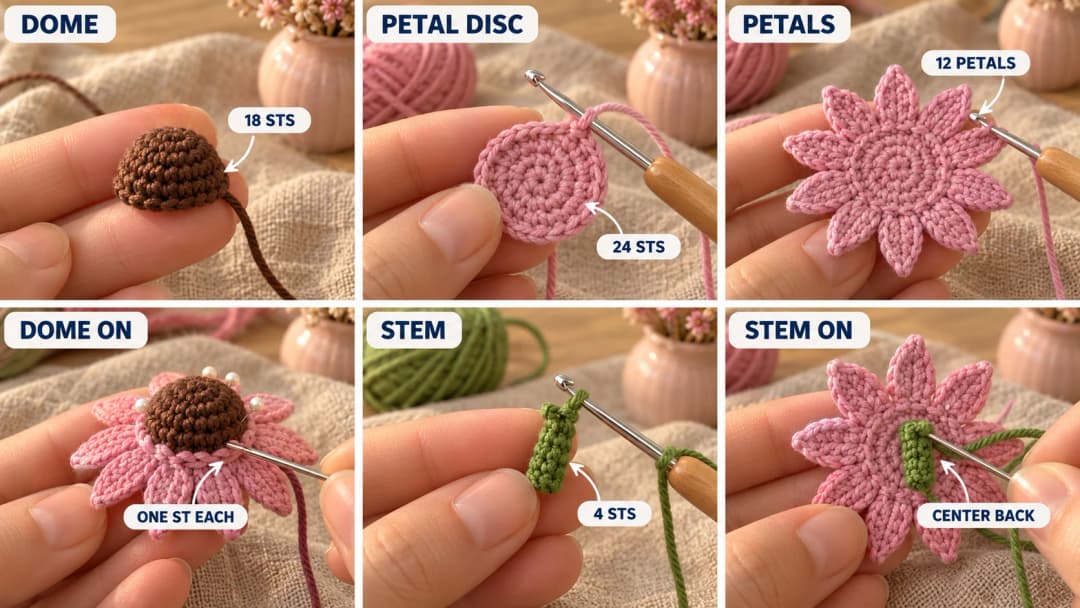
Dome (chocolate brown, Make 1). The magic ring is the very top of the coneflower, where the key loop goes in.
- R1: MR, 6 sc in the ring. (6)
- R2: inc × 6. (12)
- R3: (sc, inc) × 6. (18)
- R4–R6: sc around. (18) 3 rounds: the edges curl down into a tall dome.
Sl st in the next st and fasten off, leaving a 12 in (30 cm) tail. Don't stuff it yet.
Petal disc (dusty pink, Make 1). Worked flat in the round, then the petals go around the edge in one last round.
- R1: MR, 6 sc in the ring. (6)
- R2: inc × 6. (12)
- R3: (sc, inc) × 6. (18)
- R4: (sc 2, inc) × 6. (24)
- R5: (sl st in the next st, ch 5, sc in the 2nd ch from the hook, hdc in the next ch, dc in each of the last 2 ch, sl st in the next st) × 12. (12 petals)
Each petal starts and ends with a sl st in the edge, so it uses 2 sts of R4: 12 petals use all 24. The dc ends up at the base of the petal and the sc at the tip, so each petal is wide at the flower and pointed at the end. Fasten off and weave in the end on the back.
Bend the petals down. Real coneflower petals droop away from the cone. Once the dome is on, push each petal gently downward with your thumb, close to its base. If they spring back, hold a steaming iron just above them (never touching) for a few seconds and hold them in place until they cool. That's optional: flat petals look lovely too.
Tip. If the petals cup up instead of lying flat, R4 is too tight. Go up half a hook size for R4 only, or add a tiny bit of slack in each ch 5.
Stem (green, Make 1).
- R1: MR, 4 sc in the ring. (4)
- R2–R5: sc around. (4) A thin tube, about ¾ in (2 cm) long.
Fasten off, leaving an 8 in (20 cm) tail. Don't stuff it: the cord will run through the middle.
Put the flower together. Push a small pinch of fiberfill into the dome. Center it on the right side of the petal disc and pin it with its last round, R6, sitting on R3 of the disc: both have 18 sts. With the brown tail, whipstitch them together, one stitch in each of the 18 sts. A ring of plain pink R4 shows between the dome and the petals, like the base of a real coneflower. Turn the flower over and sew the magic ring end of the stem to the center back of the disc with the green tail, 4 small stitches around it. Keep the rest of that tail.
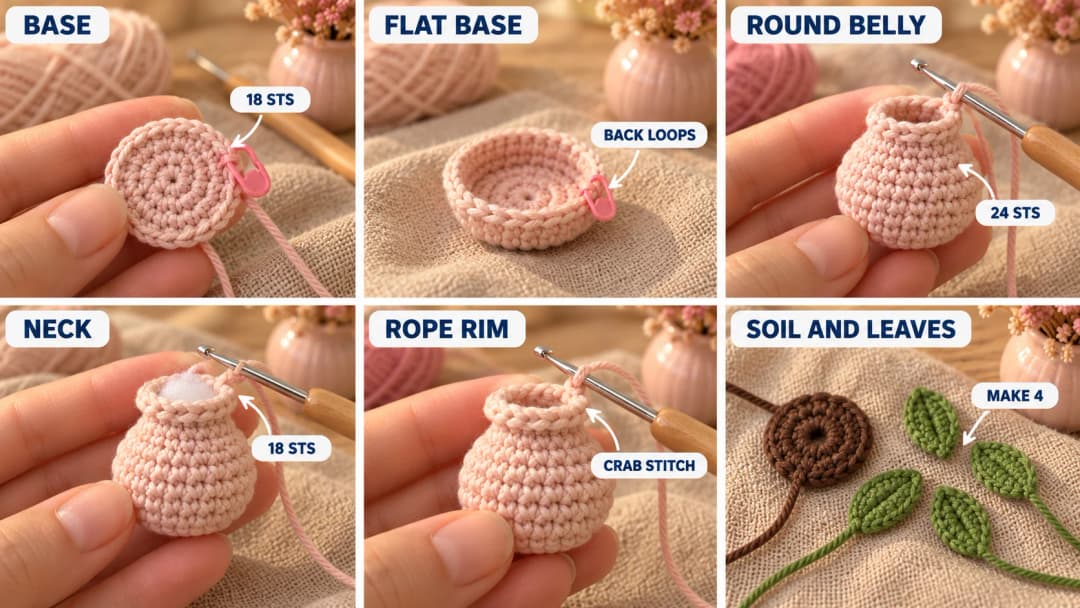
The round vase with a rope rim
Vase (blush, Make 1). The magic ring is the middle of the base, so the vase stands flat.
- R1: MR, 6 sc in the ring. (6)
- R2: inc × 6. (12)
- R3: (sc, inc) × 6. (18)
- R4: in BLO, sc around. (18) The edge turns up sharply into a flat base.
- R5: (sc 2, inc) × 6. (24) The vase rounds out.
- R6–R9: sc around. (24) 4 rounds: the round belly.
- R10: (sc 2, dec) × 6. (18) The neck.
- R11: sc around. (18)
Stuff the vase now, firmly, right up to the neck, and press the base flat on the table. Then work the rim:
- R12: reverse sc in each st around. (18) The rope rim.
To work the rim, don't turn. Insert the hook in the st to the right of your hook (left if you crochet left-handed), yarn over, pull through, yarn over and pull through both loops. Keep moving backward around the neck. The stitches twist into a little rope. Sl st in the first reverse sc and fasten off, leaving an 8 in (20 cm) tail, and weave it into the inside of the neck.
Soil (chocolate brown, Make 1).
- R1: MR, 6 sc in the ring. (6)
- R2: inc × 6. (12)
- R3: (sc, inc) × 6. (18)
Sl st in the next st and fasten off, leaving a 12 in (30 cm) tail. Pull the ring closed, but keep the little hole in the middle: the cord goes through it. The soil has 18 sts, the same as R11 of the vase, so it fits the neck exactly.
Leaves (green, Make 4). Ch 6.
- R1: sc in the 2nd ch from the hook, hdc in the next ch, dc in the next ch, hdc in the next ch, (sc, ch 2, sc) in the last ch, then along the other side of the chain, hdc in the next ch, dc in the next ch, hdc in the next ch and sc in the last ch. (10)
Sl st in the first sc and fasten off, leaving an 8 in (20 cm) tail. The ch 2 is the pointed tip; the end with the long tail is the base of the leaf, the end you'll sew. Weave the short starting tail into the tip.
Running the cord and planting the flower
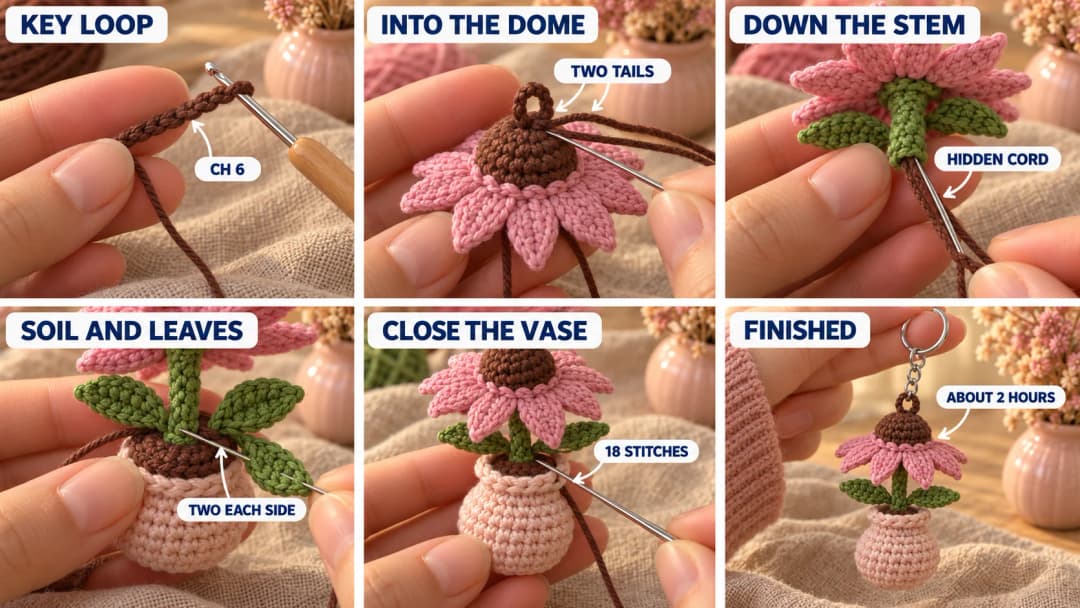
This is the part that makes it last. Work in this order: the soil goes in last, after the cord is anchored.
- Key loop. With brown, leave a 20 in (50 cm) starting tail, ch 6 and fasten off, leaving a second 20 in (50 cm) tail. Don't join it into a ring.
- Into the dome. Thread one tail onto the needle and push it into the top of the dome between R1 and R2, just left of the magic ring. Do the same with the other tail just right of the ring. Pull until the loop stands about ⅓ in (0.8 cm) above the dome.
- Down the stem. Thread both tails together onto the needle. Push it straight down through the stuffing of the dome, through the center of the petal disc, and down the middle of the stem tube, and bring it out through the open end of the stem.
- Through the soil. Push the needle through the hole in the center of the soil disc, from the top. Slide the soil up until it touches the end of the stem. With the green stem tail, sew the open end of the stem to the soil, 4 small stitches, one per stem st.
- Leaves. Pin the 4 leaves around the bottom of the stem, bases against the stem just above the soil, two on each side, tips pointing out and up over the rim. Sew each base with 3 small stitches through the stem and the soil, then hide the tails underneath the soil.
- Down to the base. Push the needle with both cord tails down through the stuffing of the vase and out through the center of the base. Hold the flower straight over the vase, with the soil resting on the neck, and pull the cord until it's just taut: the dome, stem and soil should sit snug in a line, without puckering. Take 3 small stitches through R2 of the base, crossing the center, knot the two tails firmly, and hide the end inside the vase.
- Close the vase. With the soil's brown tail, whipstitch the edge of the soil to R11 of the vase, just inside the rope rim, one stitch in each of the 18 sts. Hide the end.
Tip. Don't pull the cord tight enough to squash the dome. Taut means the flower can't tip, not that it's pressed down. If the dome dents, let a little cord back through the base before you take the 3 anchoring stitches.
Hold it up by the brown loop: the flower should stay on top of the vase, upright, and the vase should hang straight below it.
Adding the ring so it hangs upright
A key ring with a chain usually ends in a small jump ring. Open it sideways with the pliers, twisting one end toward you and the other away (never pull the ends apart), slip it through the brown loop at the top of the dome, and twist it closed until the ends meet with no gap.
Because the loop is anchored at the base of the vase, the coneflower hangs face up, with the petals spread out around the dome and the vase underneath, just like in my palm.
Safety. This keychain has a metal key ring, so it isn't a toy for children under 3.
A little row of three
The same pattern makes a cheerful set. I like one in the blush vase, one with a sage green vase and one with a cream vase, all with the same pink petals, hung together on a bag. For a different flower, keep the dome brown and swap the petals for mauve or soft orange: coneflowers come in both.
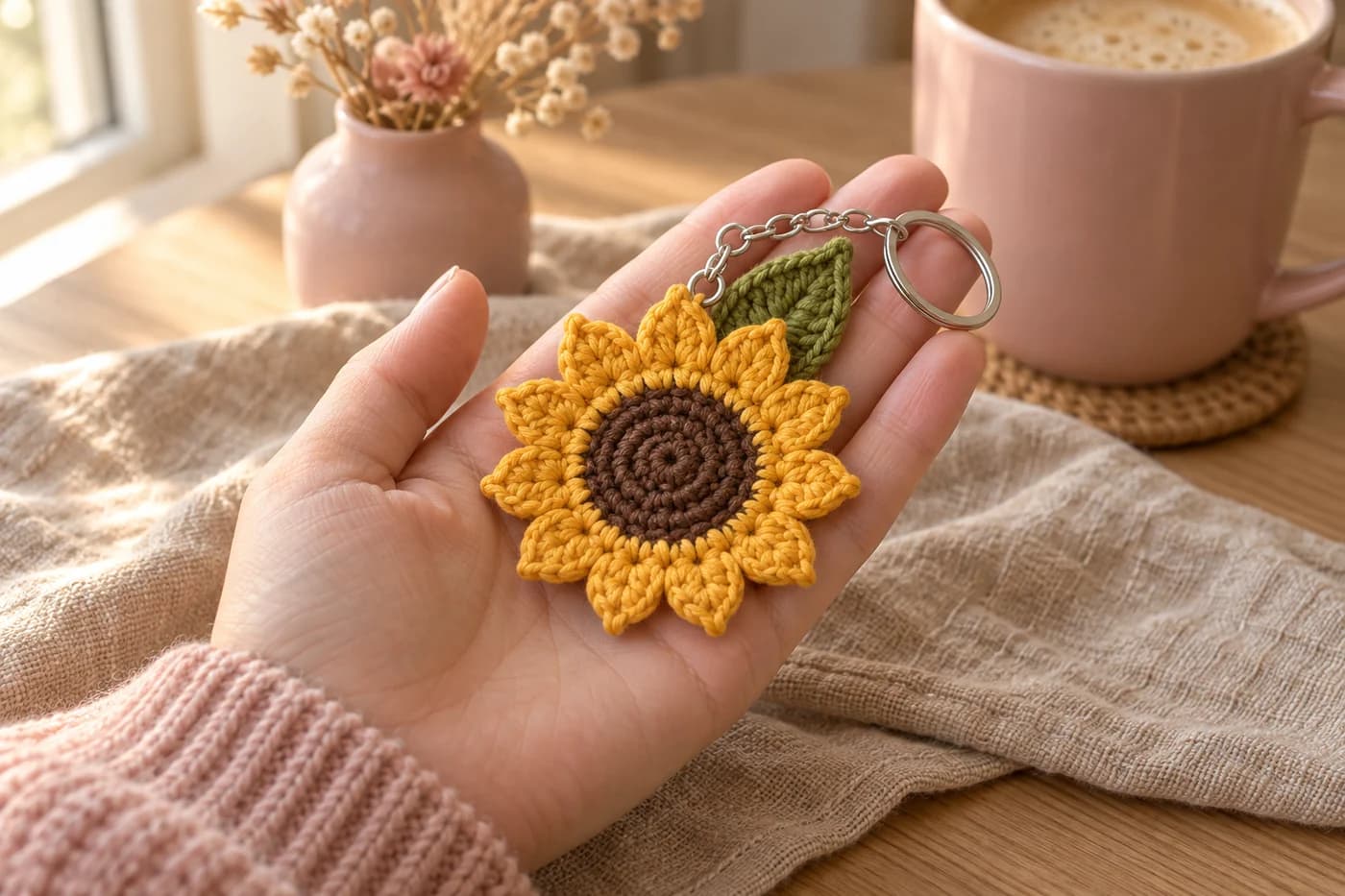
They're the kind of gift you can make the evening before, and they fit in a birthday card envelope with room to spare. If you'd like a flat flower for the same key ring, my sunflower keychain takes about an hour.
Made a little coneflower? Tag #wavodecrochet on Pinterest so I can see it.
Pattern by Clara Hartwell for Wavode. Questions? Email me at support@wavode.com.