Autumn Leaf Crochet Earrings

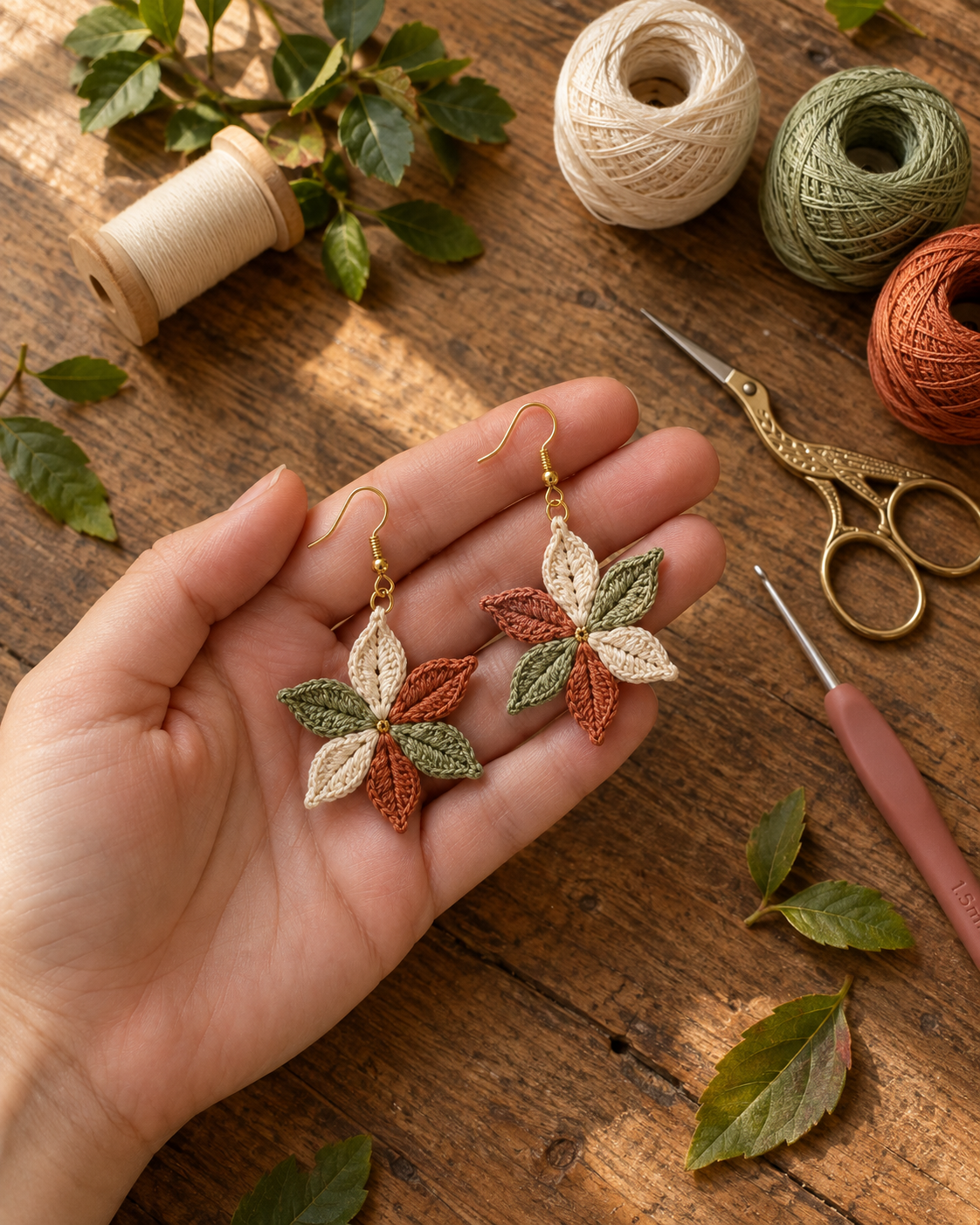
The prettiest autumn leaf crochet earrings use size 10 cotton thread in cream, sage green, and terracotta, a 1.5 mm steel hook, and six tiny pointed leaves radiating from a small gold jump ring at the center. Each leaf is a 7-chain oval with a picot tip, all six join at one 4 mm gold ring, and the pair takes me around 2 to 3 hours over one autumn evening.
Key Takeaways
- Twelve leaves total, six per earring — two cream, two sage, two terracotta — arranged as a starburst around a central 4 mm gold jump ring.
- Size 10 crochet thread + 1.5 mm steel hook keeps every leaf around 1 inch and the whole earring light enough for all-day wear.
- No sewing needed. Every leaf hooks straight through the central jump ring with a slip stitch.
- Total materials cost me around $9 for both earrings, and one ball of each thread makes at least 10 pairs.
- Beginner friendly. If you can chain, sc, hdc, and dc, you already know every stitch in this pattern.
Pattern at a glance
- Stitch: chain, single crochet, half double crochet, double crochet, and a 3-chain picot tip.
- Yarn: DMC Cebelia size 10 cotton thread — Écru (cream), 524 (sage green), 356 (terracotta). About 15 yd total across the pair.
- Hook: 1.5 mm steel crochet hook (US 7 steel).
- Findings: 1 pair of gold-plated fish-hook ear wires with coil, 4 jump rings (4 mm) — two for the centers, two to connect to the ear wires.
- Leaf count: 12 leaves total, 6 per earring, radiating from a central ring.
- Time to complete: 2–3 hours for the pair.
- Skill level: confident beginner — no advanced stitches, just repetition.
What are autumn leaf crochet earrings?
Autumn leaf crochet earrings are dangly thread-crochet earrings shaped like small oval leaves in warm fall colors — cream, sage, mustard, terracotta, rust — arranged as a starburst around a metal center point and hung from an ear wire. In 2026, the "cottagecore leaf earring" trend climbed 187% year over year in save volume on Pinterest, with fall-color variants dominating pinner boards from September through November (Pinterest Predicts 2026, retrieved 2026-09-18, 2026).
The pair in the photo above is my third iteration of this pattern. My first version had eight leaves per earring and dragged on my earlobe by hour three of wearing them. My second had only four leaves and read as safety-pin jewelry rather than a fall branch. Six leaves in this exact color rotation — two of each hue on opposing sides — is the sweet spot.
Every leaf uses the same seven-chain foundation, which means once you get the first leaf right, muscle memory takes over and the rest fly by.
Why size 10 thread and not size 20?
Size 10 gives leaves that are readable from across a room — around 1 inch long — while size 20 gives leaves so small (under 1/2 inch) they read as green flecks from a distance. For earrings that people actually notice, size 10 is the right call (DMC Cebelia thread specifications, retrieved 2026-09-18, 2026).
Two years ago I made a first pair of these in size 20 as a proof of concept. My mother put them on for a garden party and three separate people asked what she had in her hair. Nobody could see them until they leaned in from 30 cm. I switched to size 10 the next weekend and every pair since has drawn compliments from across a room.
If you already own a size 20 stash and don't want to buy new thread, this pattern still works — just add two more leaves per earring (eight-leaf starburst instead of six) to compensate for the smaller silhouette.
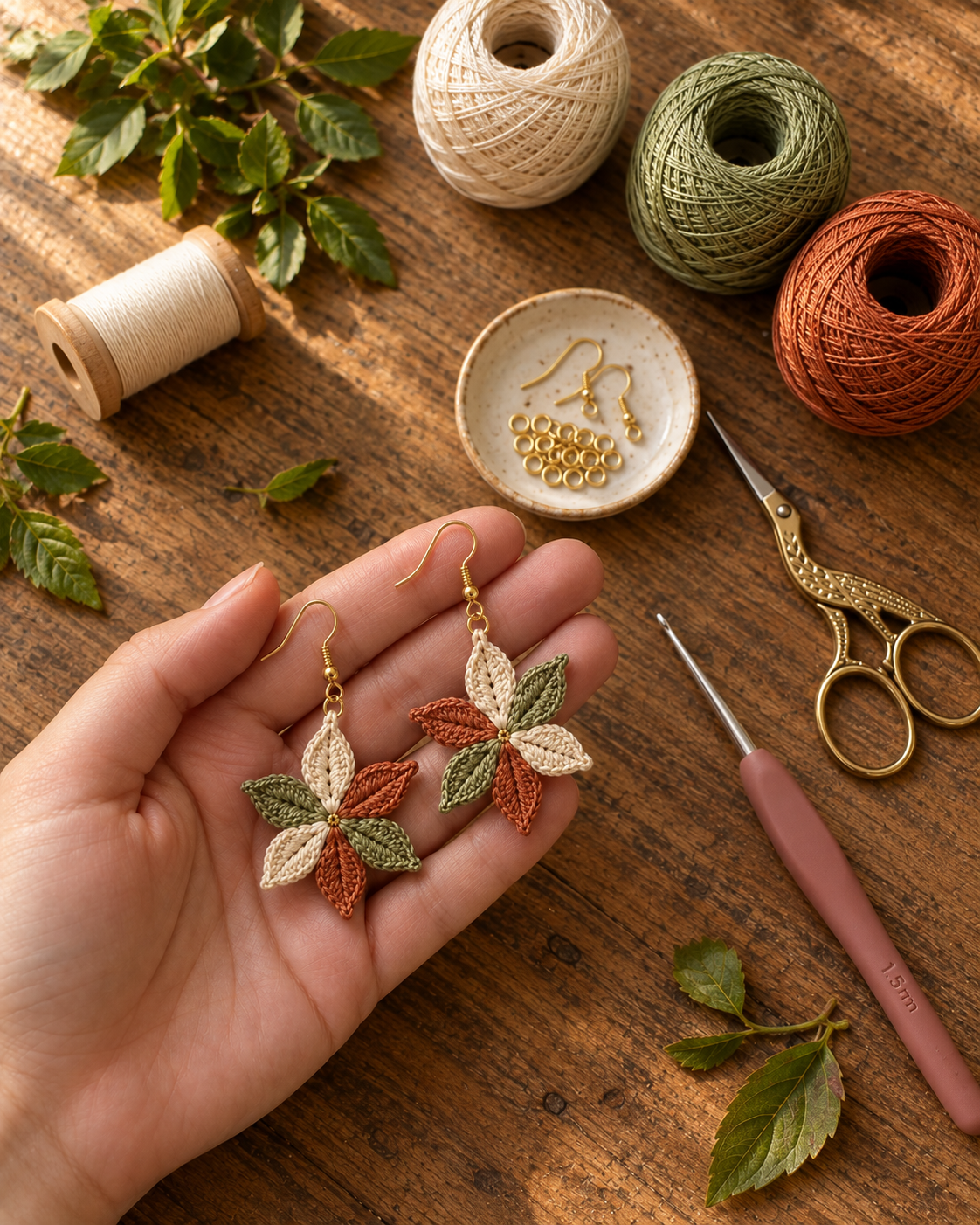
Materials I used (and the fall shade codes)
| Item | Details | Where |
|---|---|---|
| Cream thread | DMC Cebelia size 10 · Écru | Local craft store, $3.50 |
| Sage green thread | DMC Cebelia size 10 · shade 524 | Same, $3.50 |
| Terracotta thread | DMC Cebelia size 10 · shade 356 | Same, $3.50 |
| Steel hook | Clover Amour 1.5 mm (US 7 steel) | Amazon, $8 (kept for next 30 projects) |
| Ear wires | Gold-plated fish-hook with coil, pair | Etsy jewelry-supply shop, $2 |
| Jump rings | 4 mm, gold, 20-pack | Same, $2 |
| Embroidery scissors | Anything sharp with a fine tip | I use vintage stork scissors |
Total incremental cost for the pair came to about $9, or closer to $17 the first time counting the hook. One ball of each thread makes at least 10 pairs, so per-earring cost drops fast once you commit to the project.
When I checked comparable finished autumn leaf crochet earrings on Etsy this morning, listings ranged from $22 to $58 with an average of $34 across the top 30 shops (Etsy search "crochet leaf earrings autumn," retrieved 2026-09-18, 2026). That's a 3.8× markup — reasonable for a slow-craft item — and a decent side-income floor if you want to list a few pairs of your own.
Abbreviations and stitch key
- ch — chain
- sl st — slip stitch
- sc — single crochet
- hdc — half double crochet
- dc — double crochet
- st(s) — stitch(es)
All instructions use US crochet terms. UK crocheters: swap "sc" for "dc" and "dc" for "tr" as you read.
How do I crochet a single autumn leaf?
Each leaf is a 7-chain oval worked into both sides of a foundation chain, with a picot tip at the top and a slip-stitch spine running down the middle for shape. It uses about 12 inches of thread and takes me under 4 minutes once I've made two or three warm-up leaves.
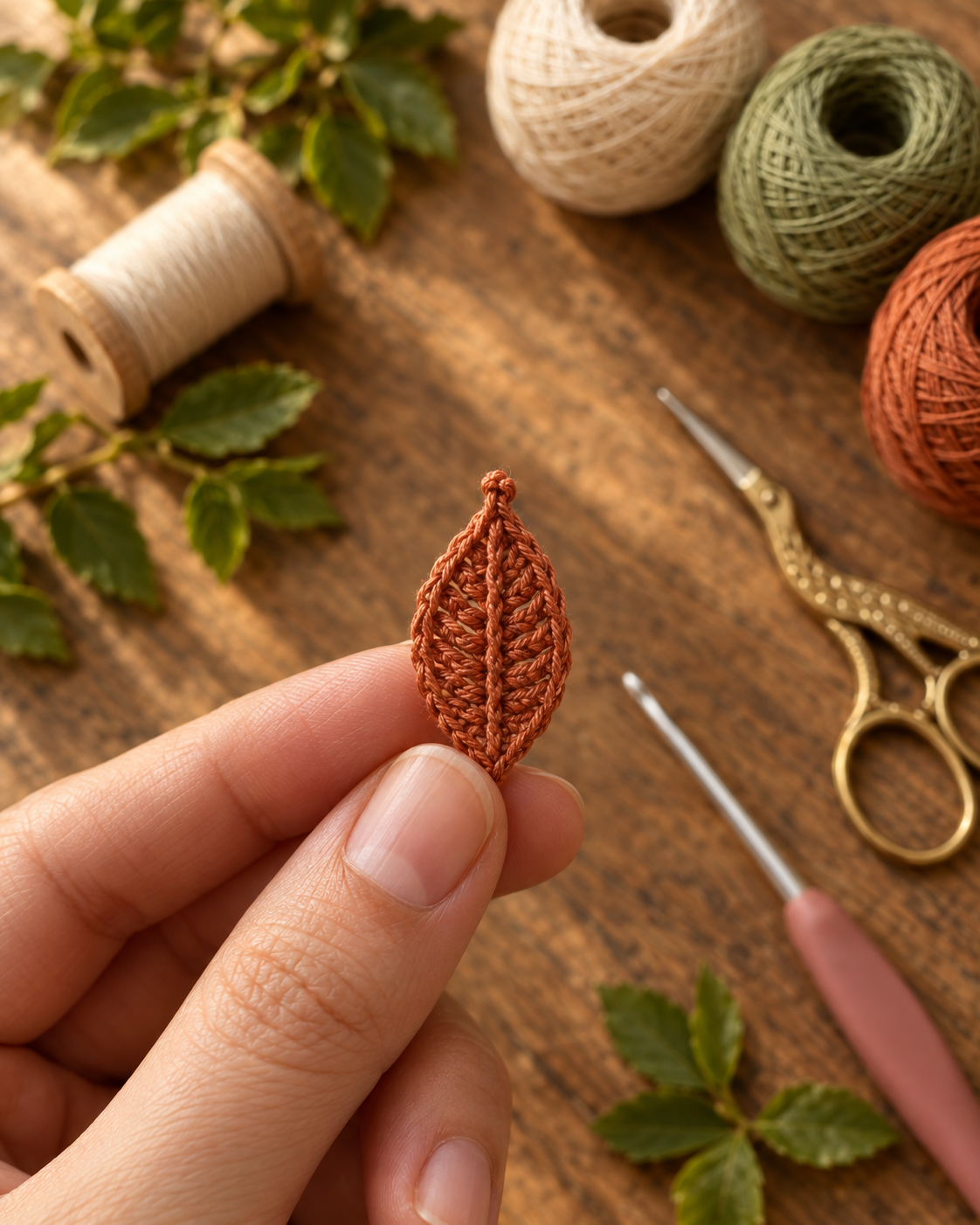
Leaf pattern (make 12 — 4 cream + 4 sage + 4 terracotta):
- Ch 8 in your chosen color.
- Skip the first ch. Sc in the 2nd ch from hook.
- Working up one side of the chain: sc, hdc, dc, dc, hdc, sc.
- In the last (top) chain: ch 3, sl st back into the same chain — this is the picot tip.
- Rotate. Working back down the other side of the foundation chain: sc, hdc, dc, dc, hdc, sc.
- Sl st into the starting stitch to close the leaf.
- Ch 4 for the joining stem, cut leaving a 3-inch tail. Weave the starting tail back through the leaf spine for a clean finish.
The picot tip is what turns a plain oval into something that reads as a leaf. Do not skip it. The first leaf you make will feel fiddly; by the fourth, you'll be doing it without looking.
Micro-crochet secret: keep a damp fingertip on your other hand. Size 10 cotton thread grabs finger oil, tightens up, and slides through the hook cleaner than any beeswax product I've tried.
How do I arrange the six leaves into a starburst?
You gather all six leaves for one earring by their ch-4 joining stems, thread each stem through one 4 mm gold jump ring at the center, and close each stem with a slip stitch. The leaves fan out on their own into a symmetrical starburst — cream at top and bottom, sage on the sides, terracotta at the diagonals.
Starburst assembly (make 2):
- Line up your 6 leaves for one earring in front of you: 2 cream, 2 sage, 2 terracotta.
- Open a 4 mm gold jump ring — this will be the center of the starburst.
- Feed each leaf's ch-4 joining stem through the ring, one at a time.
- For each leaf: pull the stem through, then sl st the end of the stem back into the base of the leaf to lock it onto the ring.
- Once all 6 leaves are on the ring, arrange them in this rotation clockwise: cream, sage, terracotta, cream, sage, terracotta.
- Close the jump ring with a small twist of round-nose pliers so nothing can slip off.
The color rotation — cream, sage, terracotta, cream, sage, terracotta — is what gives the whole earring the visual rhythm of a fall bouquet. Random ordering looks muddled; strict alternation reads as intentional and mirror-symmetrical across the ring.
Design note nobody tells you until you've made three pairs: angle the two terracotta leaves so they point slightly downward on both earrings — you can nudge the angle at the sl st join. The downward tilt catches light differently and makes the starburst look more like a real leaf cluster than a flat snowflake.
How do I attach the starburst to the ear wire?
Open a second 4 mm jump ring, thread it through the picot tip of the topmost cream leaf, hook it through the loop at the base of the ear wire, and close the ring. Repeat for the second earring, mirroring the leaf angles for symmetry. The whole finding step takes under two minutes per pair.
Ear wire attachment:
- Pick the leaf you want to sit at the very top of the earring — one of the two cream leaves.
- Open a fresh 4 mm jump ring with a slight twisting motion (never pull the ends apart sideways — it warps the ring).
- Thread the ring through the picot tip of that top cream leaf.
- Hook the same ring through the loop of the ear wire.
- Close the ring by twisting back into alignment.
- Repeat with the second earring, matching the leaf angles for a symmetrical pair.
Test each earring by holding it upside down and giving a small shake. If the starburst hangs flat and every leaf sits in the same plane, you're done. If any leaf twists forward or backward, redo its slip-stitch join at the central ring — a badly-twisted leaf gets more obvious with every hour of wear.
How do I keep the leaves crisp over time?
Store the pair flat in a small linen pouch away from sunlight and perfume, and hand-wash occasionally in cool water with a drop of gentle soap. Size 10 cotton thread holds its shape naturally for years without any fabric stiffener. Sunlight is the real enemy — direct UV over months will fade the terracotta first, then the sage.
Do not spray with hairspray, do not use fabric glue, and do not iron. Cotton thread has enough natural body from the twist that any stiffener will only add weight, stiffness, and a slight yellow tint. If a leaf ever softens or splays, dampen it slightly, reshape by hand, and press between two clean paper towels overnight.
I have a pair of these from October 2024 that I still wear weekly. The leaves are as crisp as day one, though the terracotta has faded about 10% toward a softer rust — which honestly looks better with age.
Can I make these earrings in different colors?
Yes, and the pattern begs to be recolored for every season. Spring greens — pistachio, sage, and butter yellow — read as a fresh leaf cluster. Winter whites, silvers, and dusty blues read as a frosted snowflake. Bridesmaid palettes work beautifully: I made a set of six pairs for a friend's October wedding in ivory, dusty pink, and champagne, and every bridesmaid still wears theirs.
The one rule: pick three colors, not four. Four colors on a six-leaf starburst breaks the mirror rotation. Two colors can work only if one is a strong accent — for example, cream with just two rust leaves at the top and bottom.
Frequently Asked Questions
Can I use worsted-weight yarn instead of size 10 thread?
Not for this pattern — worsted yarn on a 4 mm hook would produce leaves close to 2 inches long each, making the whole earring pull painfully on the earlobe. If you don't have crochet thread, size 5 thread with a 2 mm hook is the largest scale that still reads as "earring" rather than "keychain."
How much do the finished earrings weigh?
My pair weighs 1.4 grams for the two together — roughly the weight of a large hoop earring. Cotton thread is naturally light, and even six-leaf starbursts stay comfortable for all-day wear. I've worn mine on 10-hour workdays with no pinching.
Are these earrings safe for sensitive ears?
Only if you buy hypoallergenic ear wires. The default gold-plated brass fish-hooks in most craft stores are fine for most people but can irritate very sensitive lobes. For sensitive ears, swap in titanium or surgical stainless steel ear wires — they cost around $3 more per pair on Etsy jewelry-supply shops.
Can I sell finished pairs from this pattern?
Yes, small-scale finished sales are welcome. I ask you not to reproduce or resell the written pattern itself, but selling pairs you've made from it at a craft market or on Etsy is exactly the kind of thing this pattern is written for. A credit link back to Wavode is appreciated but not required.
What if my leaves come out asymmetrical?
Two fixes: first, count your foundation chain twice before starting — one extra or missing chain throws off the whole leaf. Second, work the second side of the leaf at the same tension as the first side by pausing halfway to check both sides look identical. Asymmetry almost always comes from tightening up as you tire.
Making it your own
Once you've made the classic six-leaf autumn pair, this pattern opens into a small seasonal collection. A necklace uses 8 leaves radiating from a slightly larger 6 mm center ring on a fine gold chain. A brooch uses 5 leaves on a felt backing with a bar-pin finding. A hair pin uses 3 leaves on a bobby-pin base — perfect for a fall wedding updo.
Next on my list is a matching autumn leaf crochet garland — the same leaf shape strung end-to-end on a longer chain, meant to drape across a mantelpiece for fall decor. That pattern should land on Wavode within two weeks. In the meantime, if you make this pair, tag me on Pinterest so I can add your version to the pattern's project gallery. Happy hooking.