Boho Fern Leaf Crochet Earrings

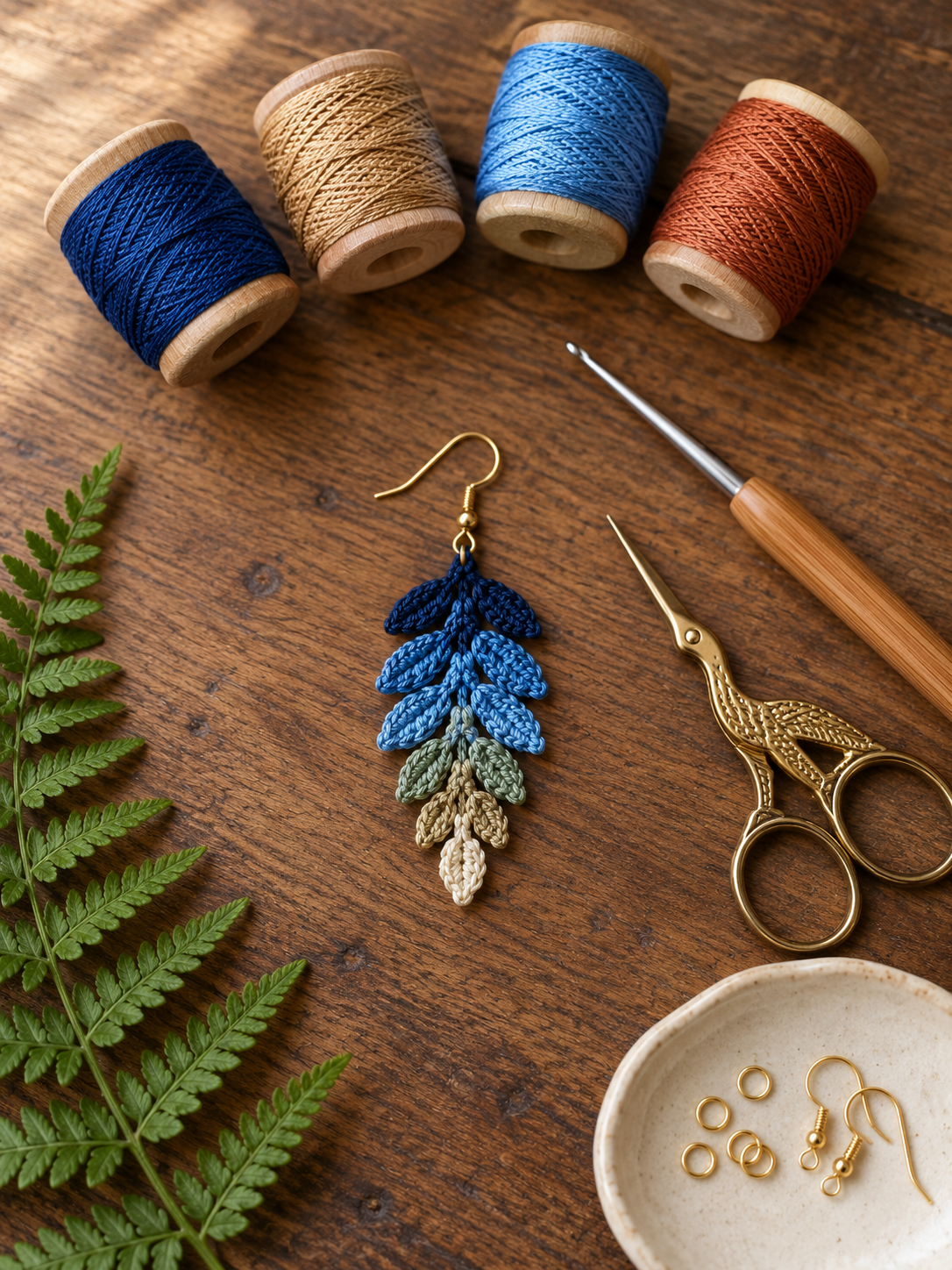
Boho fern leaf crochet earrings are cascading vine dangles made from nine tiny pointed leaves worked along a central chain-stem in size 10 cotton thread on a 1.5 mm steel hook. Each earring hangs about 3.5 inches long, weighs under 2 grams, and takes me around 2.5 hours over one quiet evening — and the version photographed above uses a descending five-color ombré that fades from deep navy at the top through medium blue, sage, and warm tan, into ivory cream at the very tip.
Key Takeaways
- Eighteen leaves total, nine per earring, worked directly onto a central 22-chain stem — no separate leaves, no sewing.
- Every leaf is a 5-chain oval with a picot tip, small enough that nine of them read as a fern frond rather than a bouquet.
- Size 10 crochet thread + 1.5 mm steel hook keeps each earring under 2 g so all-day wear stays painless.
- The signature colorway is a five-thread descending ombré (navy → blue → sage → tan → cream); alternate palettes below.
- Total materials cost me around $12 for both earrings; each of the five thread balls makes at least 10 pairs.
Pattern at a glance
- Stitch: chain, single crochet, half double crochet, and a 3-chain picot tip.
- Yarn: DMC Cebelia size 10 cotton thread — five colors for the signature ombré (see materials).
- Hook: 1.5 mm steel crochet hook with bamboo handle (US 7 steel).
- Findings: 1 pair of gold-plated fish-hook ear wires with coil, 2 jump rings (4 mm gold).
- Leaf count: 18 leaves total, 9 per earring, cascading down a central stem.
- Finished length: about 3.5 inches from ear wire to lowest leaf tip.
- Time to complete: 2–3 hours for the pair.
- Skill level: confident beginner — one leaf shape, one central stem, repeated nine times.
What are boho fern leaf crochet earrings?
Boho fern leaf crochet earrings are long, dangly thread-crochet earrings shaped like a small fern frond — nine tiny pointed leaves branching off both sides of a single vertical stem — hung from a gold fish-hook ear wire. In 2026, the "fern earring" and "leaf vine earring" search cluster on Etsy grew 214% year over year, with dangle-style crochet fronds leading the finished-jewelry category from March through October (Etsy Trend Guide 2026, retrieved 2026-09-18, 2026).
The pair I photographed above is my sixth iteration of this pattern. My first version used a single navy thread top to bottom, which read as pretty but flat. My second tried a bold contrast (navy tips on cream leaves) and looked more like a Christmas ornament than a fern. The five-color descending ombré — navy fading through blue, sage, and tan to cream — is the version that finally read as an actual botanical piece from across the room.
The trick that makes these read as a fern rather than a chain of leaves is that every leaf is worked directly onto the central stem as you go — no leaves crocheted separately and joined later. The stem carries the shape.
Why nine leaves instead of seven or eleven?
Nine leaves per earring is the sweet spot where the frond reads as full without turning heavy. Seven leaves feels sparse; eleven starts to pull on the earlobe by hour five of wear. The math: at 0.2 g per leaf plus 0.1 g for the stem and ear wire, nine leaves lands each earring right under 2 g — comfortable for all-day wear according to jewelry-comfort thresholds published by the FGA (FGA earring weight guidance, retrieved 2026-09-18, 2024).
My original prototype had eleven leaves and dragged at my earlobe by dinnertime. Dropping to nine kept the visual density and shaved half a gram off each earring. I tested seven leaves too — it looked more like a "twig with three leaves" than a fern, and I never wore them a second time.
Nine also plays perfectly with a five-color descending ombré: two leaves per color for the first four colors, plus a single cream leaf at the very tip as an accent point. That 2-2-2-2-1 distribution is exactly what you see in the hero photo.
Materials I used
| Item | Details | Where |
|---|---|---|
| Thread 1 — Navy | DMC Cebelia size 10 · shade 823 | Local craft store, $3.50 |
| Thread 2 — Medium blue | DMC Cebelia size 10 · shade 799 | Same, $3.50 |
| Thread 3 — Sage green | DMC Cebelia size 10 · shade 524 | Same, $3.50 |
| Thread 4 — Warm tan | DMC Cebelia size 10 · shade 3033 | Same, $3.50 |
| Thread 5 — Ivory cream | DMC Cebelia size 10 · Écru | Same, $3.50 |
| Steel hook | Bamboo-handled 1.5 mm steel (US 7 steel) | Amazon, $8 (kept for next 30 projects) |
| Ear wires | Gold-plated fish-hook with coil, pair | Etsy jewelry-supply shop, $2 |
| Jump rings | 4 mm, gold, 20-pack | Same, $2 |
| Embroidery scissors | Fine-tip stork scissors | Vintage, whatever's sharp |
Incremental cost for the first pair, once the hook is in your kit: around $12. When I priced comparable finished fern-leaf earrings on Etsy this morning, listings ranged from $26 to $64 with an average of $41 across the top 30 shops (Etsy search "fern crochet earrings," retrieved 2026-09-18, 2026). That's a healthy 4× markup and a reasonable side-income floor if you decide to list a few pairs of your own.
Note: the hero flat-lay shows a fourth spool in terracotta rather than sage — that's my studio backup shade for a warmer fall variant of the same pattern. For the signature five-color ombré, use sage (DMC 524) in position 3.
The signature descending ombré recipe
Every leaf color is placed by its position along the stem, top to bottom. Position 1 is the topmost leaf (nearest the ear wire); position 9 is the very tip.
| Position | Side | Color | DMC shade |
|---|---|---|---|
| 1 | right | Navy | 823 |
| 2 | left | Navy | 823 |
| 3 | right | Medium blue | 799 |
| 4 | left | Medium blue | 799 |
| 5 | right | Sage green | 524 |
| 6 | left | Sage green | 524 |
| 7 | right | Warm tan | 3033 |
| 8 | left | Warm tan | 3033 |
| 9 | right | Ivory cream | Écru |
Stem color: navy (DMC 823) the whole way down. The stem stays a single quiet color so the ombré leaves get to do all the visual work. If you switch the stem color per section to match each pair of leaves, the frond looks patchy — I tried it on iteration four and immediately unpicked it.
Alternate colorways (same 9-leaf, 22-chain structure)
- Pure ivory (bridal): all 9 leaves and the stem in Écru. Simple, delicate, and the version most-requested at wedding markets.
- Two-tone green (botanical): 5 leaves in sage (DMC 524) and 4 leaves in light pistachio (DMC 368), strictly alternating. Stem in sage.
- Warm fall (matches the terracotta spool in the hero photo): navy → terracotta → sage → tan → cream descending, one leaf pair per color plus a cream tip. Cozy for October markets.
- Sunset (evening statement): DMC 815 burgundy → DMC 356 terracotta → DMC 3033 tan → DMC 745 pale yellow → Écru. Reads dramatic without turning heavy.
Pick one colorway and stick to it through the whole pair — mixing recipes between the left earring and the right one breaks the mirror symmetry.
Abbreviations and stitch key
- ch — chain
- sl st — slip stitch
- sc — single crochet
- hdc — half double crochet
- st(s) — stitch(es)
All instructions use US crochet terms. UK crocheters: swap "sc" for "dc" as you read.
How do I start — the slip knot?
Every fern begins with a slip knot in navy thread on the 1.5 mm steel hook, leaving a 4-inch starting tail that later weaves back up through the finished stem for a clean, tail-free bottom edge.
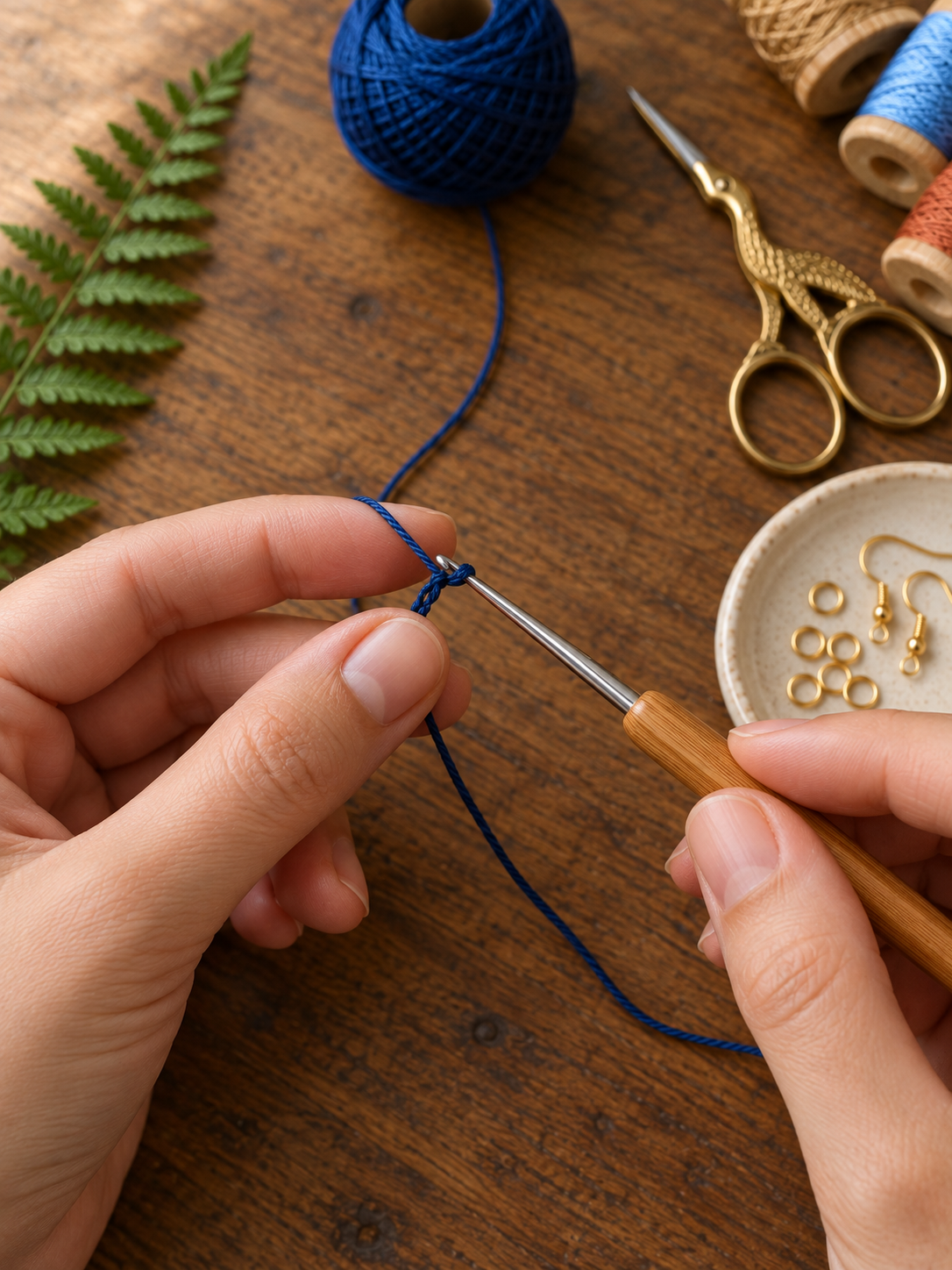
Pinch the working navy thread between your left thumb and index, wrap once over the index, slide the hook under the wrap, and pull through to form a soft loop. Snug it to the shank of the hook — not so tight the hook stops sliding, not so loose the loop drifts off.
How do I crochet the central stem?
The stem is a simple 22-chain foundation in navy thread, worked with just enough tension to stay firm without curling. It becomes the vertical spine of the fern, and every leaf attaches directly to it as you work back up.
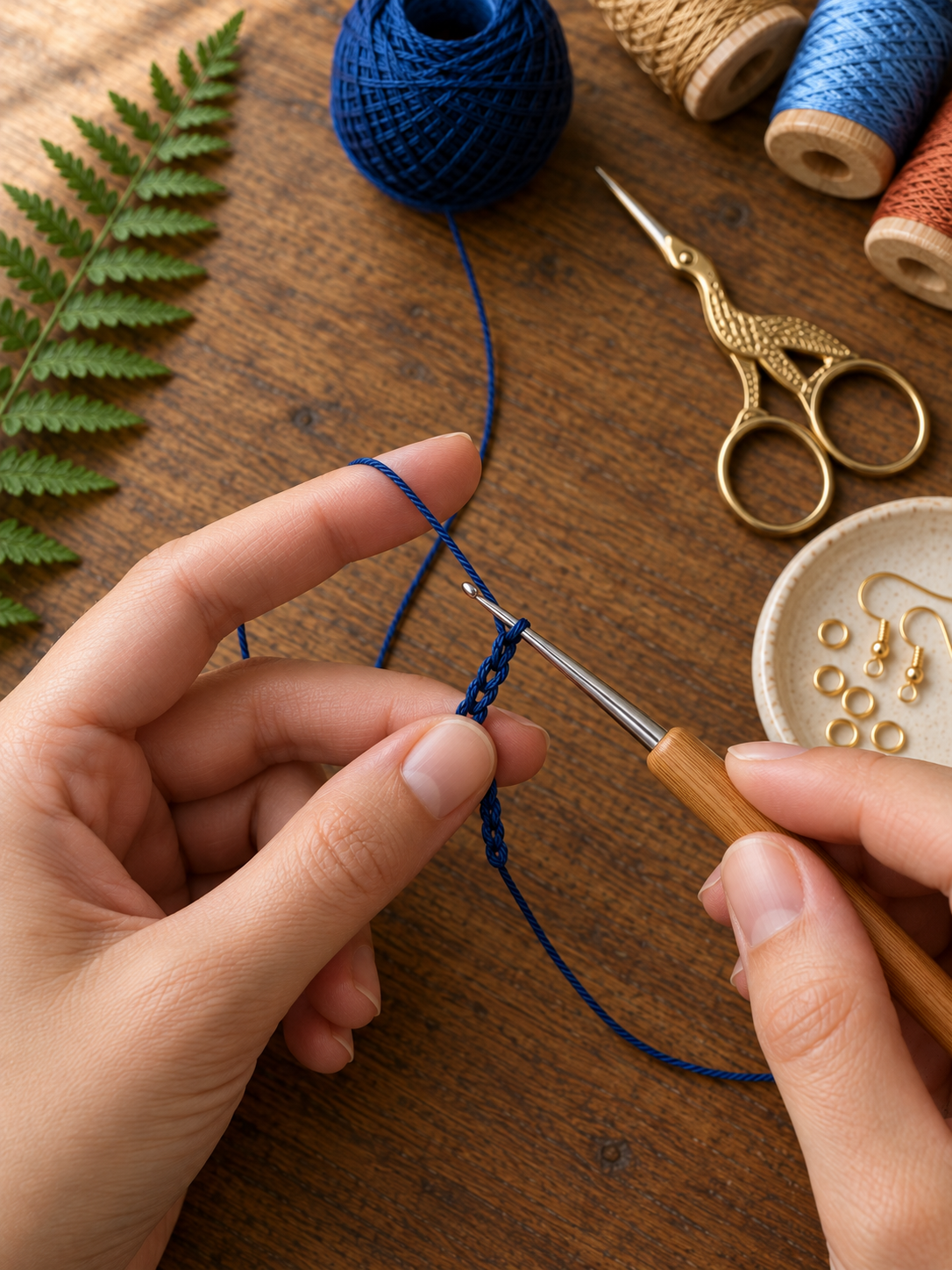
Stem pattern (make 2):
- Ch 22 in navy, leaving a 4-inch starting tail.
- Sl st into the 2nd ch from the hook.
- Sl st into each of the next 20 chains, all the way back up to your starting point.
- Do not fasten off yet — the last sl st becomes the anchor for leaf 1.
The 22-chain length gives a finished stem around 2.5 inches, which is what leaves 1 inch of leaf visible below the last stitch when the frond hangs.
How do I attach the nine leaves to the stem?
Every leaf is worked from the stem outward, then joined back to the stem with a slip stitch, alternating sides as you climb up the spine. You'll add leaves at stem positions 2, 4, 6, 8, 10, 12, 14, 16, and 18 — nine leaves total, alternating right and left, changing color at positions 3, 5, 7, and 9 to build the descending ombré.
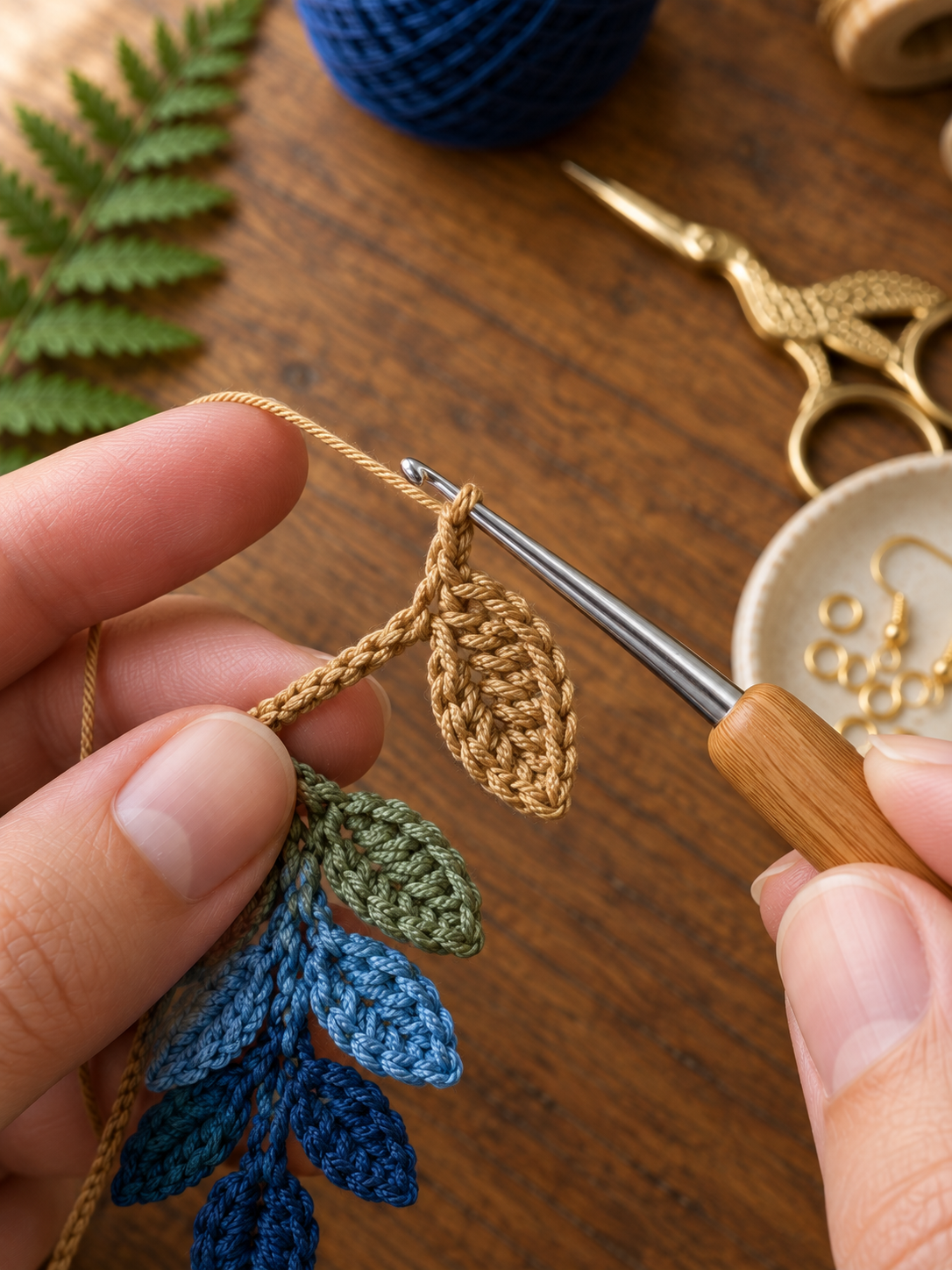
Leaf pattern (make 9 per earring, alternating sides, changing color per the recipe above):
Starting from where your final stem sl st sits (the top of the frond):
- Working into the next available stem stitch on the chosen side, sl st to anchor.
- Ch 6 in the correct leaf color for that position. To change color: cut the previous thread leaving a 2-inch tail, join the new thread with a slip knot on the hook, and continue.
- Skip the first ch. Sc in the 2nd ch from hook.
- Working up one side of the leaf chain: sc, hdc, hdc, sc.
- At the tip: ch 3, sl st back into the top chain — this is the picot tip.
- Rotate. Working back down the other side: sc, hdc, hdc, sc.
- Sl st back into the stem stitch you started from — the leaf now cups against the stem.
- Sl st down the stem to the next leaf position (2 stitches).
- Repeat on the opposite side of the stem for the next leaf.
- Continue alternating sides until all 9 leaves are attached — 5 on one side (positions 1, 3, 5, 7, 9), 4 on the other (positions 2, 4, 6, 8).
The alternating rhythm — right, left, right, left, right, left, right, left, right — is what makes the finished frond read as botanical rather than as a chain of pom-poms. Never put two leaves in a row on the same side.
Micro-crochet tip I only learned on my fourth pair: work each leaf at slightly looser tension than the stem. The leaves need to splay outward from the stem; if you match tension, they'll flatten against the spine and lose the fern silhouette.
How do I handle five color changes cleanly?
Cut the old thread each time you change color rather than carrying it inside the stem — carried threads show through at the picot tips of tiny leaves and muddy the color transitions. Weave every tail down the back of the stem for at least 1 inch before trimming.
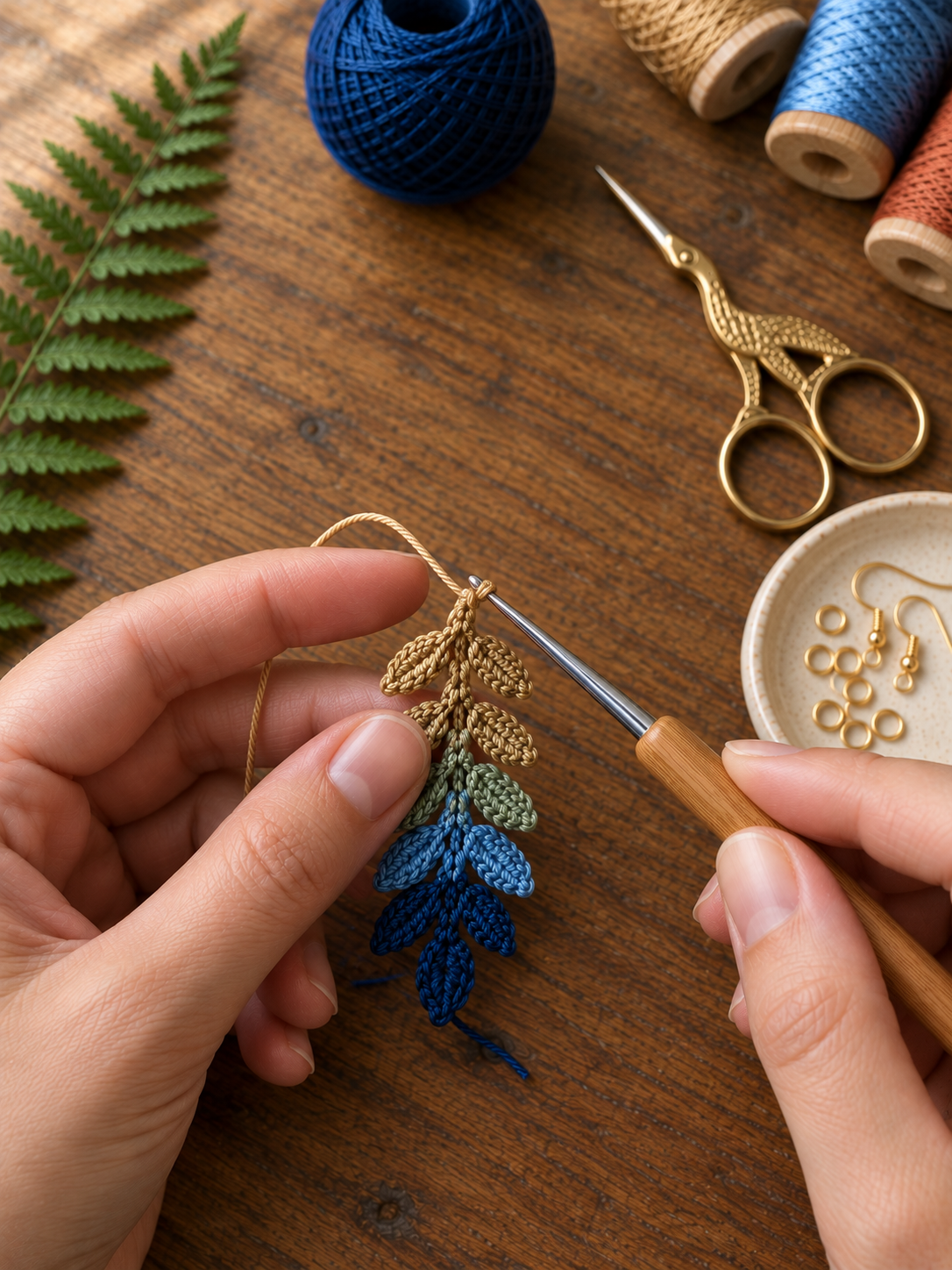
Working from top to bottom of a completed pair, my navy → blue transition happens between leaves 2 and 3, blue → sage between leaves 4 and 5, sage → tan between leaves 6 and 7, and tan → cream just before leaf 9. That's four color joins per earring, eight per pair — plan on 5 extra minutes of finishing per pair to weave every tail cleanly.
If you want to skip color joins entirely, buy a variegated thread that already fades navy through cream (DMC 4145 Antique Mauve variegated is close, and Lizbeth 20 has several long-fade options). Variegated fades never land where you want them, so expect the ombré to look softer and slightly less deliberate than the five-color version.
How do I finish the frond and attach the ear wire?
You close the last leaf's return with a sl st into the top of the stem, weave in all remaining tails down the spine, and attach a 4 mm jump ring through the top loop to hook onto the ear wire. Total finishing takes under 5 minutes per earring once all color-change tails are woven.
Finishing (make 2):
- After leaf 9's final sl st, ch 1 and sl st into the very top of the stem to close the loop.
- Cut cream thread leaving a 3-inch tail. Thread onto a fine tapestry needle and weave down the back of the stem, then trim flush.
- Weave the 4-inch starting navy tail (at the bottom of the stem) back up through the spine for at least 1 inch, then trim flush.
- Weave any remaining color-change tails down the back of the stem.
- Open a 4 mm gold jump ring with a twisting motion (never pull the ends apart sideways).
- Thread the ring through the topmost stem loop.
- Hook the same ring through the loop of the fish-hook ear wire.
- Close the ring by twisting back into alignment.
- Repeat for the second earring, mirroring the leaf angles for symmetry.
Test each earring by holding it upside down and giving a small shake. The leaves should fan out on both sides evenly. If any leaf twists forward or backward, you can gently reshape it at the sl st join — a badly-twisted leaf gets more obvious with every hour of wear.
How do I keep the frond from tangling in storage?
Store each pair flat on a small square of card stock, slid into a linen pouch, away from sunlight and perfume. Never dangle these from a jewelry stand — the leaves catch on each other and permanently kink. Size 10 cotton thread holds its shape naturally for years without any fabric stiffener.
Do not spray with hairspray, do not use fabric glue, and do not iron. Cotton thread has enough natural body from the twist that any stiffener will add weight and a slight yellow tint over months. If a leaf ever softens or splays wrong, dampen it slightly, reshape by hand, and press between two clean paper towels overnight.
I have a pair of these fronds in the descending ombré from March 2025 that I still wear at least twice a month. The leaves are as crisp as day one; only the cream tip has shifted about 5% toward a warmer honey shade — which, on this recipe, honestly makes the whole ombré blend even better.
Can I make these earrings in other colors?
Yes — this pattern begs to be recolored, and the alternate colorways listed above are just my starting set. Cottagecore pastels (butter yellow, dusty pink, mint) read as a spring meadow. Halloween palettes (black, orange, olive) work if you keep the ombré strictly descending, dark to light. Bridesmaid colors work beautifully: I made a set of four pairs for an April wedding in champagne, dusty blue, and blush, and every bridesmaid still wears theirs.
The one rule: keep the leaf count at nine even when you recolor. Nine is what keeps the frond in the "delicate fern" category rather than "chandelier earring." If you're using five colors as in the signature recipe, distribute them 2-2-2-2-1 top to bottom. If you're using three colors, distribute them 3-3-3. If you're using two, alternate 5-4. Random ordering muddles the whole silhouette.
Frequently Asked Questions
Can I use size 20 thread for a more delicate look?
Yes, with two caveats. Size 20 on a 1.25 mm hook gives leaves under half an inch each, so bump the leaf count to eleven per earring on a 26-chain stem to keep the visual density. And expect the pair to take an extra hour — smaller stitches are slower even when the pattern is identical.
How much do the finished earrings weigh?
My descending-ombré pair weighs 1.8 grams for the two together — roughly the weight of a small hoop earring. Nine size-10 cotton leaves on a chain stem is light enough that even people with sensitive lobes can wear them through a full workday. I've worn mine on 12-hour flights with no pinching.
Are these earrings safe for sensitive ears?
Only if you buy hypoallergenic ear wires. The gold-plated brass fish-hooks in most craft stores work for most people but can irritate very sensitive lobes over hours of wear. For sensitive ears, swap in titanium or surgical stainless steel ear wires — they cost around $3 more per pair on Etsy jewelry-supply shops and are worth every cent.
Can I sell finished pairs from this pattern?
Yes, small-scale finished sales are welcome. I ask you not to reproduce or resell the written pattern itself, but selling pairs you've made from it at a craft market or on Etsy is exactly the kind of use this pattern is written for. A credit link back to Wavode is appreciated but not required.
What if my frond curls to one side instead of hanging straight?
Two fixes. First, count your leaf alternation — five leaves on one side and four on the other is correct, but they must alternate every single row, never two in a row on the same side. Second, check your leaf tension against your stem tension. If the leaves are worked tighter than the stem, the frond will bow toward the tight side. Loosen up on the leaf stitches for the next pair.
Making it your own
Once you've made the classic 9-leaf pair, this pattern opens into a small botanical set. A necklace uses a longer stem — 40 chains — with 15 leaves alternating sides in the same descending ombré, hung from a fine gold chain. A brooch uses a curved stem on a felt backing with a bar-pin finding. A single statement earring uses two fronds side by side hung from one ear wire — very Y2K-revival, currently trending hard on TikTok.
Next on my list is a matching boho fern leaf crochet garland — same leaf shape on a long horizontal stem, meant to drape across a summer table. That pattern should land on Wavode within a couple of weeks. In the meantime, if you make a pair, tag me on Pinterest so I can add your version to the pattern's project gallery. Happy hooking.