Breezy Drawstring Crochet Shorts

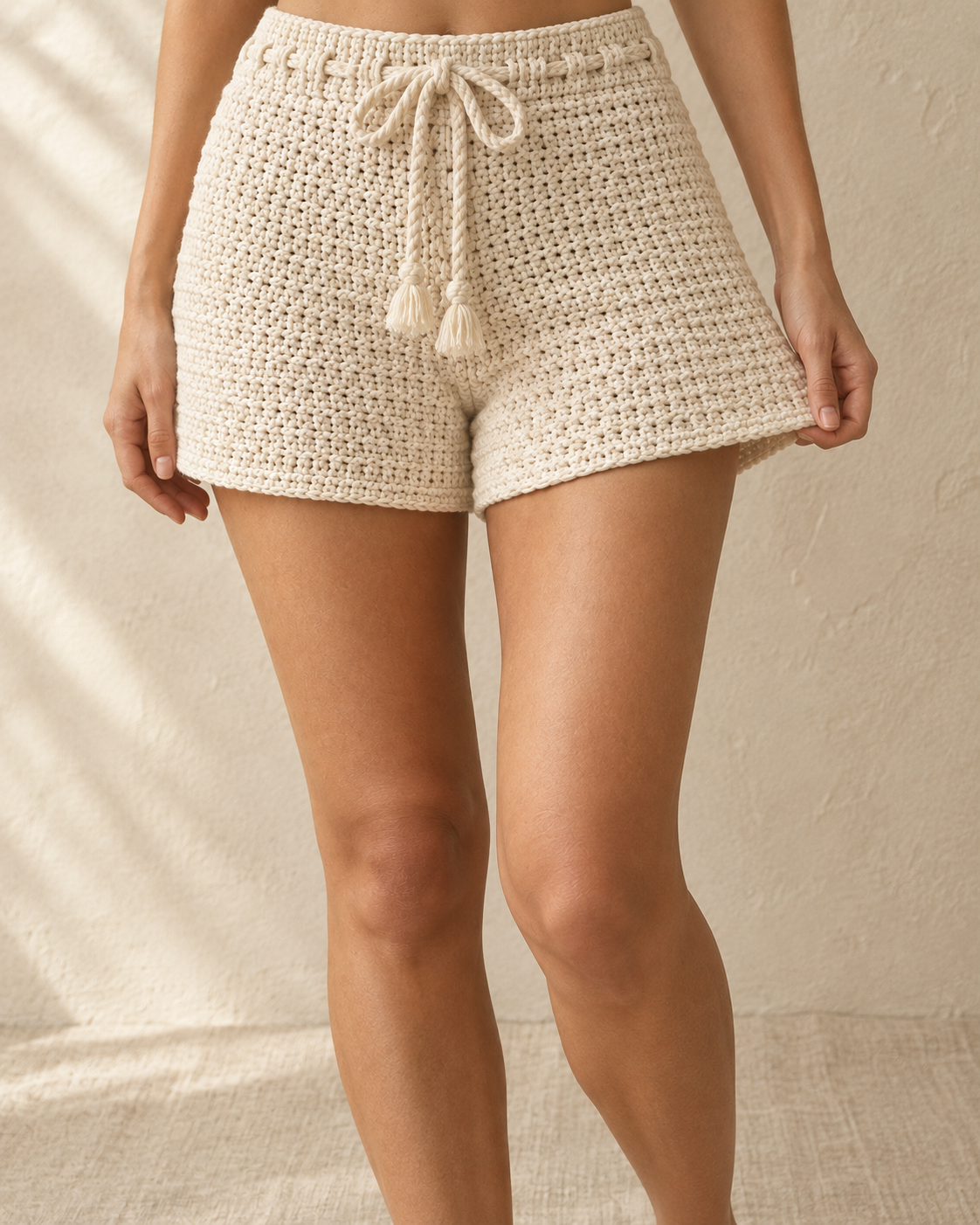
The easiest free crochet shorts pattern uses two flat rectangles worked in the moss stitch (single crochet + chain-1 alternating) with a high-rise laced waistband. There's no shaping, no decreases, no complicated waist math. You crochet two identical panels, seam the crotch and side seams, thread a slim twisted cord through the chain loops at the top, and slip into a pair of high-waisted shorts by Sunday night. Around 600 yards of worsted cotton, a 5 mm hook, and moss stitch as your only body stitch.
Key Takeaways
- Two identical flat rectangles seamed at the crotch and sides — no shaping, no gusset, beginner-safe geometry.
- 600 yd of worsted #4 cotton and a 5 mm hook produce a size-M pair in 8–12 hours (Craft Yarn Council standard gauge, 14 sts × 16 rows per 4 in in moss stitch).
- High-rise waistband with a lace-through chain-loop channel fits XS through XXL from a single panel chart.
- Moss stitch is the only body stitch; sc, chain and whipstitch cover the rest.
Pattern at a glance
- Stitch: moss stitch (sc, ch 1, skip 1) throughout the body; plain sc band at the top with a lace-through row.
- Yarn: worsted #4 weight cotton, 600 yd total (280 yd per leg panel + a bit extra for the cord).
- Hook: 5 mm (US H-8).
- Construction: 2 flat rectangles + 1 slim twisted cord laced through the front.
- Shaping: none. Drawstring pulls the waist to size.
- Finished size: fits XS–XXL, ~4 in inseam, ~13 in high rise.
- Time to complete: 8–12 hours over one weekend.
- Skill level: advanced beginner — sc, chain, and a whipstitch seam.
Why drawstring shorts are the perfect beginner wearable
Rectangles forgive everything. There's no armhole to shape, no waistband to grade, and the drawstring absorbs any tension drift across the top edge. Worsted cotton at a 5 mm hook produces a fabric dense enough to be modest, drapey enough to move with you, and quick enough that a weekend gets you a finished pair — not another swatch pile.
I made my first pair the summer I was still writing stitch counts on sticky notes. The elastic-free waist meant I could gift them to my sister two sizes down and they fit her the same way. That's why I recommend shorts as the second wearable in any beginner's queue, right after the color block cardigan.
What you'll need
Yarn (worsted #4 weight cotton, ~600 yd / 550 m)
- 600 yd ivory or ecru — Paintbox Cotton Aran in Vanilla Cream, or Lily Sugar 'n Cream in Ecru.
Hook
- 5 mm (US H-8) — Clover Amour or similar bamboo.
Notions
- Tapestry needle (large-eye, blunt).
- Stitch markers (4 small).
- Scissors.
- Measuring tape.
Gauge
- 14 sts × 16 rows = 4 in (10 cm) square in moss stitch on a 5 mm hook.
- Take five minutes to swatch. If your square runs bigger, drop to a 4.5 mm hook. If smaller, go up to a 5.5 mm.
Sizing chart
Choose the panel width based on your hip measurement plus 1 inch of ease. The drawstring cinches the waist independently, so the hip fit is what you're solving for. Moss stitch needs an even starting chain to keep the sc-ch-1 rhythm.
| Size | Hip (in) | Panel width (foundation ch) | Panel length (rows) |
|---|---|---|---|
| XS | 32–34 | 58 | 42 |
| S | 34–36 | 62 | 42 |
| M | 36–38 | 66 | 44 |
| L | 38–41 | 72 | 44 |
| XL | 41–44 | 78 | 46 |
| XXL | 44–48 | 84 | 46 |
Note: the laced cord pulls in 4–6 inches at the waist, so a size-M panel comfortably fits waists 26–32 in.
Abbreviations
- ch — chain
- sc — single crochet
- hdc — half double crochet
- BLO — back loop only
- sl st — slip stitch
- st(s) — stitch(es)
- rep — repeat
The pattern — panel 1 of 2
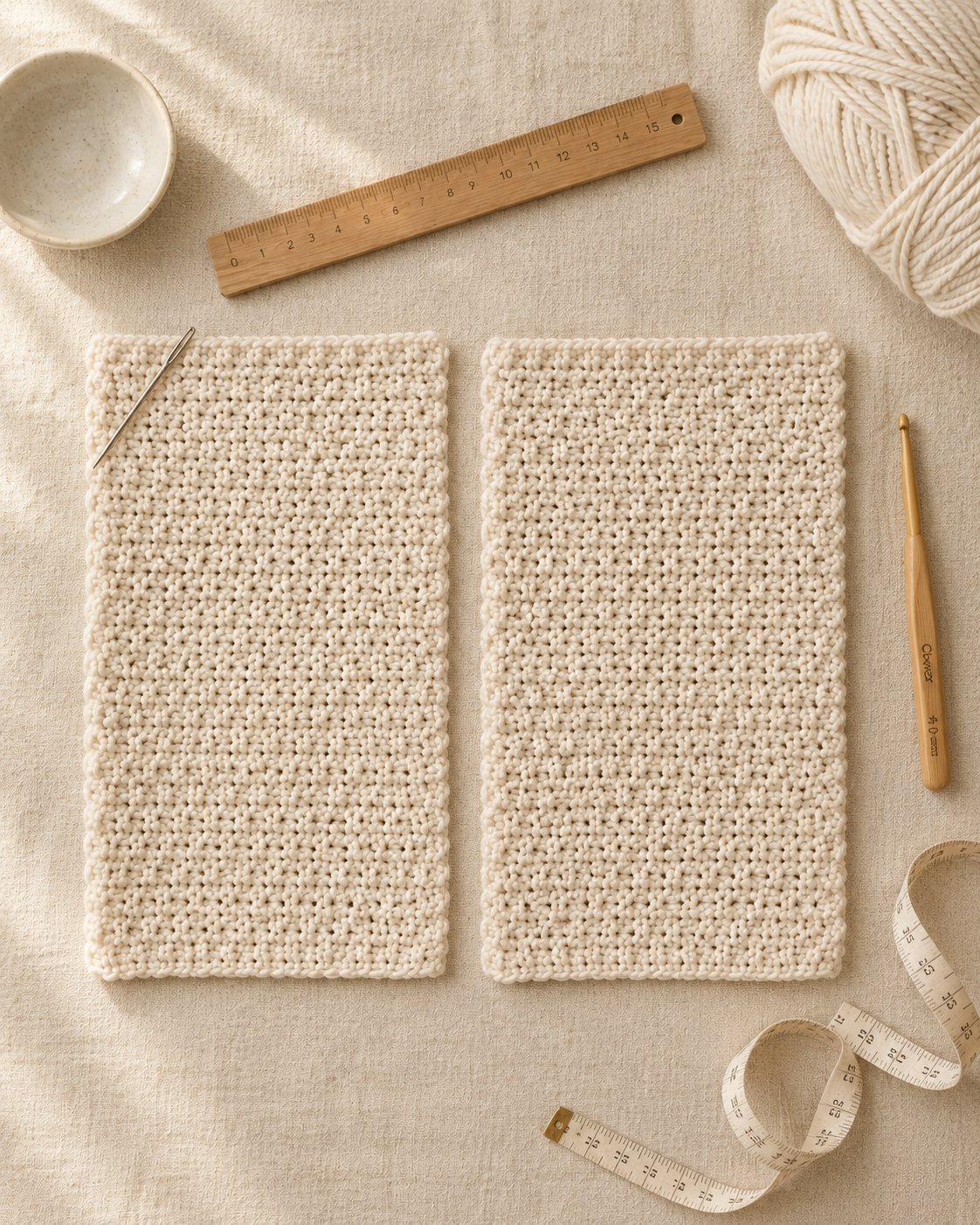
Both panels are identical. Make two.
Foundation row Chain the number of stitches for your size (must be even). For a size M: ch 66.
Row 1 (moss stitch set-up): SC in the 2nd ch from hook, ch 1, skip 1 ch, sc in next ch, rep from * across. Turn.
Row 2: Ch 2 (counts as sc + ch 1), skip first sc and first ch-1 sp, sc in next ch-1 sp, ch 1, rep from * across, ending with sc in the top of the turning ch. Turn.
Rows 3 through row-count for your size: Repeat Row 2.
The panel should measure roughly your hip-half + 0.5 in wide and 10 in tall including the top band. Fasten off Panel 1, leave a 12 in tail for seaming.
Repeat all rows to make Panel 2. Fasten off, again leaving a long tail.
Seaming the crotch and sides
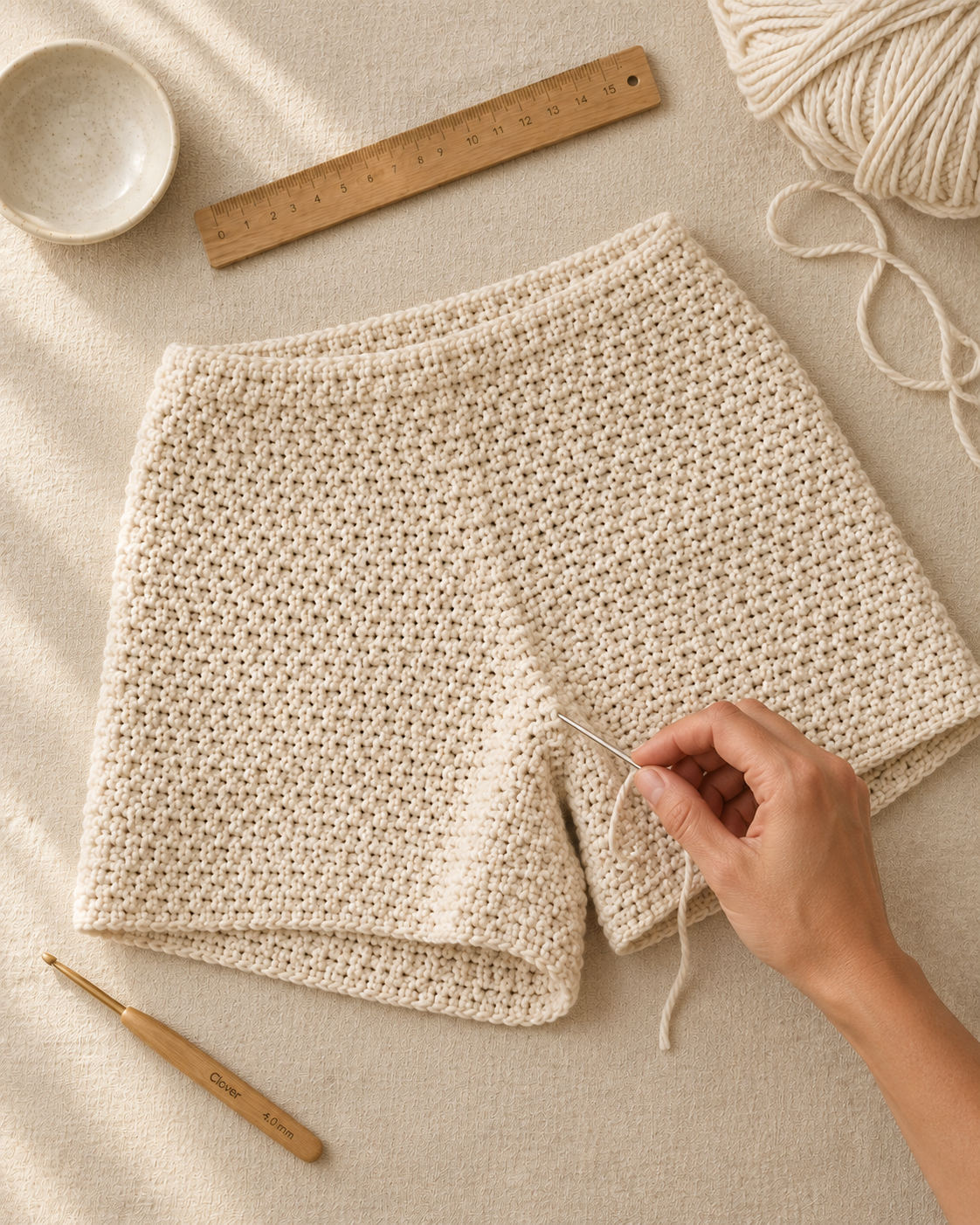
This is the only tricky part, and it isn't very tricky. Fold each panel in half widthwise so the short edges meet. You're forming a tube — one for each leg.
- Lay both panels flat with the folds pointing down (that's the inseam).
- Whipstitch the two side edges of each panel together, working from the fold up toward what will become the waistband. Seam only the bottom 6 inches of each side. Fasten off.
- Now hold the two half-seamed tubes together, right sides facing. Whipstitch the top 6 inches of one panel to the top 6 inches of the other panel — this creates the crotch seam and joins the two legs into one shorts shape.
Weave in the seam tails. Turn the shorts right-side out.
The high-rise waistband and lacing loops
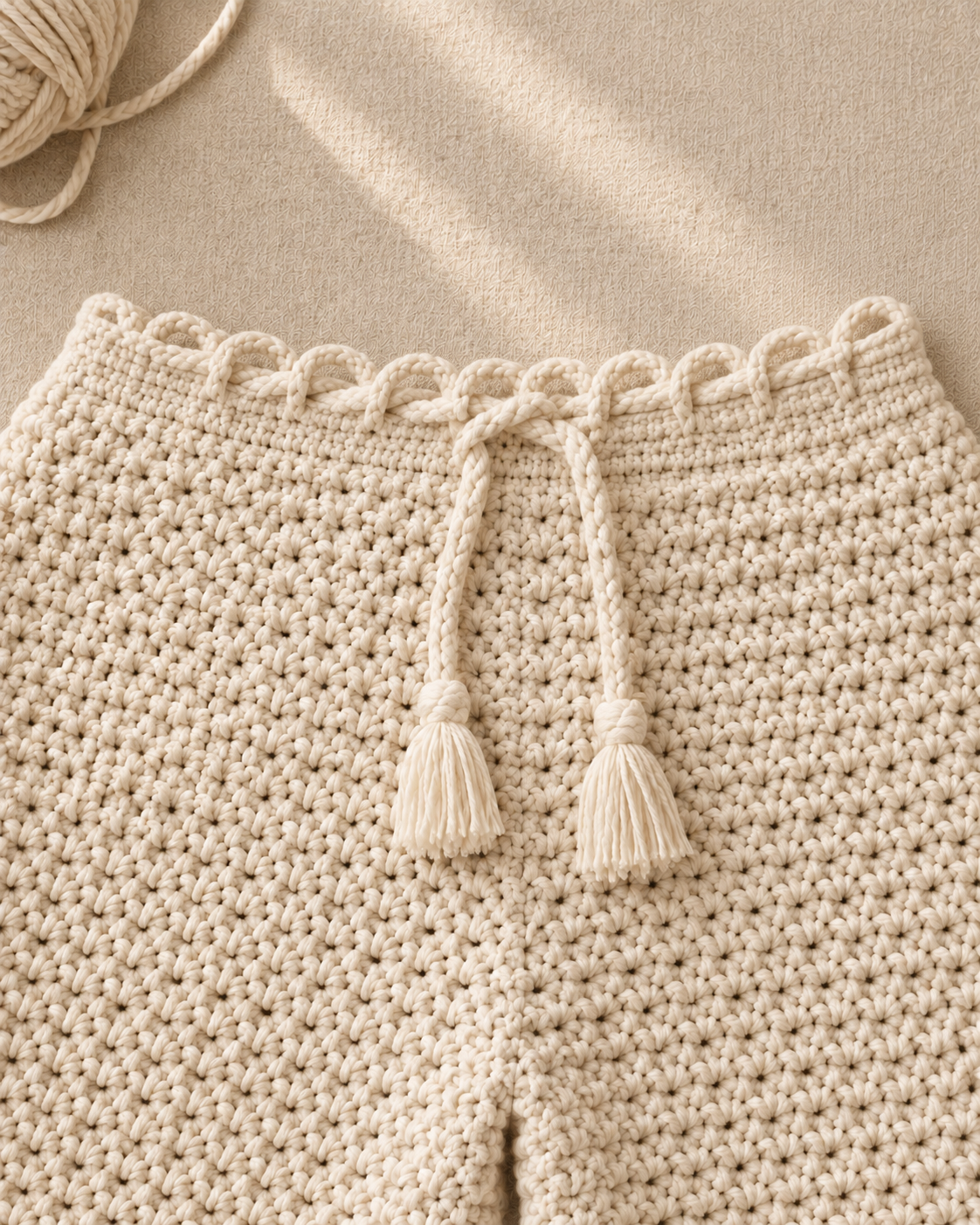
The waistband is a short plain-sc band worked in the round directly onto the joined shorts, topped with a row of chain loops that the cord laces through — the visible "corset lacing" look at the top of the front.
Round 1: Join yarn at the center-back top edge with a sl st. Ch 1, sc evenly around the entire top opening (roughly 1 sc per row end + 1 sc per ch-1 sp across the top of each panel). Aim for a multiple of 4 — for size M that's 120 sts. Sl st to join.
Rounds 2–4: Ch 1, sc in each st around. Sl st to join. (120 sc)
Round 5 — lacing-loop round: Ch 1, sc in first st, ch 4, skip 3 sts, sc in next st, rep from * around, ending with ch 4, sl st into the first sc. This creates a row of chain-4 arches all around the top edge.
Round 6 (top finish): Ch 1, sc in each ch-4 arch and each sc around (3 sc in each arch). Sl st to join. Fasten off, weave in ends.
The chain-4 arches are your lacing channels — the cord threads under one arch, over the next, all the way across the front.
Making the drawstring cord
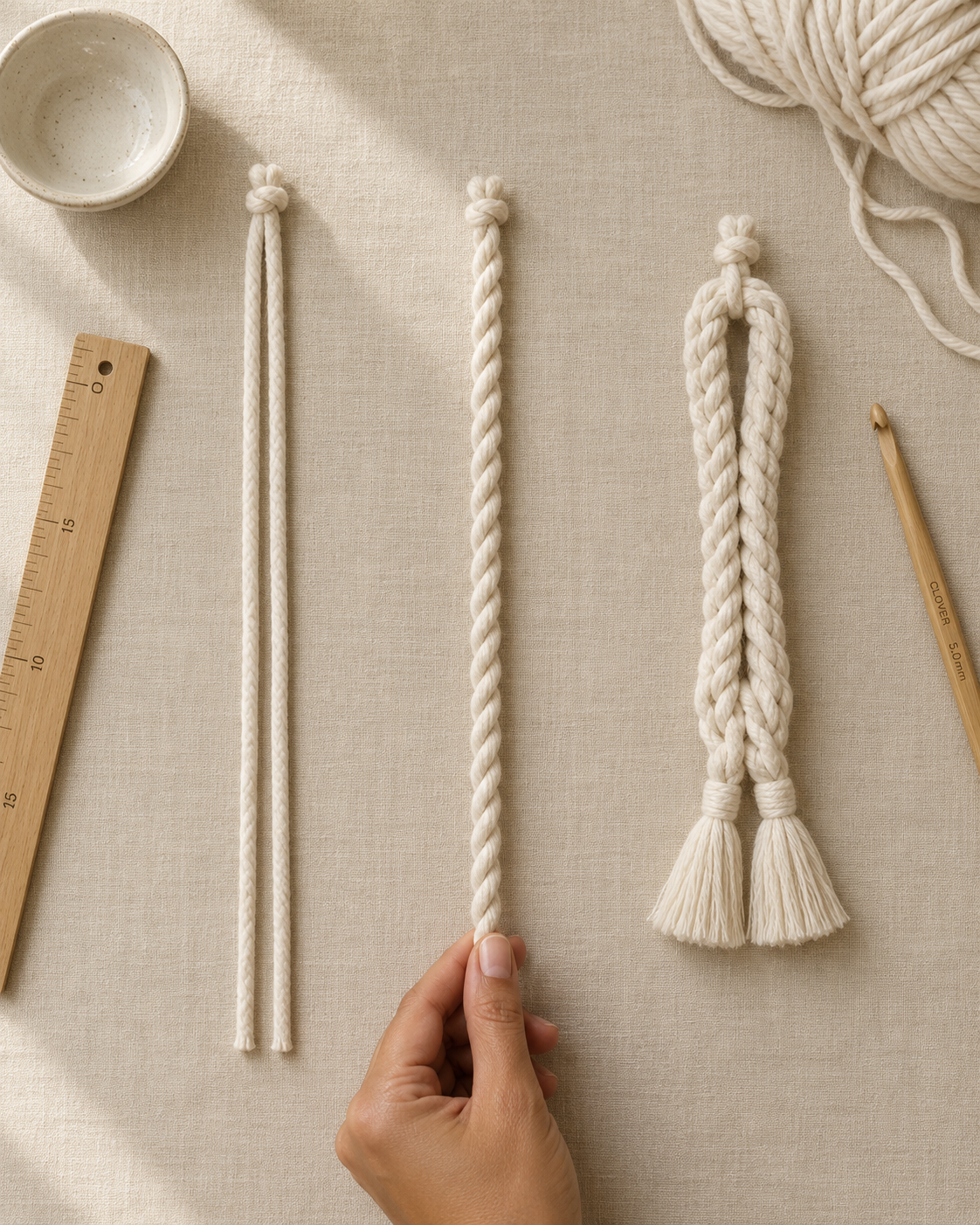
The cord in the photo is a twisted two-strand cord — the little spiral twist along its length is what gives it that neat rope look. It takes five minutes to make, no hook needed. If you'd rather stick to pure crochet, there's a chain-cord version at the end of this section.
The twisted cord (the one in the photos)
- Cut two lengths of yarn about the width of the front panel × 4. For size M, roughly 1.2 yards (110 cm) each.
- Hold both strands together and knot one end. Loop the knotted end onto a doorknob, a drawer handle, or ask a friend to hold it.
- Walk backward until the yarn is taut. Twist the free end tightly in one direction (about 100–150 turns) until the whole length starts to kink back on itself when you release a bit of tension.
- Keeping the tension, pinch the middle of the length. Bring the two ends together — the cord will twist onto itself, forming a neat two-strand spiral cord.
- Knot the joined ends together tightly, about 1.5 in from the tip.
Adding the two tiny tassels
- Cut 8 short strands of yarn, each about 4 in (10 cm).
- Hold the 8 strands together, fold them in half around one knotted end of the cord.
- Wrap a separate 6-in piece of yarn tightly around all strands, about ½ in below the fold, to bind the tassel head.
- Trim the tassel skirt to about 1 in.
- Repeat on the other end of the cord.
Lacing the cord
Look at the photo: the cord enters through one chain-4 arch to the left of center-front, passes behind the front waistband, and exits through one chain-4 arch to the right of center-front. Both tassels then dangle down over the moss stitch at the center-front. That's it — no shoelace weave, no bow.
- Thread one end of the cord onto a tapestry needle (or just push it — worsted cotton stiff enough).
- From the outside, poke the end into the second arch left of center-front, run it behind the waistband inside the shorts, and pull it out through the second arch right of center-front.
- Tug both ends until the tassels hang evenly at center-front, roughly 4 in long each. Adjust the fit by pulling the cord tighter or looser before you wear the shorts.
Pure-crochet alternative — chain cord
Prefer to keep it 100% crocheted? Make two long chains and use them side by side:
- With a 5 mm hook, chain 150 (~40 in for size M). Fasten off, weave in ends.
- Make a second identical chain.
- Hold the two chains together as one cord when lacing — this fakes the two-strand look of the twisted version. Add tassels the same way.
Finishing touches
- Block gently. Wet-block the shorts by soaking in cool water, squeezing (never wringing), and pinning flat to dry. Cotton relaxes beautifully after a first block.
- Trim ends. Weave every tail through at least 6 stitches in two directions before snipping.
- Optional edging. For a scalloped hem, join yarn at the leg opening, ch 1, then sc, skip 1 st, 5 hdc in next st, skip 1 st, rep around.
Styling my breezy shorts
I wear mine three ways all summer:
- Beach cover-up over a bikini, with woven leather sandals.
- Loungewear at home, paired with a fitted white tank and slouchy socks.
- Late-summer layer over opaque tights with an oversized cardigan — the "winter shorts" trick you see all over Pinterest.
Care instructions
Hand-wash in cool water with a wool-safe soap. Squeeze out excess water in a rolled towel. Lay flat to dry. Cotton holds shape best when it dries horizontally, and the shorts will look freshly finished after every wash.
Troubleshooting the shorts
My waistband gaps at the back. Skip Round 5 and go straight to Round 6 for a shorter, snugger band.
The legs are too tight around my thighs. Add 6 stitches to your panel width and rework at the next size up in the chart. The drawstring will still cinch the waist.
The chain arches stretched out. Use a smaller hook (4.5 mm) for Rounds 5 and 6 only, then return to your main hook for the rest.
My fabric is stiff. Cotton loosens with wear and washing. Block firmly the first time and give the shorts one full wear cycle before deciding.
Frequently asked questions
Can I use elastic instead of a drawstring?
You can, but I prefer the laced cord for a shorts pattern this loose. A 1-inch braided elastic threaded through Round 5 works if you skip the chain arches and turn Rounds 5–6 into a plain casing instead. The laced cord lets one size fit five bodies, which is why I default to it.
Will these shorts show through?
Worsted cotton at a 14-sts-per-4-inches moss-stitch gauge is opaque enough for beachwear and loungewear, but I'd wear a nude short liner underneath for a full day out. Going down to a 4.5 mm hook gives a denser fabric if you want more coverage.
How do I know if 600 yards is enough for my size?
Sizes XS–L land safely inside 600 yd. XL uses closer to 680 yd, and XXL wants 750 yd. Buy one extra skein for XL and up. Cotton skeins keep for years — the leftovers become dishcloths.
Can I make these in a lighter yarn?
Yes. DK cotton (#3) at a 4 mm hook works for a summery beach version — recalculate gauge (roughly 18 sts per 4 in in moss stitch) and adjust panel width to hit your target hip measurement.
How long do crochet shorts hold their shape?
Well-made cotton crochet garments soften but keep their structure through 40–50 wash cycles when hand-washed and flat-dried. I still wear the first pair I made three summers ago.
Related patterns from my hook
- The color block crochet cardigan layers beautifully over these shorts for chilly beach evenings.
- The chunky striped crochet scarf uses the same rectangle-first construction if you want to build confidence before starting the shorts.
- Save the leftovers for the crochet mini bow bag — a fifty-yard project that finishes the vacation set.
Ready to hook a pair?
Save this pattern to your Pinterest board, grab your ivory cotton, and start Panel 1 tonight. If you finish a pair, tag me on Pinterest — I love seeing how each hook-hand reads the same rectangles differently.