Sage Flare Crochet Skirt

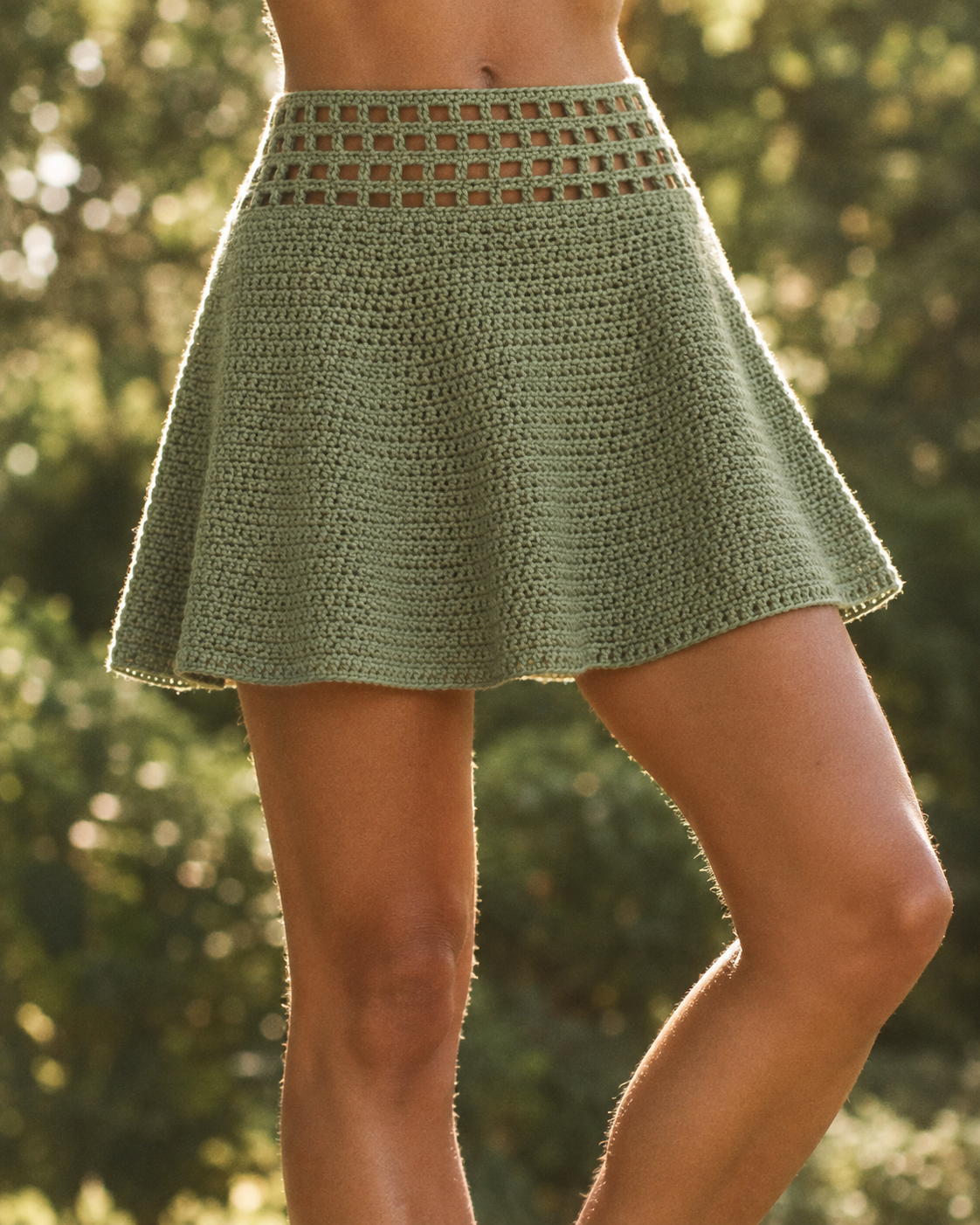
The easiest free crochet skirt pattern uses two flat trapezoid panels in single crochet with a filet-mesh waistband worked in the round on top. The mesh band gives you that airy see-through detail every tennis skirt on Pinterest is showing this year, and the trapezoid panels do the flare with simple side increases — no circle math, no dartting. Around 750 yards of sage worsted cotton, a 5 mm hook, and single crochet as your only body stitch.
Key Takeaways
- Two identical trapezoid panels seamed at the sides — the flare comes from side increases, not circle geometry.
- 750 yd of worsted #4 cotton and a 5 mm hook produce a size-M skirt in 10–14 hours (Craft Yarn Council standard gauge, 14 sc × 16 rows per 4 in).
- High-waisted filet-mesh band (dc + ch-1 windowpanes) worked in the round after seaming, with a slim drawstring option.
- Single crochet body, dc-mesh waistband, whipstitch seams — no fancy stitches, no shaping darts.
Pattern at a glance
- Stitch: single crochet (SC) throughout the body; dc + ch-1 filet mesh for the waistband.
- Yarn: worsted #4 weight cotton, 750 yd total (350 yd per panel + 50 yd for the waistband).
- Hook: 5 mm (US H-8).
- Construction: 2 flat trapezoid panels + 1 mesh waistband worked in the round on top.
- Shaping: 1 side increase every 4 rows on each edge (both panels) — that's the flare.
- Finished size: fits XS–XXL, ~15 in length, high rise waistband.
- Time to complete: 10–14 hours over one weekend.
- Skill level: advanced beginner — sc, dc, chain, and whipstitch seams.
Why a trapezoid skirt beats a circle skirt for beginners
A true circle skirt needs a magic-ring start and evenly spaced increases every round — miscount once and one side droops. Trapezoids give you the same flared silhouette with math you can eyeball. Craft Yarn Council research shows most first-year crocheters abandon garment patterns because of shaping errors, not stitch difficulty. Rectangles with side increases sidestep that entirely.
I made my first tennis skirt from these exact trapezoids the spring my niece asked me to teach her. She was still learning to count her sc, and she finished a wearable size-XS skirt in eight days. The mesh band hides any first-timer waistband wobbles too.
What you'll need
Yarn (worsted #4 weight cotton, ~750 yd / 685 m)
- 750 yd sage green — Paintbox Cotton Aran in Sage Green, or Scheepjes Stone Washed XL in Green Agate.
Hook
- 5 mm (US H-8) — Clover Amour or similar bamboo.
Notions
- Tapestry needle (large-eye, blunt).
- Stitch markers (6 small — you'll mark increases).
- Scissors.
- Measuring tape.
Gauge
- 14 sc × 16 rows = 4 in (10 cm) square on a 5 mm hook.
- Take five minutes to swatch. If your square runs bigger, drop to a 4.5 mm hook. If smaller, go up to a 5.5 mm.
Sizing chart
Choose panel width based on your waist measurement plus 1 inch of ease (the mesh waistband stretches slightly and the drawstring cinches it). Length is fixed at 15 in for a classic mini — add or remove rows in multiples of 4 to change length.
| Size | Waist (in) | Panel width bottom (sts) | Panel width top (sts) | Panel rows |
|---|---|---|---|---|
| XS | 24–26 | 88 | 48 | 60 |
| S | 26–28 | 94 | 52 | 60 |
| M | 28–30 | 100 | 56 | 60 |
| L | 30–33 | 108 | 62 | 60 |
| XL | 33–36 | 118 | 68 | 60 |
| XXL | 36–40 | 128 | 76 | 60 |
The bottom is roughly 40% wider than the top — that's the flare. If you want more swing, add 2 extra increases per side (widening the hem by 4 sts).
Abbreviations
- ch — chain
- sc — single crochet
- dc — double crochet
- sl st — slip stitch
- st(s) — stitch(es)
- rep — repeat
- inc — 2 sc in same stitch (increase)
The pattern — panel 1 of 2
Both panels are identical. Make two. Start from the hem (widest edge) and decrease upward toward the waist.
Foundation row Chain the bottom-width number for your size + 1. For a size M: ch 101.
Row 1: SC in the 2nd ch from hook and in each ch across. Turn. (100 sc for size M)
Rows 2–5: Ch 1, sc in each st across. Turn.
Row 6 (decrease row): Ch 1, sc2tog, sc in each st across to last 2 sts, sc2tog. Turn. (98 sc)
Rows 7–9: Ch 1, sc in each st across. Turn.
Row 10: Repeat Row 6. (96 sc)
Continue the pattern: decrease 1 st at each edge every 4th row until you have the top-width number of stitches for your size (56 sts for M). Then work straight (no decreases) until Row 60. Fasten off, leaving a 15-in tail for seaming.
Repeat all 60 rows for Panel 2. Fasten off, again leaving a long tail.
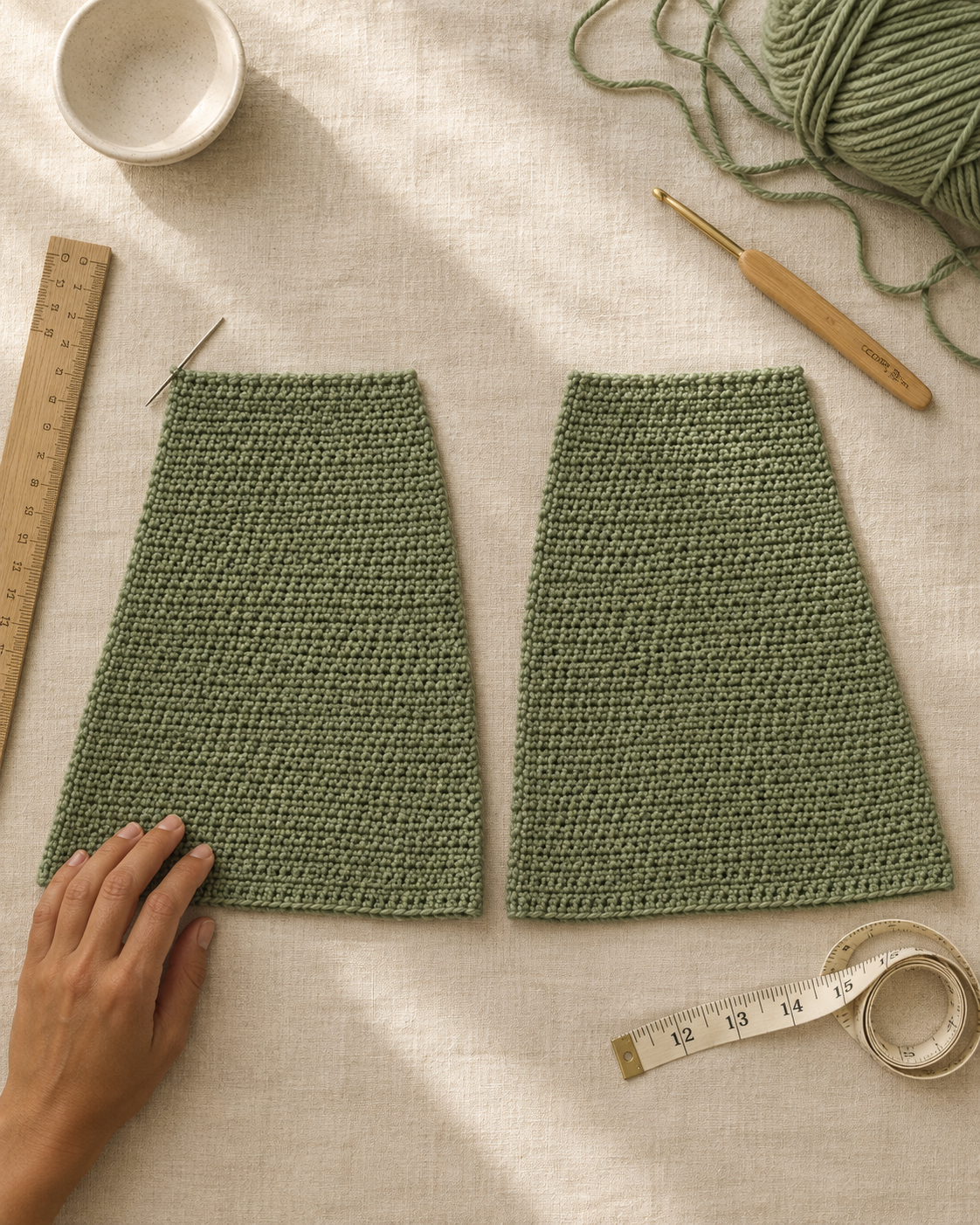
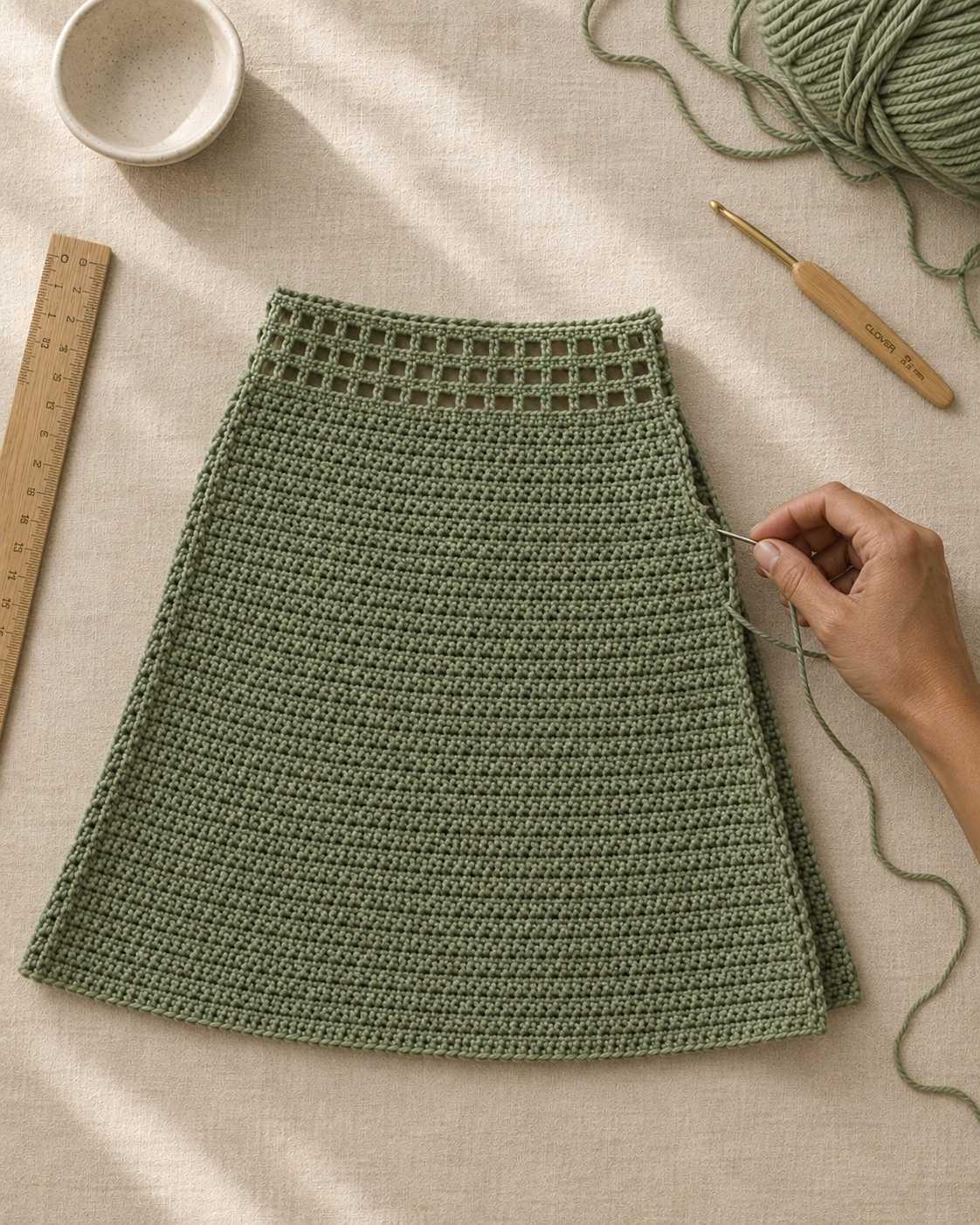
Seaming the side seams
Two seams, both straight lines. This is the easy part.
- Hold Panel 1 and Panel 2 with right sides together, aligning the side edges (the sloped edges).
- Thread the long tail onto a tapestry needle. Whipstitch the entire right side seam from hem to waist, matching row-for-row.
- Fasten off, weave in ends.
- Repeat on the left side.
Turn the skirt right-side out. You should have a tube shaped like a trapezoid in cross-section — wider at the hem, narrower at the top waist.
The filet-mesh waistband
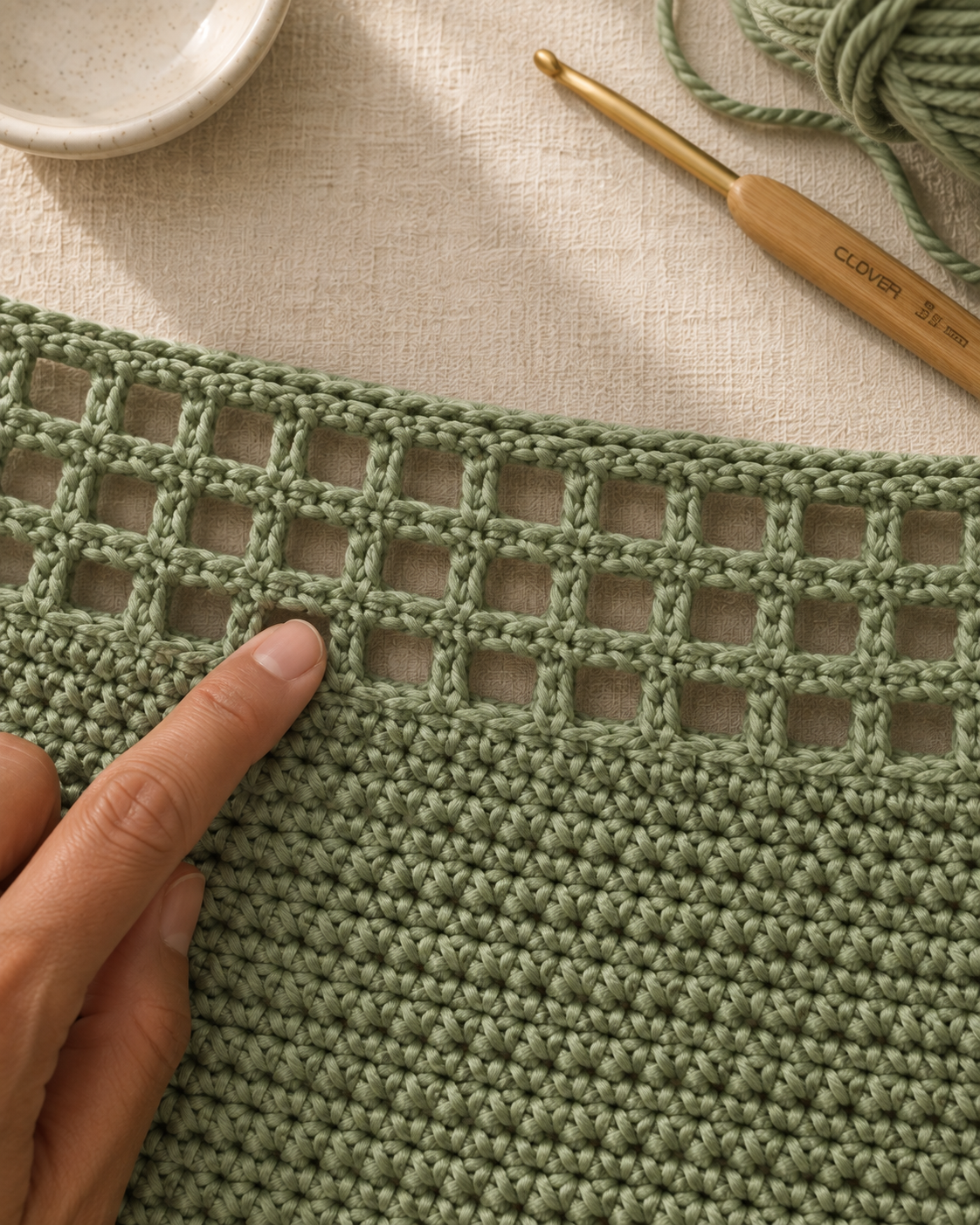
Worked directly onto the top edge of the joined skirt, in the round. The mesh is a simple dc, ch-1, skip 1 repeat that reads as tiny windowpanes — the tennis-skirt signature look.
Round 1: Join sage yarn at the center-back top edge with a sl st. Ch 1, sc evenly around the entire top opening. For size M, aim for 112 sts (an even multiple of 4). Sl st to join.
Round 2 (mesh set-up): Ch 3 (counts as first dc), ch 1, skip 1 st, dc in next st, rep from * around, ending with ch 1, sl st into the 3rd ch of beginning ch-3. (56 dc, 56 ch-1 spaces)
Rounds 3–5: Ch 3, ch 1, skip ch-1 sp, dc in next dc, rep from * around, ending with ch 1, sl st into the 3rd ch of beginning ch-3. The mesh grid builds up — you'll see the little windowpanes stacking.
Round 6 (optional drawstring channel): Ch 3, ch 2, skip 1 dc, dc in next dc, rep from * around, sl st to join. This gives slightly larger holes at the top edge for a slim cord.
Round 7 (top finish): Ch 1, sc in each dc and each ch-1 sp around (2 sc per repeat). Sl st to join. Fasten off, weave in ends.
Optional slim drawstring
If your waist runs 1 inch smaller than the skirt band, a slim cord in the top round keeps the skirt snug. Make it exactly the way you'd make the shorts drawstring — a twisted two-strand cord or a doubled chain.
- Cut two lengths of sage yarn about 1.2 yards each.
- Twist them together tightly, fold, and let them ply into a cord (full instructions in my breezy drawstring shorts pattern).
- Weave the finished cord through the ch-2 spaces of Round 6, starting and ending at center-front.
- Add small tassels to each end and tie a soft bow.
Finishing touches
- Block firmly. Wet-block the skirt by soaking in cool water, gently squeezing out water in a towel, and pinning flat with the hem opened into a semicircle to set the flare. Cotton keeps the shape once dry.
- Trim ends. Weave every tail through at least 6 stitches in two directions before snipping.
- Optional scalloped hem. Join yarn at any hem edge, ch 1, then sc, skip 1 st, 5 dc in next st, skip 1 st, rep around. Sl st to join, fasten off. Adds a soft feminine finish.
Styling my sage flare skirt
I wear mine three ways all season:
- Tennis outfit — white fitted tank, white sneakers, hair up. The mesh band reads athletic.
- Weekend casual — cream cropped tee, tan sandals, small crossbody bag.
- Late-summer transitional — chunky cream cardigan on top, opaque tights, ankle boots. The sage green plays perfectly with autumn palettes.
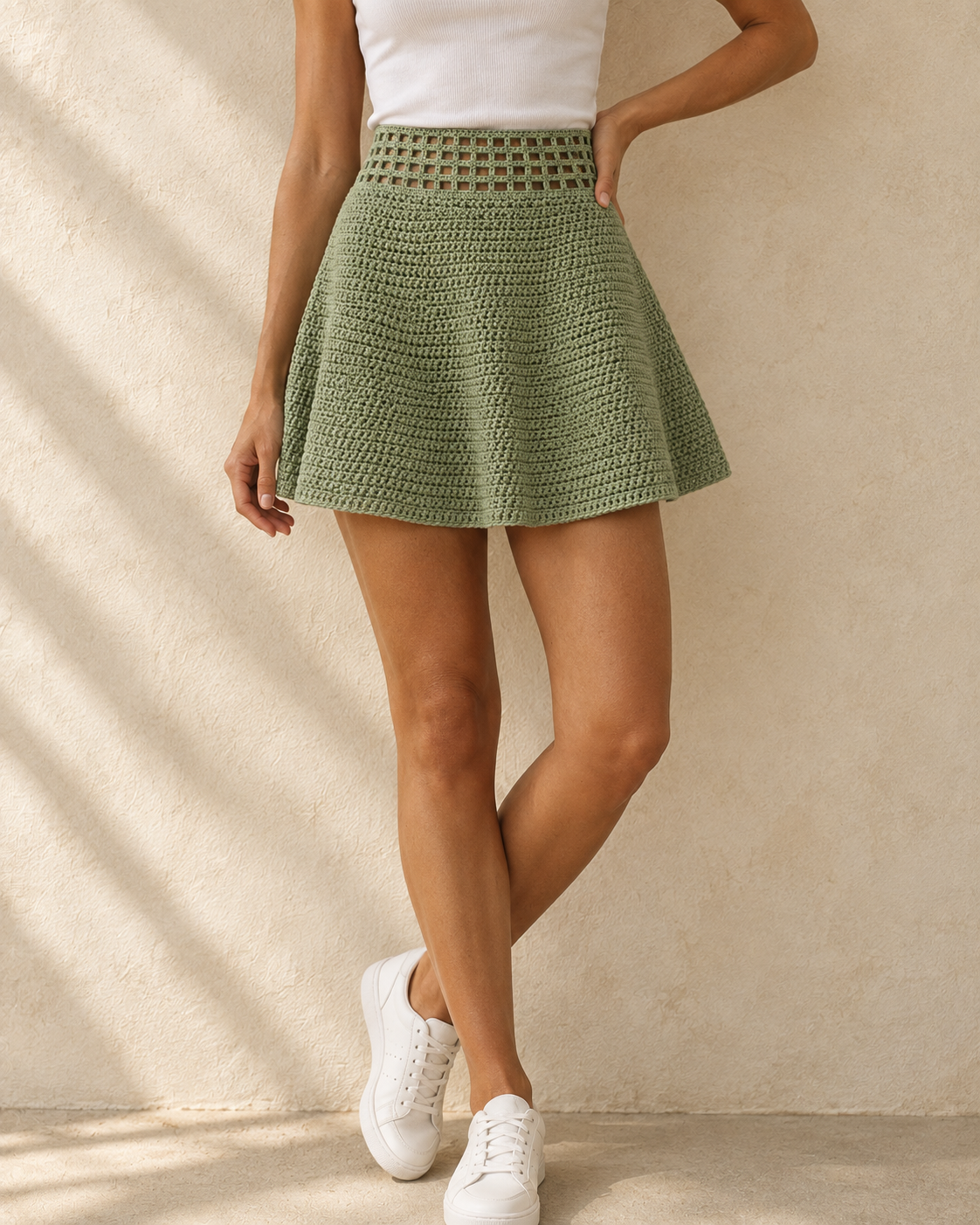
Care instructions
Hand-wash in cool water with a wool-safe soap. Roll in a towel to remove excess water — never wring. Lay flat to dry, reshaping the hem into a semicircle so the flare stays crisp. Cotton relaxes with every wash; the skirt gets softer without losing structure.
Troubleshooting the skirt
My waistband is too loose. Weave a slim drawstring through Round 6 (see above). Or start Round 1 with 8 fewer sc — the mesh still stacks evenly on multiples of 4.
The hem flips up. You're likely working with too tight a tension. Try one hook size larger for the last 10 rows of each panel, or block the hem edge under heavier weights.
My decreases show as visible steps. Alternate the decrease side each cycle — decrease on the right edge one time, then the left edge next time — instead of both edges every 4 rows. It looks smoother.
Fabric is stiff. Cotton loosens after the first block and one wear. Block firmly, then give it a full day out before deciding.
Frequently asked questions
Can I make this skirt in the round instead of flat panels?
You can, but you'll need to distribute increases evenly around the tube (roughly 8 increases spaced around every 4 rounds). Flat trapezoids are more forgiving because you only track two edge-columns instead of eight increase-columns.
Will the mesh waistband stretch out over time?
Cotton mesh holds shape better than acrylic. In my three summers of wearing this skirt, the band has softened but not sagged. The optional drawstring in Round 6 is your insurance — cinch it a bit tighter if the band ever relaxes.
How much yarn do I need for size XL or XXL?
XL uses about 830 yd, XXL closer to 920 yd. Buy 2 extra ounces on top of the 750 baseline for those sizes. Cotton skeins keep well — leftovers become washcloths or the crochet bow bag.
Can I make it longer than 15 inches?
Yes. Add rows to the "work straight" section at the top (Rows after your last decrease) for a mid-thigh or knee length. Add rows before your first decrease for extra flare in the hem. Each 4 rows adds about 1 inch of length.
Is worsted cotton hot to wear in summer?
Cotton breathes well and wicks moisture — that's why tennis whites have used it for a century. The mesh waistband adds ventilation right where you need it. I've worn mine in 90°F weather without overheating.
Related patterns from my hook
- The breezy drawstring crochet shorts share the same worsted cotton palette and finish the summer set.
- The color block crochet cardigan layers over the skirt for autumn wear.
- Save leftovers for the crochet mini bow bag — a fifty-yard project in matching sage.
Ready to hook one?
Save this pattern to your Pinterest board, grab your sage cotton, and start Panel 1 tonight. If you finish one, tag me on Pinterest — I love seeing which hook-hand reads the same trapezoids into a completely different silhouette.