Crochet Mini Rose: Free 15-Minute Pattern with Leaves

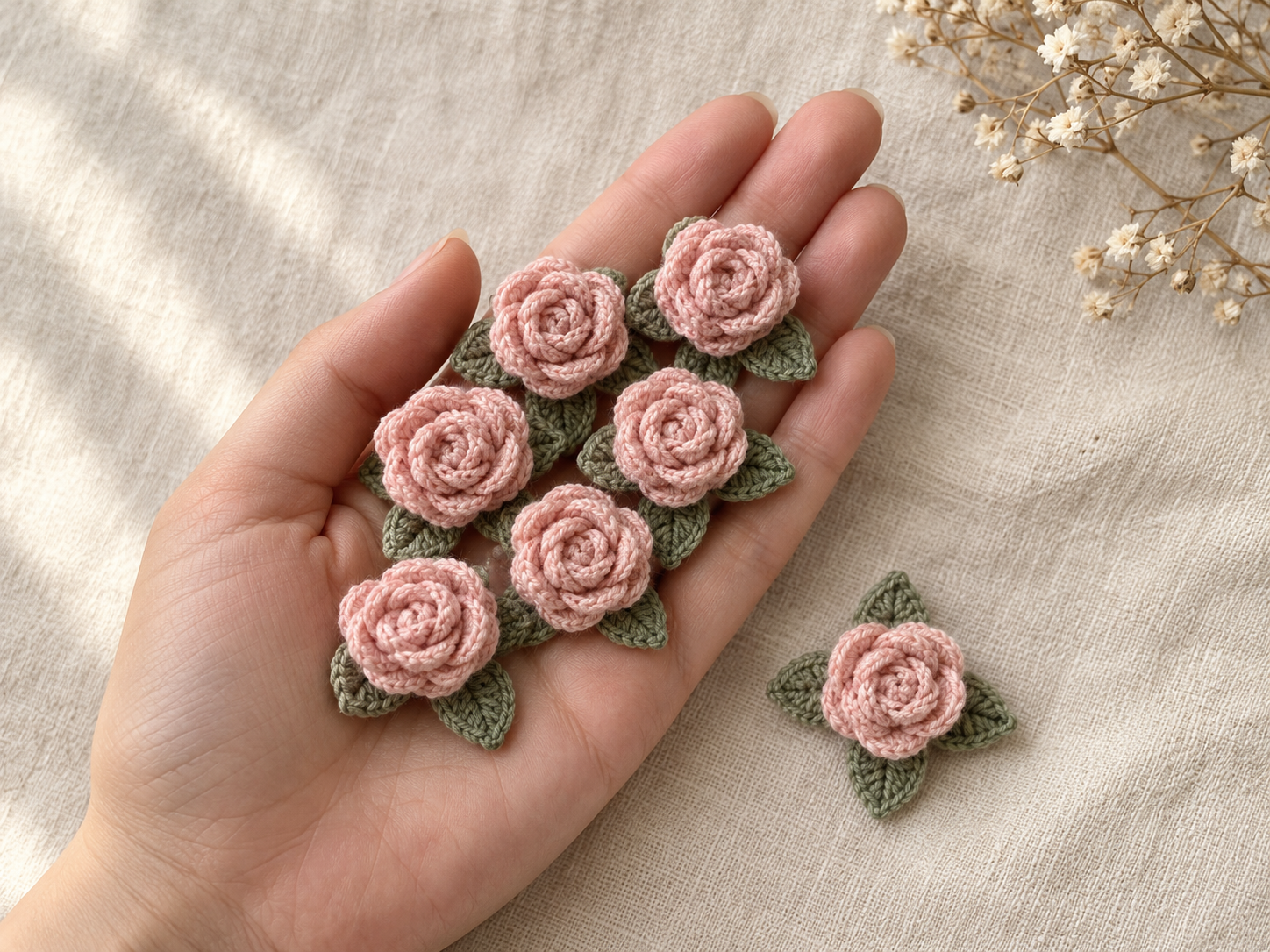
A crochet mini rose is a small crocheted strip rolled into a spiral flower, usually about 1 to 1.5 inches across, often finished with a three-leaf sepal base. You need scrap yarn, a 2.5mm hook, and roughly fifteen minutes per rose once you've made your first one.
I've stitched more than forty of these little roses this summer. They've ended up on greeting cards, a friend's wedding favours, and a very small pair of earrings I wear too often. Here's the exact pattern I settled on after tweaking the rolled-strip method half a dozen times.
Key Takeaways
- The rose is a straight crocheted strip (chain + fan of double crochets) rolled tight and stitched at the base.
- Use DK-weight cotton — Yarn Weight #3 in the Craft Yarn Council system. It holds crisp petal edges at this scale.
- One rose uses about 3 metres of pink and 2 metres of green — a single 50g ball makes 30+.
- Craft Yarn Council classes this as a Level 2 Easy project: basic stitches, simple shaping, simple finishing.
What You Need to Crochet a Mini Rose
You need a 2.5mm hook (US B/1), scraps of DK-weight cotton in pink and green, a tapestry needle, and small scissors. That's the whole list. No stuffing, no wire, no glue — the rose holds its shape from the tension of the roll and a few stitches through the base.
Why DK cotton specifically? The Craft Yarn Council Standard Yarn Weight System puts DK at weight #3, with a knit gauge of 21–24 stitches per 4 inches. That density gives crisp petal edges at a 1-inch scale. Sport (#2) works too but looks a little sparse; worsted (#4) makes a rose closer to 4cm across, which is a different project.
Materials:
- Yarn: DK-weight 100% cotton. I use DMC Natura Just Cotton in Rose Layette (N06) and Amazona (N77). Lion Brand 24/7 Cotton is a good worsted alternative if you want a slightly larger rose.
- Hook: 2.5mm (US B/1). A 3mm also works if your tension is on the tight side.
- Tapestry needle — a size 22 chenille needle glides through DK cotton without splitting stitches.
- Small sharp scissors for close-trim tails.
- Optional: hair clip, earring hook, brooch pin, or a folded card blank if you're finishing pieces.
This mini rose is what the Craft Yarn Council defines as a Level 2 Easy project — "projects using basic stitches, repetitive stitch patterns, simple color changes, and simple shaping and finishing." If you can chain, work a double crochet, and slip stitch, you're ready.
For the yarn beginners always ask about, see my guide to the best cotton yarn for small crochet projects.
How Do You Crochet a Mini Rose? Step by Step
You crochet a straight strip of double crochet fans, fasten off leaving a long tail, roll the strip tight from one end into a spiral, and sew through the base to hold it. The leaf trio is a separate small round worked directly onto a magic ring. Total time: about 12 to 15 minutes once you've made one.
Stitch abbreviations (US terms): ch chain · sl st slip stitch · dc double crochet · MR magic ring.
The rose (rolled-strip method)
Step 1 — Make the base chain. Chain 25 in pink DK cotton. Leave a 4-inch starting tail — weave it in later. Keep tension a touch looser than usual; too-tight chains fight the roll. 25 chains gives a rose about 2.5cm across, which is the sweet spot for hair clips and cards. Chain 15 for tiny earring roses; 35 for a bouquet filler.
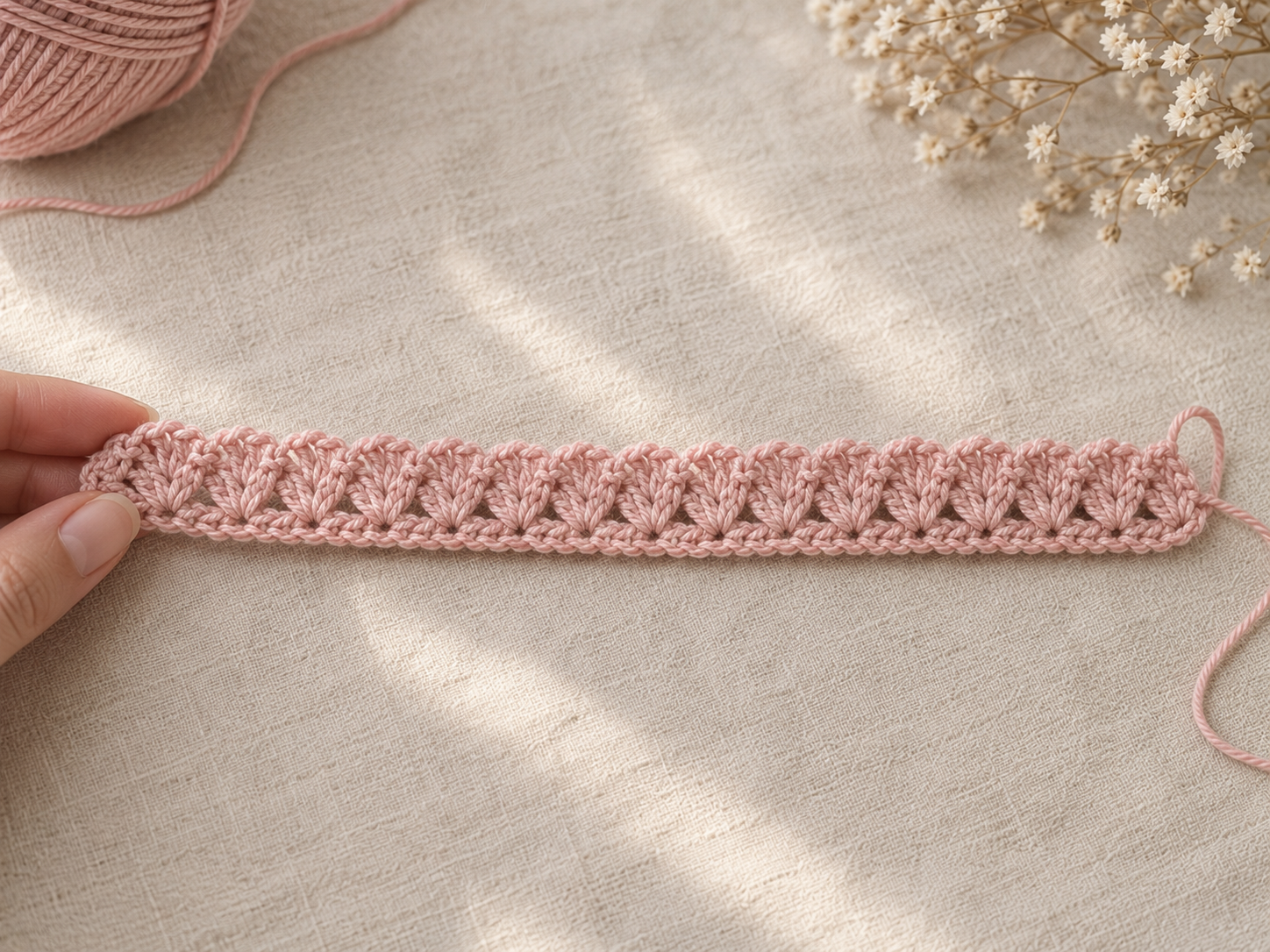
Step 2 — Work the fan row. 2 dc in the 4th chain from hook, then 3 dc in each remaining chain across. The turning ch-3 counts as your first dc, so you start with 2 dc + turning ch in the first stitch and 3 dc in every chain after. Cut yarn leaving a 10-inch tail — you need this length to stitch the base. Pull the tail through the last loop to fasten off.
Step 3 — Roll the rose. Roll the strip tight from the fasten-off end toward the starting tail. Keep the bottom edge (the original chain) flush — that's the base. The top edge naturally flares outward into petals as you roll. Pinch the base as you go. Ease pressure toward the outer petals so they flare instead of pressing flat against the core.
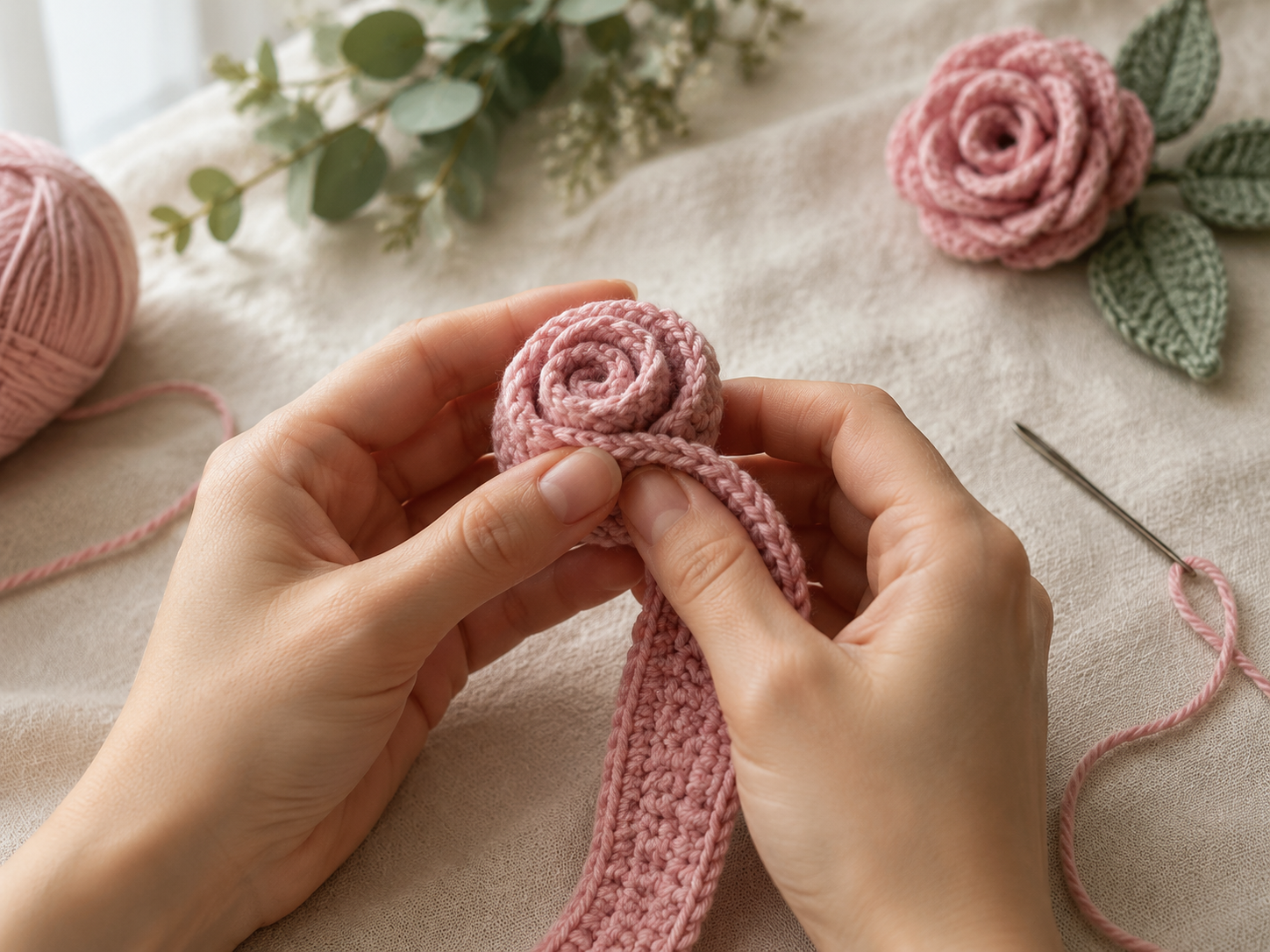
Step 4 — Secure the base. Thread the 10-inch tail onto a tapestry needle and stitch through the base 4 to 5 times. Push the needle straight down through the bottom of the roll, catching every layer. Do this in two directions to form a small X. That locks the spiral so it can't unroll. Don't cut the tail — you'll use it to attach the rose to the leaves.
The leaf base (3-leaf sepal)
Step 5 — Make a magic ring. In green DK cotton, form a magic ring and ch 1. If the magic ring is new to you, chain 4 and slip stitch in the first chain to form a small ring instead. Either works — the magic ring just closes tighter and vanishes into the finished piece. See my step-by-step magic ring tutorial if it's your first.
Step 6 — Work three leaves. Round 1: [ch 3, 3 dc in ring, ch 3, sl st in ring] three times. Each bracketed repeat makes one pointed leaf: the ch-3 forms one edge, the 3 dc fill the middle, the ch-3 forms the other edge, the slip stitch anchors it. You'll finish with three leaves radiating from the center. Pull the magic ring closed and fasten off with a short tail.
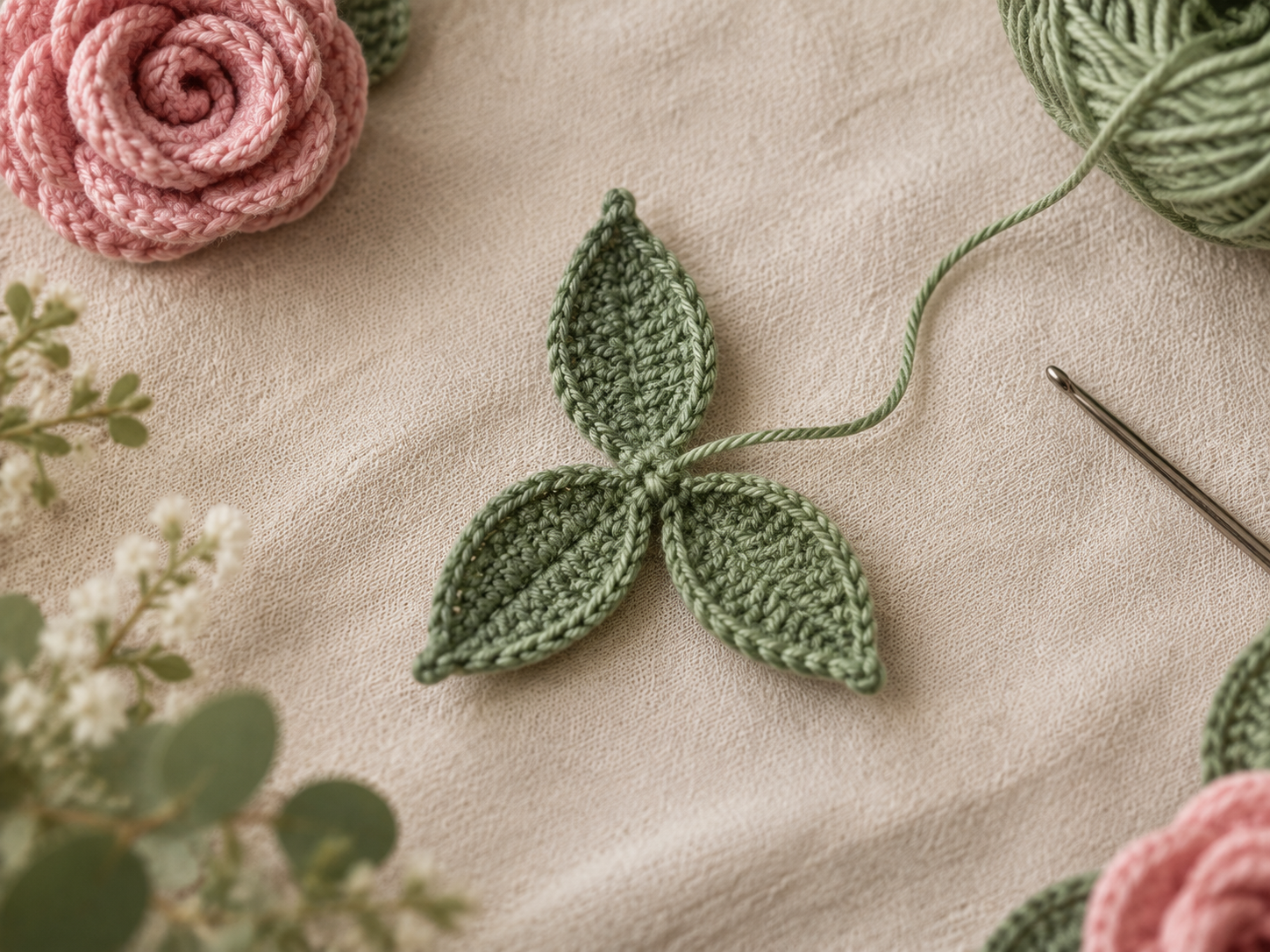
Step 7 — Assemble. Sit the rose in the center of the leaves and stitch through the base with the pink tail. Push the tapestry needle down through the rose base, out through the underside of the leaf trio, and back up through the rose. Repeat three or four times so the two pieces lock together. Weave in all tails and trim close.
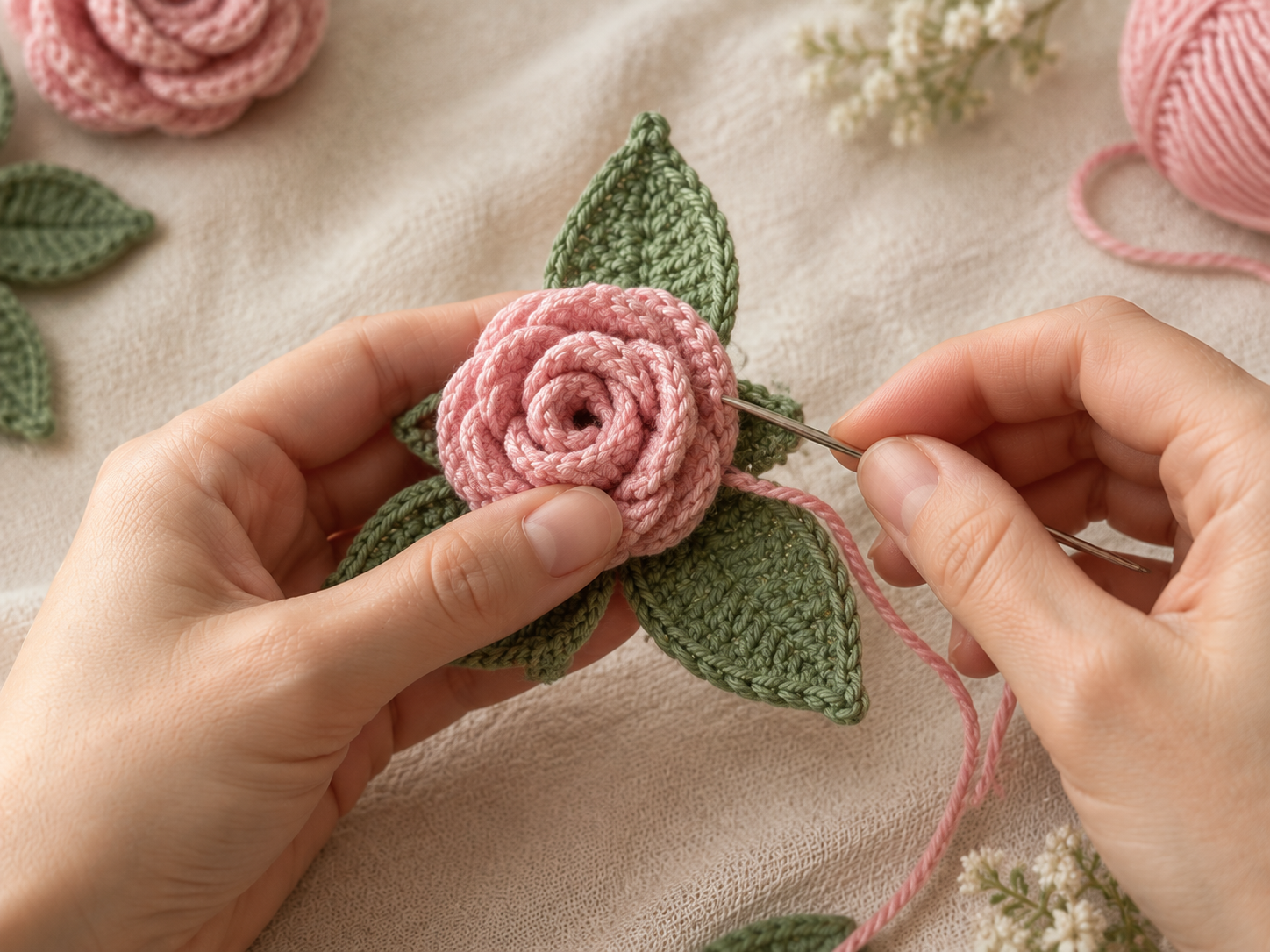
That's the whole pattern.
How Much Yarn Does a Mini Rose Actually Use?
Yardage scales with yarn weight. Working the same 25-chain strip in different Craft Yarn Council weight classes gives a consistent progression: about 2.5 metres in sport (#2), 3 metres in DK (#3), and 4 metres in worsted (#4). DK is my default because it hits the right visual density at a 2.5cm rose size without looking crowded.
Practical implication: a single 50g ball of DMC Natura Just Cotton (155m per ball) yields around 50 mini roses. That is a lot of Christmas gift toppers from one ball of pink cotton.
For a size chart of how starting chain length maps to finished rose diameter, see my mini rose size guide, from earring stud to cake topper.
What Can You Make With Crochet Mini Roses?
Mini roses turn into wearable and giftable pieces: earrings, hair clips, brooches, cake toppers, appliqué for cards and gift wrap, bouquet fillers, and embellishments on plain sweaters or cushion covers. Etsy has whole subcategories dedicated to them — the mini rose earrings market and micro crochet flower earrings market are both dedicated Etsy category pages, which tells you something about the demand.
My own record: I made eighteen roses in one Sunday afternoon for a friend's bridesmaid card boxes. Three balls of DMC Natura, one podcast, done by 5pm.
Ideas to try:
- Statement earrings — glue two roses to earring posts, or stitch through a jump ring.
- Hair clips — sew or glue onto plain metal alligator clips.
- Cake toppers — thread fine floral wire through the base of three roses for a cluster.
- Greeting cards — one rose glued to a folded cream card is a five-minute finish.
- Bouquet fillers — a dozen roses on wired stems tucked into a store-bought posy.
- Appliqué — stitch onto a plain sweater lapel or a linen napkin corner.
See how to turn crochet flowers into earrings for the findings-and-glue side of the finish.
How Do I Make My Mini Rose Look Fuller?
Two changes fix a flat-looking rose: chain more stitches at the start (35 instead of 25), and roll the last few inches loosely rather than tight. The extra length adds an outer whorl of petals; the loose roll lets them flare instead of pressing flat against the core. It's the single biggest lever you have.
The other thing worth doing is blocking. A quick steam over the kettle spout, held with tweezers, softens the cotton and lets the outer petals sit open in their final shape. I do this before I glue anything. For a proper walkthrough see my guide to blocking small crochet pieces.
What I got wrong the first time: I used acrylic worsted, and the whole rose looked like a fuzzy pom-pom within a day. Cotton holds crisp edges; acrylic doesn't. Learn from my ugly first batch.
Common Mistakes and How to Fix Them
Most first-time mini roses fail for one of three reasons: yarn that's too fuzzy, too-tight starting chains that won't roll, or a base that wasn't stitched through enough times. All three are fast to fix once you know what to look for.
The rose won't hold its spiral shape. Your base stitches aren't going through every layer. Push the needle straight down through the bottom of the roll, not sideways — sideways only catches the outer layer. Do it 4 to 5 times minimum.
The petals look flat instead of open. Either the roll is too tight all the way through, or your yarn is too thin for the hook. Try 35 chains, a looser outer roll, and check your DK cotton against the CYC #3 gauge — 21–24 sts / 4 inches.
The rose is fuzzy after a day. You're using acrylic or a wool blend. Switch to mercerised cotton. It's the single biggest quality upgrade for miniature crochet, and the reason the rolled-strip mini rose became a staple of published Ravelry patterns like Happy Patty's Mini Rose.
Frequently Asked Questions
How long does it take to crochet a mini rose? About 12 to 15 minutes per rose once you've made your first one. The first one usually takes twice that because of the roll-and-stitch step. A batch of ten takes roughly two hours if you work assembly-line style — all strips first, then all rolls, then all leaves, then all assembly.
What yarn is best for a mini rose? DK-weight mercerised cotton (Craft Yarn Council weight #3). It holds edges, doesn't fuzz, and takes steam blocking well. DMC Natura Just Cotton, Scheepjes Catona (doubled), and Ricorumi Cotton DK all work. Avoid acrylic and wool blends at this scale — they lose petal definition within a day.
Can beginners crochet a mini rose? Yes — the Craft Yarn Council rates the technique as Level 2 Easy: basic stitches, simple shaping, simple finishing. If you can chain, work double crochet, and slip stitch, you already have every skill this pattern needs. The finishing (rolling and stitching) is the fiddliest part.
Can I sell mini roses I crochet from this pattern? Yes — you can sell the finished roses. The rolled-strip method itself is a public-domain crochet technique, taught in printed leaflets since the 1970s. What you can't do is republish this specific write-up or my photos. Standard indie-crafter rule: sell the object, not the pattern.
Do I need a magic ring for the leaves? Strictly no — chain 4 and slip stitch to form a ring works too. The magic ring just closes tighter, which matters more at 2.5cm than at 25cm. If you crochet at this scale often, learning the magic ring is worth an afternoon.
What's Next?
Once you've made a few singles, the natural next step is a rose cluster or garland — same motif, more of them, joined with a chain stem or glued to a wire. Or size up: the same method scales to a 3-inch statement rose using worsted-weight cotton and a 4mm hook.
For the size-up, see my 3-inch statement rose brooch pattern. For matching foliage, try the five free crochet leaf patterns. And if you want the chart in a printable format, grab the printable mini rose PDF with US and UK stitch conversion.
If you'd like small-project patterns like this one landing in your inbox each week, join the Wavode letter — one email, Saturday morning, no filler.
Questions about this pattern? Write to support@wavode.com.