Free Crochet Snake Pattern

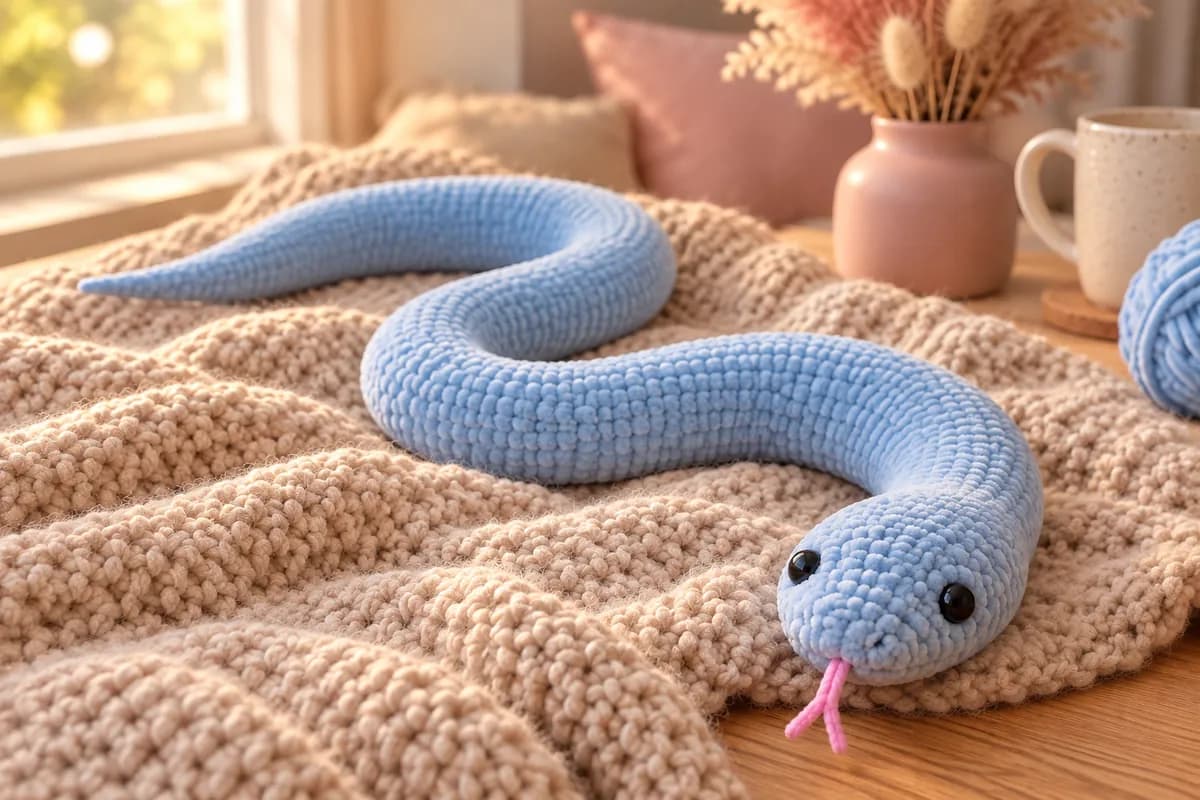
This free crochet snake pattern makes a long, squishy plush snake, about 30 inches from tail to snout, with a little forked pink tongue. It's one piece, worked in the round from the tip of the tail to the snout, so there's nothing to sew on except the tongue. You'll need about 100 yards of plush chenille yarn, a 5 mm hook and 2 to 3 hours.
Key Takeaways
- One continuous tube: the tail grows from 4 to 12 stitches, the body stays at 12, and the head swells to 18 before closing at the snout.
- No sewing except the tongue, which is a tiny chain fork.
- Light stuffing in the body keeps it bendy, so it drapes over a shoulder or wraps around a wrist.
- About 100 yd (90 m) of super bulky plush yarn, which is one 300 g ball.
Why I love this plush snake
Some patterns are all about the details. This one is all about the feel: a long, soft, bendy snake you can drape over your shoulders or loop around your arm. It's my go-to for a last-minute gift, because it's quick and nobody guesses how easy it was.
It's also the best first amigurumi I know. Most of it is plain single crochet in a spiral, 12 stitches a round, so you can work it while watching a movie. The only shaping is a slow taper at the tail and a gentle bulge for the head.
Why plush yarn? It hides small tension wobbles, so the body comes out smooth, and the stitches almost disappear. The result looks like a soft toy from a shop, not a first project.
Skill level. Easy. You need a magic ring, sc, inc and dec in the round, and stuffing as you go. Plush yarn is a little harder to count, so I'll show you how to keep track.
If you like quick plushies, my soft baby dolphin and Piko the pond turtle are just as beginner friendly.
What you'll need
Yarn: super bulky #6 plush chenille, such as Bernat Baby Blanket, in powder blue: about 100 yd (90 m). That's one 300 g ball (220 yd), or two 100 g balls. Plush yarn is soft, it washes well, and it builds a long snake quickly.
Tongue: a scrap of pink worsted yarn, about 1 yd. Worsted is much easier to shape into a tiny fork than chenille.
I worked the plush amount out from the stitch counts: about 900 single crochet at roughly 4 inches of plush yarn each, plus a little for the closing and tails.
Hook and notions
- 5 mm (US H-8) hook. It's much smaller than the label suggests. Plush yarn needs a tight fabric, or the stuffing shows between the stitches.
- Two 8 mm black safety eyes, or black worsted yarn to embroider the eyes.
- Polyester fiberfill, about 2 oz (55 g).
- A stitch marker, a tapestry needle and scissors.
Gauge and finished size
Gauge isn't critical, but tension is. Your stitches should be tight enough that the stuffing doesn't show through. As a check, the body tube (12 sts) should be about 1¾ in (4.5 cm) thick when lightly stuffed. If it's much fatter, go down to a 4.5 mm hook.
Round gauge: the length is all in the rounds, so it's worth checking. Aim for about 5 rounds to 2 in (5 cm), measured along the body after 10 body rounds. If your rounds are shorter, you'll need a few more body rounds to reach the same length. I'll remind you to measure before you start the head.
Finished snake: about 30 in (76 cm) from the tip of the tail to the snout, at the round gauge above. The head is about 2¼ in (6 cm) wide. Measure your first one: plush yarns vary a lot from brand to brand, and you can make the snake longer or shorter by changing the number of body rounds.
Abbreviations (US crochet terms)
- MR = magic ring
- ch = chain
- sl st = slip stitch
- sc = single crochet
- inc = 2 sc in the same st
- dec = single crochet two together (I use the invisible decrease through the front loops)
- st(s) = stitch(es)
- rnd(s) = round(s)
Work in continuous rounds, without joining. Move the stitch marker up at the start of every round.
Counting plush stitches. Chenille hides the V's. Feel for the stitch instead of looking for it: each stitch has a little hole to its right. And count the rounds in groups of 10, with a scrap-yarn tie every 10 rounds. That's a lifesaver on the long body.
The pattern — step by step
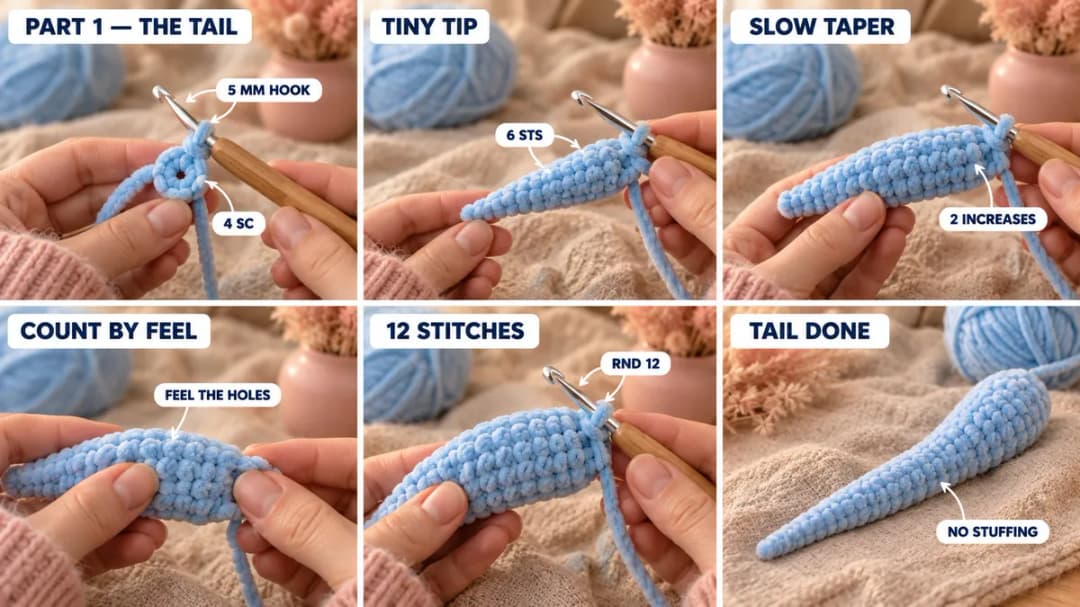
Part 1 — The tail (Rnds 1–12)
The magic ring is the tip of the tail. The snake grows from there all the way to the snout.
- Rnd 1: MR, 4 sc in the ring. (4)
- Rnd 2: Sc in each st around. (4)
- Rnd 3: (Sc, inc) × 2. (6)
- Rnds 4–5: Sc in each st around. (6)
- Rnd 6: (2 sc, inc) × 2. (8)
- Rnds 7–8: Sc in each st around. (8)
- Rnd 9: (3 sc, inc) × 2. (10)
- Rnds 10–11: Sc in each st around. (10)
- Rnd 12: (4 sc, inc) × 2. (12)
Pull the starting tail tight to close the tip, then tuck it inside the tail. You have a slim cone, about 4 to 5 in (10–13 cm) long at the round gauge above. For a longer, finer tip, add 1 even round after each increase round. Don't stuff the tail tip. It's too narrow, and it should stay floppy.
Part 2 — The body (Rnds 13–64)
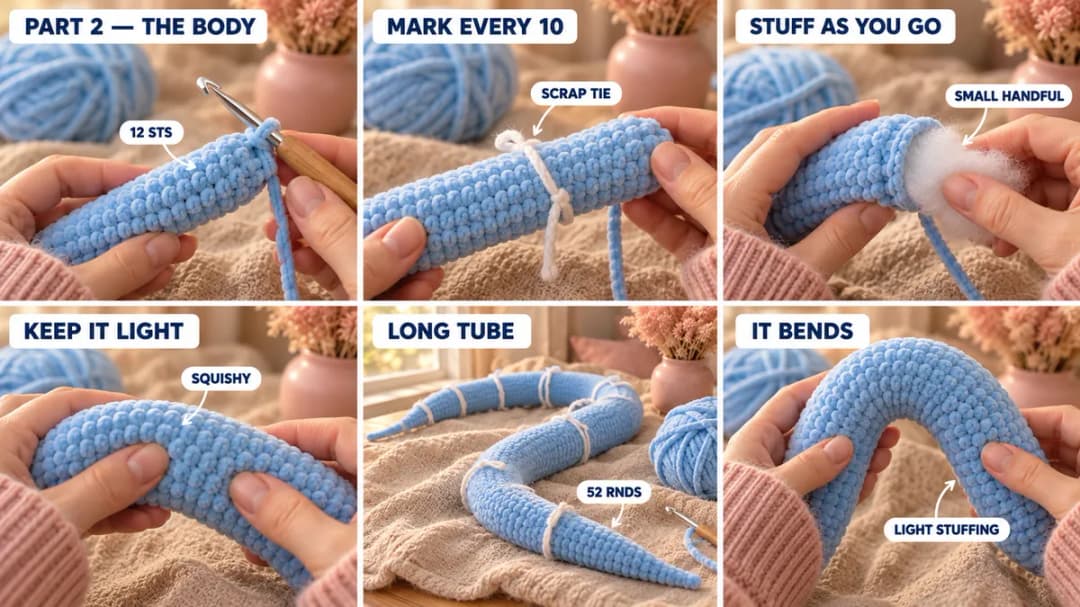
- Rnds 13–64: Sc in each st around. (12) That's 52 rounds.
Stuff as you go: every 10 rounds or so, push in a small wisp of fiberfill, the same amount each time, and spread it along the tube with your fingers. Keep the body lightly stuffed, just enough to round it out. A firm body turns into a stiff pole, and a light one bends, drapes and wraps. Even stuffing matters more than the amount: one big clump makes a lump that won't curve.
The stitches spiral a little as you go. That's normal for continuous rounds, and plush yarn hides it.
Measure before the head. Lay the snake flat and measure from the tail tip to your hook. It should be about 26 in (66 cm), because the head adds about 4 to 5 in. If it's shorter, work a few more body rounds; if it's longer, that's fine, the snake is just longer.
Make it longer or shorter. Every 5 extra body rounds add about 2 in (5 cm) and about 7 yd of yarn. A 40-in snake needs about 25 more rounds, so about 35 yd more.
Part 3 — The head (Rnds 65–76)
The last round closes at the snout. Before you start the head, look at the body and pick the side you like best as the top. The eyes go on that side.
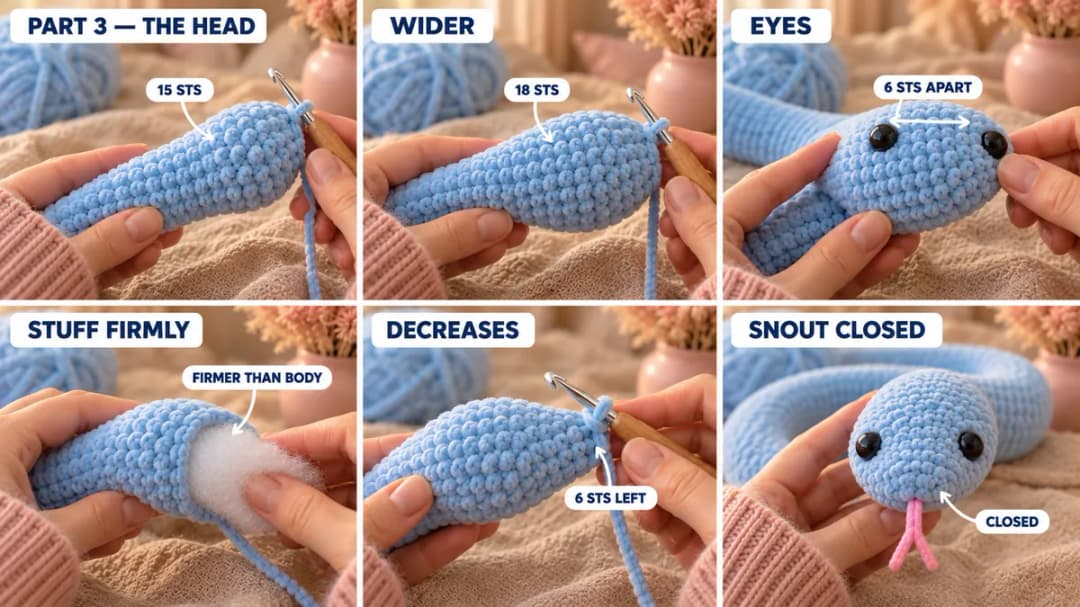
- Rnd 65: (3 sc, inc) × 3. (15)
- Rnd 66: (4 sc, inc) × 3. (18)
- Rnds 67–72: Sc in each st around. (18) Six even rounds give the head its long, slightly oval shape.
Eyes. Insert the safety eyes between Rnds 70 and 71, on the top of the head toward the front, with 6 sts between them. Check them from the front before you snap the washers on. For a baby or a toddler, skip the safety eyes and embroider each eye with black worsted instead: 4 or 5 short stitches stacked on the same spot, over 1 st.
- Rnd 73: (4 sc, dec) × 3. (15)
- Rnd 74: (3 sc, dec) × 3. (12)
Stuff the head firmly, more than the body. Press it a little flat from top to bottom as you go, so it looks like a snake's head rather than a ball.
- Rnd 75: (2 sc, dec) × 3. (9)
- Rnd 76: (Sc, dec) × 3. (6)
Fasten off, leaving a 6-in tail. Thread it through the front loops of the last 6 sts, pull the snout closed and weave the tail in.
Part 4 — The tongue and finishing
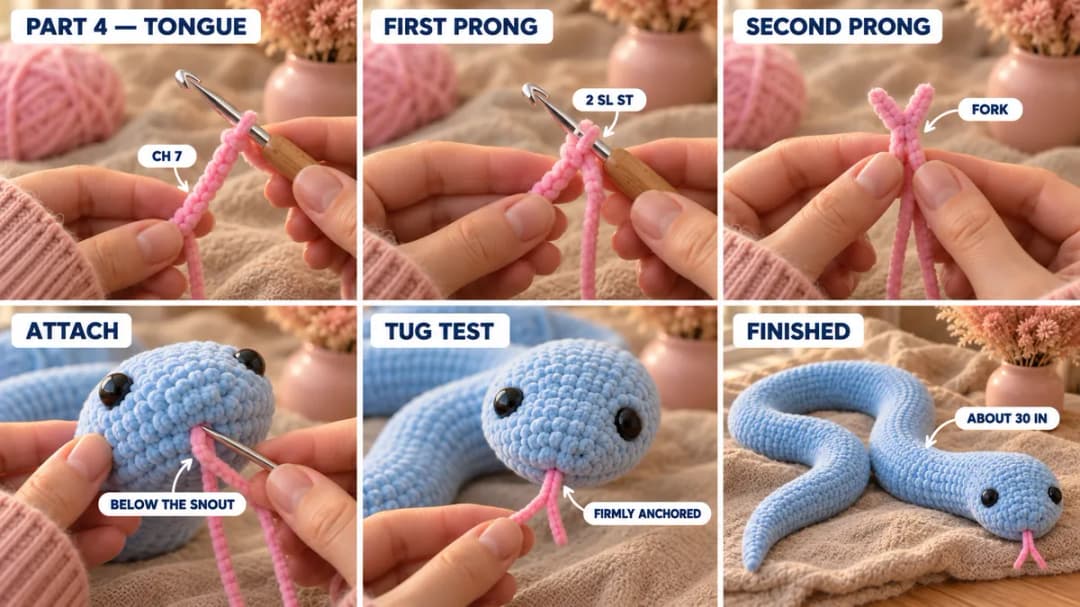
Tongue (pink worsted). Leave a 6-in tail, then ch 7.
- Sl st in the 2nd ch from the hook and in the next ch. That's the first prong.
- Ch 3. Sl st in the 2nd ch from the hook and in the next ch. That's the second prong.
- Sl st in each of the 4 remaining ch of the first chain, back to the start.
Fasten off, leaving a 6-in tail. You have a little Y, with both tails at the base.
Attach the tongue. Thread both tails onto the needle and push them into the center of the snout, just below the closing point, then out through the bottom of the head. Knot the two tails together twice, push the knot into the head and hide the ends inside. Tug the tongue gently to check that it's firmly anchored.
Shape your snake. Lay it in loose S-curves, or coil it around a wrist, a chair arm or a plant pot, and shape each curve with your hands. A lightly stuffed body drapes into soft curves, but it won't hold a stiff pose on its own.
Safety. Safety eyes are a small part, so I don't recommend them for children under 3. For babies and toddlers, embroider the eyes, and check the tongue knot from time to time. Don't add wire or pipe cleaners to a toy for a child.
Make it yours — quick variations
| Variation | Change from base pattern |
|---|---|
| Striped snake | Change color every 4 rounds of the body, on the last yarn over of the round before. |
| Giant snake | Add 25 body rounds for a 40-in snake to drape over a sofa or a shoulder. |
| Baby-safe snake | Embroider the eyes and stitch the tongue flat on the snout instead of letting it hang. |
| Sleepy snake | Embroider two short curved lines in black instead of eyes, for a snake that's dozing. |
| Mini snake | Use worsted cotton and a 3.5 mm hook for a slim snake about 15 in long. |
Troubleshooting the three things that go wrong
The stuffing shows through
Your stitches are too loose for plush yarn. Go down half a hook size, and pull each stitch a little snug. Stuffing the body lightly also helps, because firm stuffing stretches the fabric open.
The snake is stiff and won't bend
The body is overstuffed. Pull a little fiberfill out through the head end before you close it, or squeeze the body to spread the stuffing out. It should feel squishy, not firm.
The eyes end up on the side
The round marker drifts as the rounds spiral. Ignore the marker when you place the eyes: pick the top of the head by eye, then count 3 sts on each side of the center.
Frequently asked questions
How long does this crochet snake take? About 2 to 3 hours. The tail takes about 20 minutes, the long body about an hour and a half, and the head and tongue about half an hour.
How much yarn do I need? About 100 yd (90 m) of super bulky plush yarn, plus a yard of pink worsted for the tongue. One 300 g ball of Bernat Baby Blanket is plenty for a 30-in snake.
Can I use regular yarn instead of plush? Yes. Worsted acrylic or cotton with a 3.5 mm hook gives a slimmer snake, about 15 in long with the same counts. Add body rounds if you want it longer.
Is this a good first amigurumi? Yes. It's one piece, the stitch count stays at 12 for most of it, and there's almost no sewing. If you can make a magic ring and work sc in a spiral, you can make this snake.
Can I sell snakes made from this pattern? Yes, you're welcome to sell finished snakes made from this free pattern at markets, on Etsy or as gifts. Please credit "Pattern by Wavode" in your listing and link back to this page. What you can't do is republish this write-up or my photos as your own pattern.
Related patterns on Wavode
- Soft baby dolphin: a 10-inch plush dolphin for beginners.
- Piko the pond turtle: a chunky turtle with no sewing.
- Crochet lion plush: a cream lion with a scalloped mane.
- Crochet rubber duck: a classic yellow duck amigurumi.
Made a snake? Tag #wavodecrochet on Pinterest. I re-pin every finished make and credit the maker.
Pattern by Clara Hartwell for Wavode. Questions? Email me at support@wavode.com.