Crochet Baby Socks

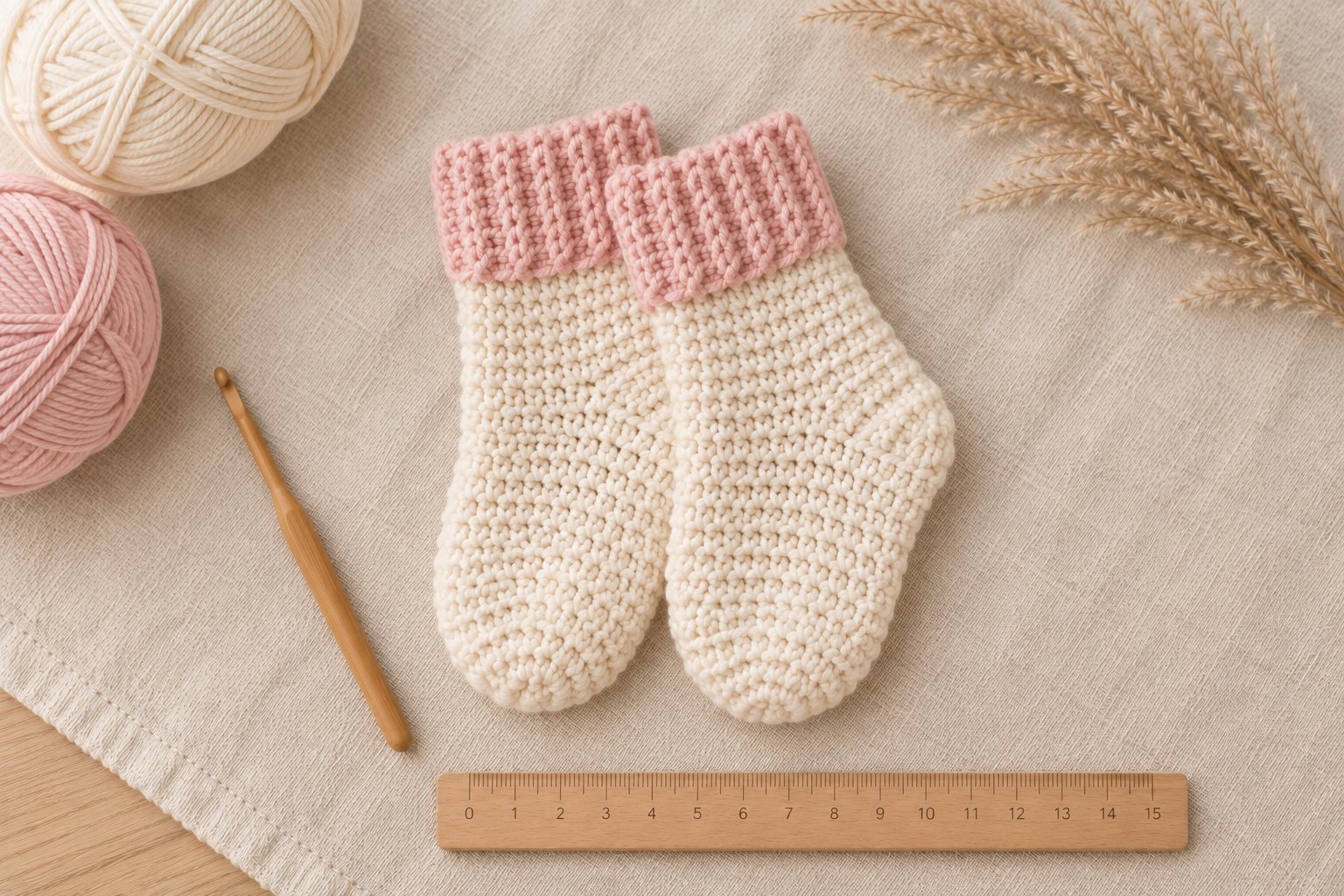
The easiest free crochet baby socks pattern is a cuff-down tube — a stretchy ribbed cuff worked flat and seamed, then single crochet in the round down the leg and foot, finished with a small rounded toe. No heel shaping to fuss with, which is exactly what a non-walking baby foot wants. Cream DK cotton with a soft blush cuff stripe, around 80 yards total, a 3.5 mm hook, and one relaxed evening from cast on to weaving in the last end.
Key Takeaways
- Ribbed cuff worked flat in back-loop-only sc for stretch, seamed into a ring, then the leg and foot crocheted seamlessly in the round.
- 70 yd cream + 10 yd blush DK #3 cotton, 3.5 mm hook, sized for 0–3, 3–6, and 6–12 months (Craft Yarn Council baby-foot sizing chart).
- No heel construction — a straight tube foot is designed for pre-walker babies and finishes far faster than a shaped sock.
- Finishes in 2–3 hours per pair — a same-day baby-shower gift if the shower is tomorrow.
Pattern at a glance
- Stitch: single crochet (SC), worked in back loops only for the cuff, standard sc for the leg and foot.
- Yarn: DK #3 weight cotton, 80 yd total (70 cream + 10 blush).
- Hook: 3.5 mm (US E-4).
- Construction: ribbed cuff worked flat and seamed → leg picked up along the cuff edge in the round → straight foot tube → gathered toe.
- Shaping: none through the foot — decreases only at the toe.
- Finished size: 3 baby sizes (0–3, 3–6, 6–12 months).
- Time to complete: 2–3 hours per pair.
- Skill level: advanced beginner — sc, sc2tog, chain, and a short sl st seam through both layers of the cuff.
Why a ribbed cuff matters for baby socks
Baby socks fall off. That's the universal truth every new parent learns in the first week. A plain sc cuff has almost no memory in it, so it slides straight off a wiggly foot. The trick is working the cuff flat in back-loop-only single crochet, which creates a horizontal ribbing that stretches side to side. When it's seamed into a ring, that stretch becomes a gentle grip around the ankle — enough to stay put through a nap, gentle enough not to leave a mark on tiny skin.
I hooked my first pair of baby socks the winter my nephew was born. His mum had a drawer full of storebought socks that lasted about four minutes on his feet each. The pair I made with a proper ribbed cuff? She still has them, worn thin at the toes, tucked into his baby box. That's the difference the cuff makes.
What you'll need
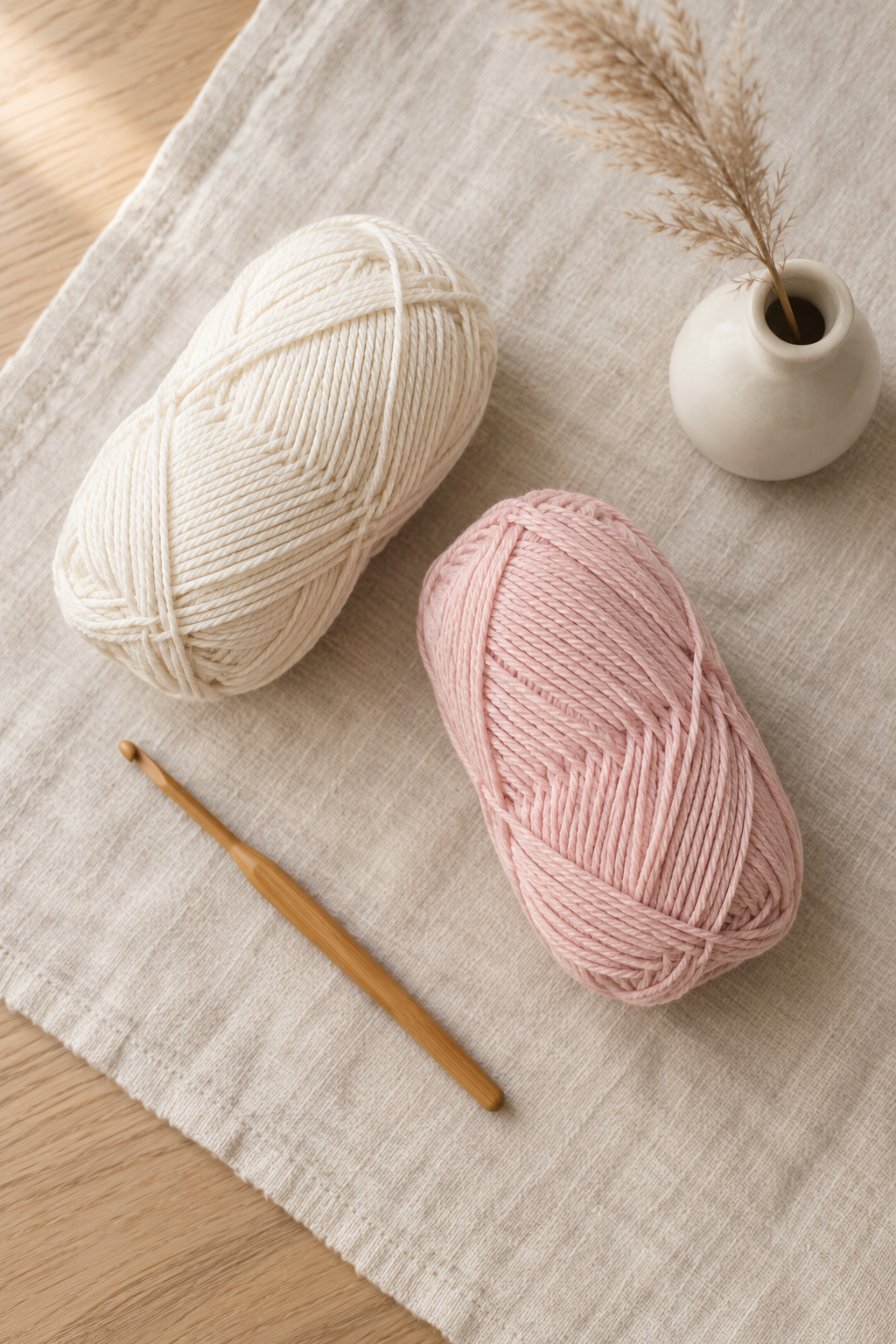
Yarn (DK #3 weight cotton, ~80 yd / 74 m total)
- 70 yd cream / ivory — Paintbox Cotton DK in Vanilla Cream, Rico Creative Cotton DK in Ecru, or DMC Natura Just Cotton DK in Ivory.
- 10 yd soft blush / dusty pink — Paintbox Cotton DK in Blush Pink, Rico Creative Cotton DK in Pastel Pink.
Scheepjes Catona is a lovely cotton but sits between sport and light DK — if you want to substitute it, check your swatch against the gauge below and go up half a hook size if the fabric feels stiff.
Hook
- 3.5 mm (US E-4) — Clover Amour or a similar bamboo hook. If you crochet tight, go up to 4 mm.
Notions
- Tapestry needle (large-eye, blunt).
- Stitch marker (1).
- Scissors.
- Measuring tape.
Gauge
- 20 sc × 22 rows = 4 in (10 cm) square on a 3.5 mm hook in DK cotton.
- If you're within one stitch of gauge, the fit still works. Baby socks forgive.
Sizing chart (baby foot length)
Choose the size from the baby's actual foot length, not the birthday. Some newborns arrive with 3.5-inch feet, others with 4-inch feet — measure whenever you can.
| Size | Age (approx) | Foot length | Cuff rows | Leg rounds | Foot rounds |
|---|---|---|---|---|---|
| 0–3 mo | Newborn to 3 mo | 3.5 in | 20 | 6 | 12 |
| 3–6 mo | 3 to 6 mo | 4 in | 22 | 7 | 14 |
| 6–12 mo | 6 to 12 mo | 4.5 in | 24 | 8 | 16 |
If in doubt, size up. A slightly loose sock stays on with the ribbed cuff; a tight one turns into a red ring around the ankle.
Abbreviations
- ch — chain
- sc — single crochet
- sc BLO — single crochet in back loop only
- sc2tog — single crochet two together (a decrease)
- sl st — slip stitch
- st(s) — stitch(es)
- rep — repeat
Making the ribbed cuff (make 2, one per sock)
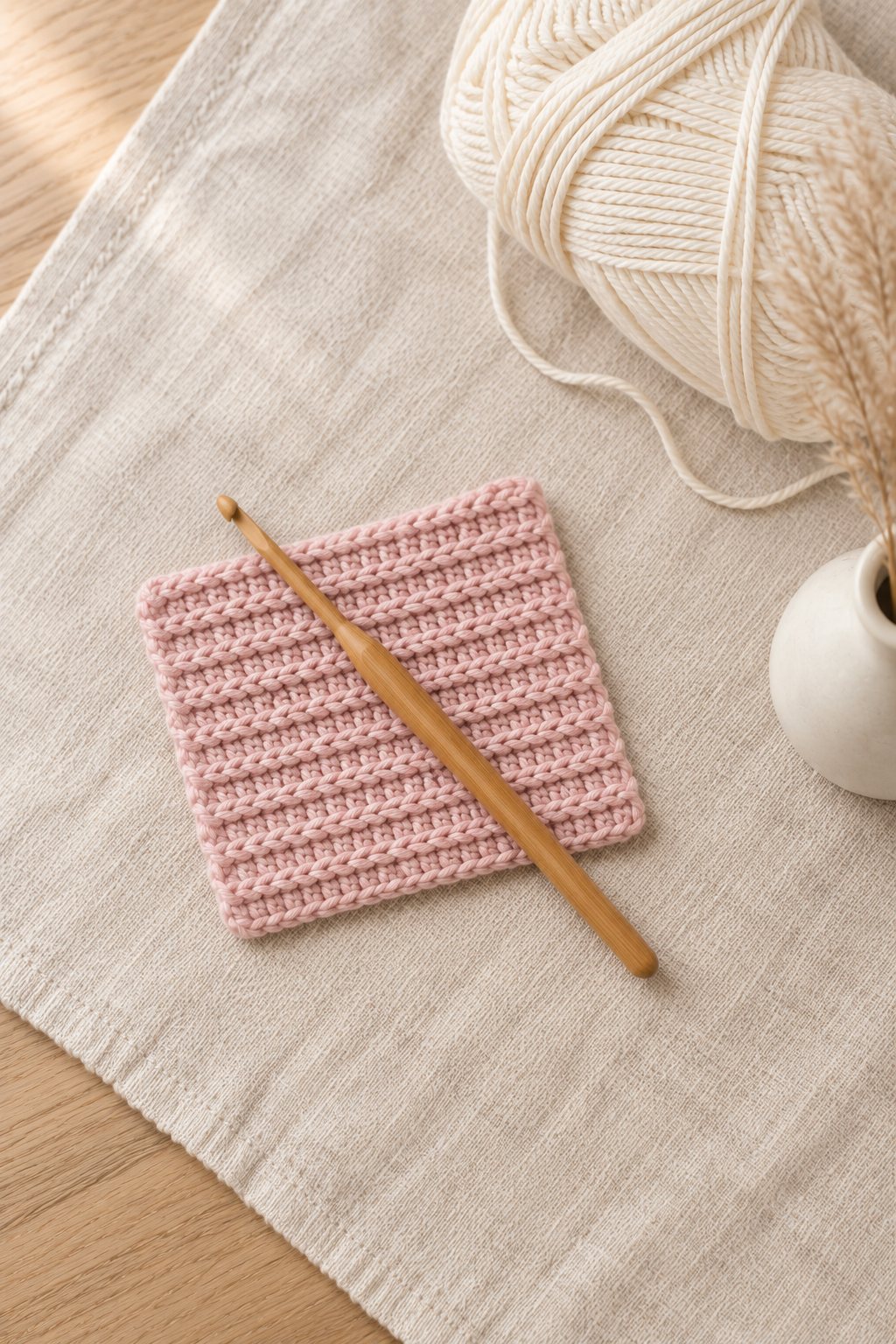
The cuff is worked flat as a small rectangle, then seamed into a ring. The stripes of back-loop-only sc create a stretchy ribbed texture that hugs the ankle.
Foundation: With blush yarn, ch 9 (for all sizes — the cuff height stays the same across sizes; only the length changes).
Row 1: SC in the 2nd ch from hook and in each ch across. Turn. (8 sc)
Rows 2–20 (for size 0–3 mo; use 22 rows for 3–6 mo, 24 rows for 6–12 mo): Ch 1, sc BLO in each st across. Turn.
The back-loop-only stitch creates a visible ridge every row — that's the ribbing. After the last row, do NOT fasten off. Fold the rectangle in half so the two short ends meet, wrong sides together.
Seaming the cuff into a ring: Sl st the two short ends together through both layers (8 sl st). Turn the ring right-side out and rotate it so the ribbing runs vertically around the ankle. Fasten off, leaving a 4-in tail to weave in later.
You now have a small stretchy tube — the ankle cuff.
Picking up the leg (worked in the round)
Rotate the cuff ring so the ribs run vertically. You'll work into the long edge of the rectangle — one stitch per row-end.
Round 1: Join cream yarn with a sl st into any row-end along one long edge of the cuff. Ch 1, then work 1 sc into each row-end all the way around the cuff opening. For size 0–3 mo, that's 20 sc; 3–6 mo is 22 sc; 6–12 mo is 24 sc. Sl st to first sc to join.
Place a stitch marker in the sl-st join so you can find the round start again.
Rounds 2–6 (0–3 mo; use rounds 2–7 for 3–6 mo, rounds 2–8 for 6–12 mo): Ch 1, sc in each st around. Sl st to first sc to join.
The leg is a short straight tube — no shaping. Baby ankles are almost the same circumference as baby feet, so the tube stays uniform all the way through.
Working the foot (straight tube, no heel shaping)
Because this pattern skips heel construction, the foot is simply a continuation of the leg tube. This straight-tube design is intended for pre-walker babies — the foot slides in easily and the ribbed cuff keeps the sock in place. Once a baby starts walking, a properly shaped sock with a heel and non-slip sole is a better choice.
Rounds 7–18 (0–3 mo; use 8–21 for 3–6 mo, 9–24 for 6–12 mo): Ch 1, sc in each st around. Sl st to first sc to join.
Before starting the toe, lay the sock flat and measure from the cuff join to the last worked round. Stop the foot rounds when this measurement is about 1 cm (⅜ in) shorter than the target foot length from the sizing chart — the toe decreases will close that remaining length as they gather the tip.
Shaping the toe (rounded gather-close)
Toe decreases pull the tube into a rounded closed end. Each size uses a slightly different sequence so every stitch is consumed cleanly — do not use the wrong size's rounds even if the numbers look close.
Size 0–3 mo (starting from 20 sts)
- Toe round 1: Ch 1, [sc2tog, sc in next 2 sts] 5 times. Sl st to join. (15 sts)
- Toe round 2: Ch 1, [sc2tog, sc in next st] 5 times. Sl st to join. (10 sts)
- Toe round 3: Ch 1, sc2tog around (5 times). Sl st to join. (5 sts)
Size 3–6 mo (starting from 22 sts)
- Toe round 1: Ch 1, [sc2tog, sc in next 2 sts] 3 times, then [sc2tog, sc in next 3 sts] 2 times. Sl st to join. (22 sts consumed → 17 sts)
- Toe round 2: Ch 1, [sc2tog, sc in next st] 5 times, then sc2tog once. Sl st to join. (17 sts consumed → 11 sts)
- Toe round 3: Ch 1, sc2tog 5 times, then sc in the last st. Sl st to join. (11 sts consumed → 6 sts)
Size 6–12 mo (starting from 24 sts)
- Toe round 1: Ch 1, [sc2tog, sc in next 2 sts] 6 times. Sl st to join. (18 sts)
- Toe round 2: Ch 1, [sc2tog, sc in next st] 6 times. Sl st to join. (12 sts)
- Toe round 3: Ch 1, sc2tog around (6 times). Sl st to join. (6 sts)
Closing the toe (all sizes)
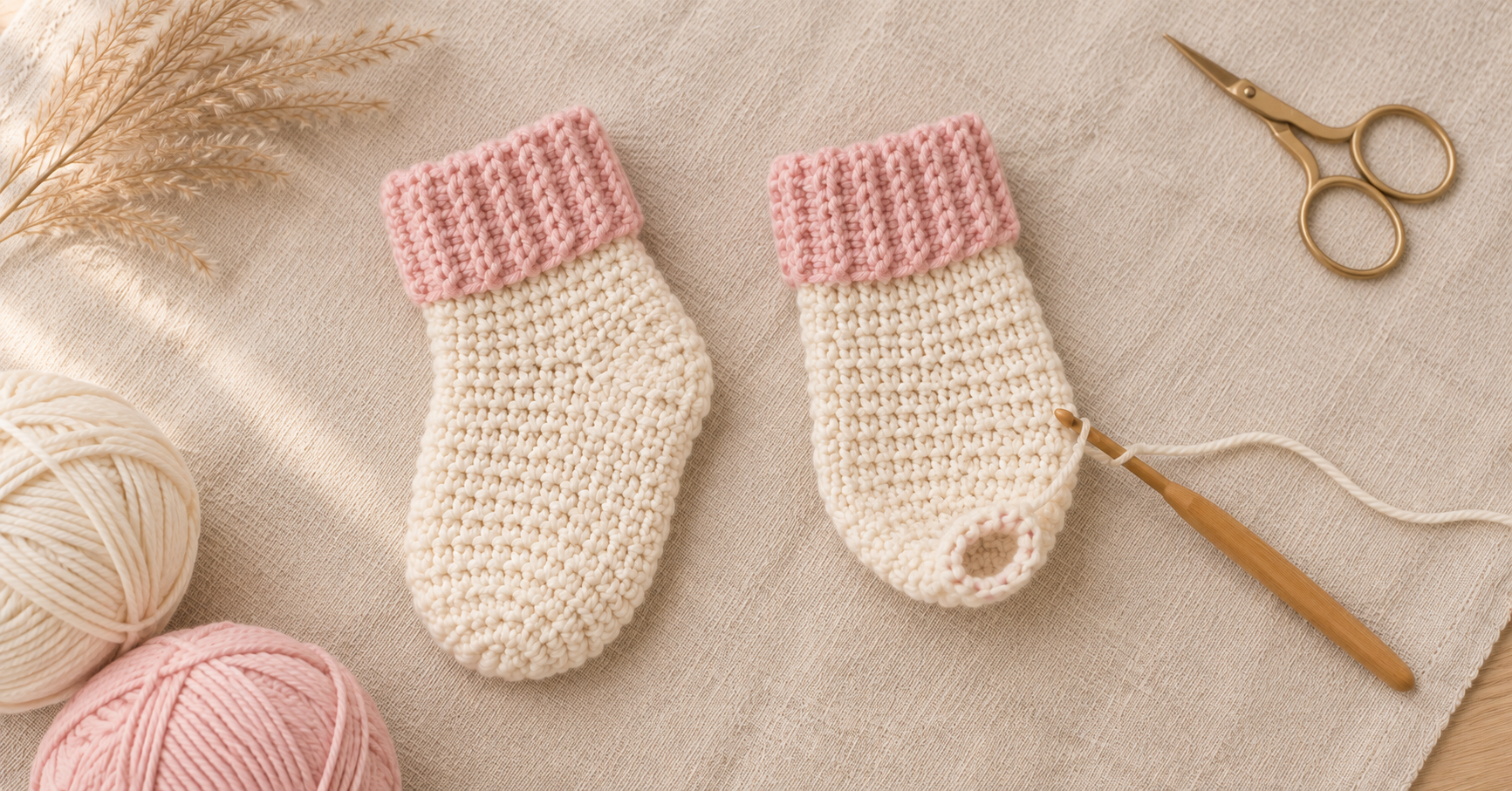
Fasten off, leaving a 10-in tail. Thread the tail through the remaining loops with a tapestry needle, pull tight to close the toe, and secure with 2–3 small stitches on the inside. Weave the tail in through the sole for at least 2 inches — baby toes find loose ends.
Repeat everything for the second sock.
Finishing touches
- Weave every end through at least 6 stitches in two directions, ideally along the inside of the cuff seam or under the toe. Babies will find any loose tail within a week.
- Block gently. Slip the finished sock over a rolled-up dishcloth to shape the tube, mist lightly with cool water, and let air-dry. No heat, no iron — DK cotton relaxes into shape on its own.
- Optional monogram. A single embroidered initial in blush thread on the outer cuff turns a plain pair into a baby-shower keepsake. Use a backstitch, small letters, and knot securely on the wrong side of the cuff (which is fully enclosed against the leg, so no scratchy edges touch skin).
Care instructions
Hand-wash in cool water with a fragrance-free baby-safe soap. Squeeze between a rolled towel to remove water. Reshape the tube and lay flat to dry. Never wring the sock or hang it from the cuff — DK cotton stretches when wet and won't recover its shape. These socks handle the newborn laundry rota beautifully and hold up wash after wash.
Troubleshooting the socks
The cuff won't stay on the ankle. The ribbing is worked too loosely. Rework the cuff with the same yarn on a hook a half size smaller (3.25 mm), or count that you're doing sc back loop only — not both loops. The BLO is what creates the stretch.
The toe puckers into a point instead of a rounded end. You skipped the middle toe round. All three rounds are needed for a rounded shape — the middle round (the [sc2tog, sc in next st] sequence) is what smooths the taper. Rework from the last plain foot round.
The leg tube is baggy at the ankle. Your row count on the cuff was too high, or the picked-up leg round has more sc than the number of cuff rows. Recount: 20 rows on the cuff means 20 sc around the leg for size 0–3 mo. One-to-one is the rule.
One sock is longer than the other. Count foot rounds on both — losing one round is easy on the second sock. Rip back to match and rework the toe.
The pair looks flat and stiff. DK cotton stiffens the first wear. A gentle warm-water soak and a lay-flat dry softens the fibers within one cycle.
Frequently asked questions
Are these baby socks safe for a newborn?
Yes, when made with cotton and securely woven ends. Cotton is breathable, hypoallergenic, and washable — three qualities that matter for newborn skin. Natural cotton lets tiny feet regulate temperature the way bare feet do, which is why I prefer it over acrylic for baby wear. Avoid buttons, beads, or embellishments on socks for babies under 12 months, and always check for a caregiver's specific medical guidance if the baby has known sensitivities.
Can I make these socks for a walking baby?
The tube design fits best on pre-walkers (under 10 months roughly). Once a baby stands and toddles, they need a proper shaped heel and a non-slip sole. For a walker, size up two sizes, add a small oval reinforcement patch on the sole, and consider a light dot of puffy fabric paint on the underside for grip once the socks are complete and washed.
Can I use acrylic yarn instead of cotton?
You can, but cotton is worth the small extra cost for baby gifts. Acrylic pills after a few washes, doesn't wick moisture, and can trap heat on tiny feet. If you must use acrylic, choose a soft baby-blend labeled "hypoallergenic" and avoid metallic or novelty yarns entirely.
How many pairs can I make from one 50 g skein?
A standard 50 g DK cotton skein (approximately 125 yd) makes 1 pair in size 6–12 months or 1.5 pairs in size 0–3 months. Buy a small 20-yard mini-skein of the accent color and you can make a full baby-shower set of three pairs from one main-color skein.
What if my gauge is off?
Baby socks forgive a stitch either way, but if you're two or more stitches off per 4 inches, the fit changes noticeably. Tight crocheter? Go up to a 4 mm hook. Loose crocheter? Try a 3.25 mm. Always measure across a swatch of at least 4 inches, not a single row.
Related patterns from my hook
- The rosebud baby booties pair with the socks for a full baby-shower gift bundle.
- The classic newborn bonnet rounds out a matching baby set in the same cream-and-blush palette.
- The easy crochet baby blanket is the pillar pattern of the wavode baby collection.
Ready to hook a pair?
Save this pattern to your Pinterest board, grab your cream cotton, and start the cuff tonight. If you finish a pair, tag me on Pinterest — I love seeing which accent colors you dream up.